ZenABM: Run LinkedIn Ads Directly Inside Claude and ChatGPT with AI

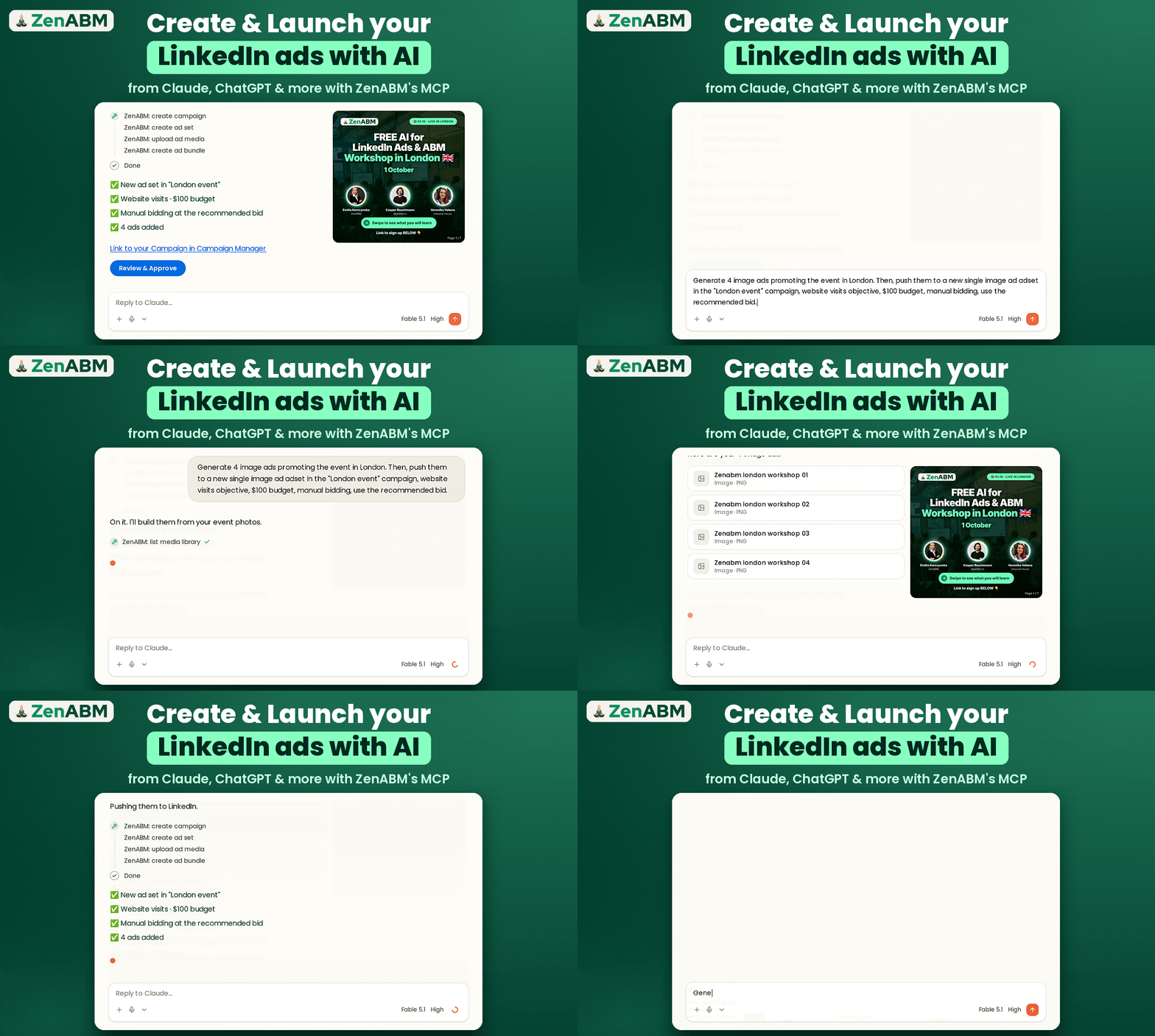
ZenABM lets marketers run LinkedIn ads end-to-end from inside Claude, ChatGPT, or its own AI Agent via MCP.
ZenABM is an AI-powered ad management tool for B2B marketing teams, designed to eliminate the friction of switching between AI assistants and LinkedIn Campaign Manager. It offers two integration paths: an MCP server that embeds into tools like Claude and ChatGPT, and a native Agent called Zena — both equipped with 20+ expert skills and 96 tools covering the full ad lifecycle. Zena also auto-generates weekly and monthly reports with revenue attribution data, targeting the long-standing ROI measurement challenge in B2B marketing. Its #2 debut on Product Hunt validates the appeal of packaging professional workflows into AI Agents, though real-world performance still awaits broader validation.
Say Goodbye to Copy-Pasting: LinkedIn Ads Enter the AI-Native Era
For B2B marketing teams, LinkedIn Campaign Manager has always been a necessary but frustrating tool. Constantly copying and pasting between AI assistants and the ad dashboard is both inefficient and error-prone. ZenABM aims to solve exactly this pain point — it lets marketers create, launch, and optimize LinkedIn ads directly within AI tools like Claude, ChatGPT, and Perplexity.
The product recently launched on Product Hunt, earning 185 upvotes and 41 comments to land in the #2 spot for the day, across the Advertising, Artificial Intelligence, and LinkedIn categories. The strong reception signals that B2B marketing automation is a space the market is clearly watching.
Two Integration Paths: MCP Server and a Native AI Agent
ZenABM offers two technical approaches to enable "AI-driven ad management."
MCP Server: Plug Into Your Existing AI Tools
The first approach uses an MCP (Model Context Protocol) server. MCP is a connectivity standard that has been gaining traction in the AI tool ecosystem — it allows external services to be called directly by large language models as "tools." This means users don't need to switch platforms. They can drive LinkedIn ad operations through natural conversation, right inside the Claude or ChatGPT interface they already use.
For teams that have deeply integrated AI assistants into their daily workflows, the value here is zero migration cost — no new software to learn, just give instructions in a familiar chat window.
MCP (Model Context Protocol) was proposed and open-sourced by Anthropic in late 2024. At its core, it's a standardized "AI tool-calling protocol." Before MCP, every AI application that wanted to connect to an external service — a database, an API, a third-party platform — had to build its own private integration logic, which was costly and hard to reuse. MCP unified this interface standard: an external service builds an MCP server once, and it can be called directly by any AI client that supports the protocol (such as Claude Desktop or Cursor). When a user makes a request in conversation, the AI model automatically determines which tool to call, what parameters to pass, and integrates the result back into the conversation context. By choosing MCP as its integration standard, ZenABM means that as long as a user's AI client supports MCP, they can seamlessly invoke LinkedIn ad capabilities — without ZenABM having to build separate plugins for every AI tool.
Native AI Agent "Zena"
The second path is ZenABM's own AI Agent, named Zena. According to the company, both the MCP server and Zena are equipped with 20+ expert skills and 96 tools. That number suggests a fairly granular breakdown of functionality, covering the full loop from ad creation and launch to optimization.
These "expert skills" are essentially the experience and workflows of senior ad managers, packaged into AI-executable capability modules — enabling users without professional advertising experience to achieve near-expert-level results with AI assistance.
Automated Reporting: Connecting Engagement to Revenue Attribution
Beyond ad management, ZenABM's other key selling point is automated reporting. The AI Agent Zena can generate weekly and monthly reports that go beyond standard ad metrics to include company-level engagements and revenue attribution.
Revenue attribution has always been one of the hardest things to quantify in B2B marketing — tracing exactly how much real revenue came from a given ad spend is notoriously difficult. If ZenABM can automatically consolidate this data into reports, it would be genuinely useful for marketing teams trying to prove campaign ROI. That said, the accuracy of its attribution will need to be validated in real business scenarios.
AI Comes to the ABM Playbook
The product name itself (ABM stands for Account-Based Marketing) makes it clear that ZenABM is targeting precision marketing in the B2B space. ABM centers on delivering customized outreach to specific target accounts, and LinkedIn is the go-to platform for B2B customer acquisition.
Bringing AI Agents into the ABM workflow represents a broader trend: marketing tools are no longer just interfaces for humans to operate — they're becoming platforms where AI takes on more of the execution and decision-support work. Users shift from being operators to being directors, expressing intent in natural language while the AI handles the tedious implementation.
The real-world effectiveness of products like this ultimately comes down to two things: whether the AI's understanding of ad strategy genuinely reaches "expert" depth, and whether the integration of 96 tools is stable and reliable. The high Product Hunt ranking shows there's clear market demand, but the gap between a compelling demo and a reliable daily productivity tool still takes time to close.
Account-Based Marketing (ABM) is the polar opposite of "spray and pray" in B2B marketing: teams pre-select a set of high-value target companies (Accounts), then design customized content and outreach paths aimed at the decision-makers within those companies. LinkedIn is the platform of choice for executing ABM strategies, thanks to its rich profile data on job titles, company size, and industry. Traditional ABM execution is cumbersome — it requires constant context-switching between CRMs, ad dashboards, and analytics tools, with manual reconfiguration every time you adjust an audience or creative. AI Agents theoretically compress this entire workflow: just describe your goal in natural language (e.g., "Run this creative against CTOs at Series B+ SaaS companies"), and the Agent automatically handles audience search, ad group creation, and budget allocation. This is the core logic behind ZenABM's emphasis on "packaged expert skills."
Takeaway
ZenABM moves LinkedIn ad management into the AI chat interface, lowering the barrier to entry through both an MCP server and a native Agent, while attempting to solve the B2B attribution problem with automated reporting. For marketing teams that rely on LinkedIn for lead generation and are already using AI assistants, this is an efficiency tool worth watching. Its rise also reinforces a broader signal: packaging professional workflows into AI Agents is becoming the new direction for SaaS product evolution.
Related articles

Trump's Request to Rename the Atlantic Rejected by Google; 1Password Lets AI Agents Log In Securely
The Vergecast roundup: Trump's request to rename the Atlantic the 'Trump Ocean' was politely declined by Google's CEO; 1Password's new feature lets AI agents log into accounts without touching passwords; OPPO launches the world's first 200-megapixel phone, the Find X10 Pro Max. All three point to the boundaries of tech authorization and trust.

The Truth About American College Party Culture: The Risks Schools Won't Admit
Behind American college party culture, the administration's "don't ask, don't tell" attitude is amplifying freshman risks. This article analyzes how the pandemic strengthened Greek dominance, freshmen's difficulty accessing safety information, and the chain reactions caused by a culture of denial.

OpenAI Reportedly Raising $30B at $1.25T Valuation Ahead of IPO
OpenAI is planning a $30B funding round at a possible $1.25T valuation, paving the way for an IPO. If completed, it would set a private company valuation record. This article analyzes the funding size, pre-IPO logic, and industry signals.