Zero-Background Agent Development Guide: A Full Breakdown of the Six-Week Hands-On Roadmap

A breakdown of the six-week framework in Bilibili's 748-episode Agent tutorial, noting that failure mainly stems from missing scenario positioning, not the field.
The article examines a Bilibili "all 748 episodes" AI Agent development tutorial and identifies the root cause of beginner pitfalls—blindly following trends, copying templates, and lacking scenario positioning—rather than the field itself. The tutorial compresses learning into six weeks: weeks 1–2 build foundations in core architecture and paradigms like ReAct and CoT; weeks 3–4 cover multi-agent collaboration and RAG; weeks 5–6 focus on lightweight deployment and hands-on projects. The article affirms the module design and lightweight orientation but notes the pace is tight for complete beginners, who need programming and prompt fundamentals first; "get a job upon completion" is marketing talk, and learners should value architecture over API details.
AI Agent development is moving from proof-of-concept to real-world business deployment, but many beginners fall into the trap of "learn it and forget it, build it and abandon it" right at the entry stage. A set of Agent development tutorials on Bilibili labeled "all 748 episodes" puts forward a viewpoint worth unpacking: the problem isn't the field, it's the way you enter it. Based on the tutorial's six-week learning framework and combined with current mainstream Agent practices, this article lays out a practical learning path.

Why 90% of People Stumble When Learning Agents
The tutorial opens by pointing directly at three typical failure modes: blindly following trends without identifying a real use case, copying ready-made templates wholesale, and spending a huge amount of time without producing anything usable. This isn't alarmism—Agent development involves the coordination of multiple modules such as Planning, Memory, and Tool Use. Simply copying the configuration of an open-source demo often quickly falls apart in real-world multi-turn interactions and exception handling.
The deeper problem lies in a lack of positioning. The value of an Agent comes from replacing or augmenting a specific workflow. If learners don't first figure out "whose problem does this agent solve, and what problem is it," technical stacking loses its anchor.
The Six-Week Learning Framework: From Architecture Awareness to a Complete Project Loop
The tutorial compresses the learning period into six weeks, with each week focused on one capability layer, presenting an overall progressive structure of "foundation—core—advanced—integration—expansion—hands-on practice."

Weeks 1–2: Master the Architecture and Operating Principles
The first week lays the foundation, covering the Agent's core architecture and components: task planning, memory modules, and the basic logic of tool use. The second week goes deeper into operating principles, focusing on mainstream paradigms such as ReAct and CoT—the phrase "reactquarty mainstream paradigm" in the original tutorial text should be a slip of the tongue or subtitle error referring to ReAct and chain-of-thought-related paradigms. Learners should use ReAct (alternating reasoning and acting) as the core reference.
The key at this stage isn't memorizing concepts, but understanding how an Agent, upon receiving a user request, decomposes the task, selects tools, observes results, and corrects its next action.
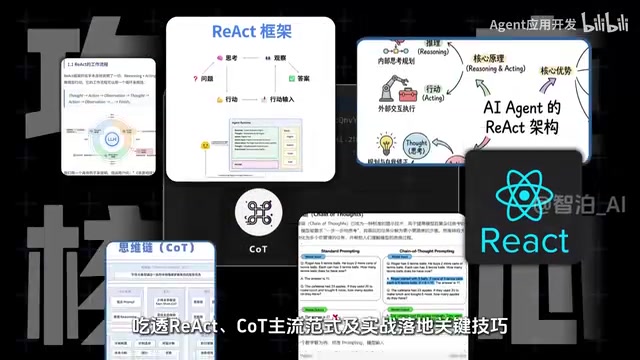
The ReAct paradigm stands for Reasoning and Acting and was proposed by Shunyu Yao and others in 2022. Its core is to let a large language model decide at each reasoning step whether to call external tools, and to use the observations returned by tools as input for the next round of reasoning, forming a "thought—action—observation" loop. Unlike chain-of-thought (CoT), which generates an answer in one pass, ReAct significantly reduces hallucinations by introducing external feedback and can handle tasks that require real-time information. In implementation, ReAct usually relies on prompt templates to constrain model output to the "Thought/Action/Observation" format, and developers can also quickly build it using ReAct Agent wrappers from frameworks such as LangChain. Understanding ReAct's loop termination conditions and tool description design is key to debugging Agent behavior.
Weeks 3–4: Multi-Agent Collaboration and RAG Integration
The third week moves into multi-agent collaboration, involving role division, communication mechanisms, and tuning techniques, with the goal of solving the problem of output bias in single agents on complex tasks. The fourth week connects RAG and Agent construction logic—retrieval-augmented generation enables Agents to answer based on external knowledge bases, which is currently the most common combination form in enterprise deployment.
The tutorial emphasizes "adapting lightweight tools to real business scenarios," an orientation worth affirming: not every scenario requires a heavyweight framework, and the minimal implementation that can get the business running is often more valuable.
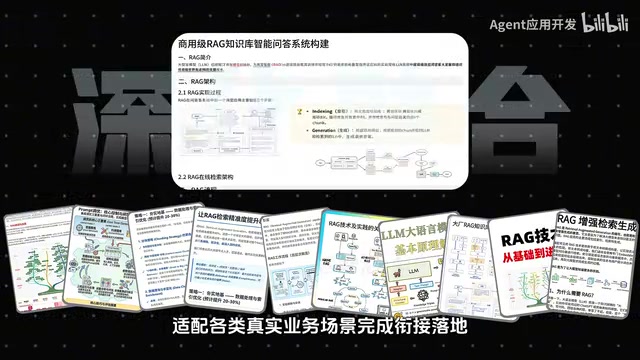
RAG (Retrieval-Augmented Generation) is a technical architecture that combines external knowledge retrieval with large model generation. Its typical process is: encode the user's question as a vector, retrieve the most relevant document chunks from a vector database, then splice these chunks as context into the prompt so the model generates an answer grounded in evidence. For an Agent, RAG is equivalent to adding a dynamically queryable external knowledge base to the memory module, enabling the agent to answer questions about enterprise private knowledge beyond its training data. In practice, embedding models (such as the text-embedding series) and vector databases (such as FAISS and Chroma) are often used to build the retrieval pipeline, and attention should be paid to tuning aspects such as chunking strategy, number of retrieved results, and reranking—these directly determine the accuracy and timeliness of the Agent's answers.
Multi-Agent Collaboration refers to breaking down complex tasks among multiple Agents with different role settings and coordinating them through message passing, a shared blackboard, or an orchestrator to achieve the goal. Common patterns include: a manager Agent assigning subtasks, expert Agents performing their respective duties, and a reviewer Agent validating outputs. Compared with a single Agent, multi-agent systems can reduce the complexity of a single prompt and improve the accuracy of specialized division of labor, but they also introduce new problems such as communication overhead, infinite loops, and role conflicts. Mainstream frameworks such as AutoGen and CrewAI provide primitives for role definition and dialogue orchestration. Learners should focus on understanding task decomposition granularity and the design of termination conditions, rather than remaining at the level of calling framework APIs.
Weeks 5–6: Deployment and a Complete Project Loop
The fifth week focuses on lightweight deployment and customization for industry scenarios, and the sixth week requires independently completing multi-scenario hands-on projects. From a learning-design perspective, the final two weeks are the stage for assembling the fragmented capabilities of the previous four weeks into a complete deliverable, and also the dividing line for testing whether you can truly apply what you've learned.
A Calm Assessment of This Learning Path
Going from beginner to being able to independently complete an Agent project in six weeks is a fairly tight pace. For developers with programming fundamentals, this framework's module division is reasonable; but for complete beginners, before the first week they probably still need to shore up API calling, prompt engineering, and basic Python skills. The tutorial's promotional phrase "get a job upon completion" is marketing talk; actual employability depends on project depth, not the number of class hours.
Another point to watch out for is framework version iteration. The Agent development toolchain updates extremely quickly, and the specific libraries and interfaces involved in the tutorial may change with versions. Learners should focus on architectural thinking rather than the details of calling a particular API.
Frequently Asked Questions
Can beginners with no background learn Agent development? Yes, you can get started, but it's advisable to first master basic programming and API calls; otherwise, the hands-on parts of the six-week framework can easily get stuck.
What is the ReAct paradigm? An Agent operating paradigm that lets the model alternate between reasoning and tool calls, and one of the current mainstream implementation approaches.
What is the relationship between RAG and Agents? RAG provides Agents with external knowledge retrieval capability, and the two are often combined to improve answer accuracy.
Is six weeks really enough? The framework can serve as a roadmap, but the ability to deliver projects requires additional practice time and should not be expected according to promotional claims.
One-line Summary
A breakdown of the six-week learning framework in Bilibili's 748-episode Agent tutorial, pointing out that the main cause of failure is a lack of scenario positioning, not the field itself.
Paragraph Summary
The article examines a Bilibili "all 748 episodes" AI Agent development tutorial and analyzes the root cause of why 90% of beginners stumble—blindly following trends, copying templates, and lacking scenario positioning—rather than the field itself being bad. The tutorial compresses the learning period into six weeks: the first two weeks build the foundation and cover the Agent's core architecture and operating paradigms such as ReAct and CoT; weeks three and four move into multi-agent collaboration and RAG integration; weeks five and six focus on lightweight deployment and a complete multi-scenario hands-on loop. The article affirms its module division and lightweight orientation, while calmly noting that the six-week pace is too tight for complete beginners, who need to first build up programming and prompt fundamentals; it also notes that "get a job upon completion" is marketing talk, and learners should value architectural thinking over specific API details.
Related articles

Why Does the Tesla Roadster Need to Fly? A Deep Dive into Musk's Wild Demo
Tesla's Roadster launch showed wall-climbing, upside-down driving, and flying stunts—but The Vergecast notes the demo car may lack a battery, the Rocket version is invite-only and not street-legal, and the website terms don't guarantee delivery. After nine years of delays, why does this car still need to exist?

AI Is Not a Replacement: Human-AI Collaboration Through the Lens of Factory Root Cause Analysis
Starting from factory root cause analysis, this article explains how AI accelerates evidence chain construction rather than replacing human experts, exploring the pragmatic implementation logic and business value of 'AI supporting people rather than replacing them.'

AI Agent Decision Auditing: Building an Evidence Chain in Regulated Workflows
Starting from a Reddit discussion, this article analyzes three core issues in AI agent decision auditing within regulated workflows: what fields audit records should contain, how to handle feedback latency for erroneous decisions, and how to continuously calibrate LLM judge consistency with human judgment.