Zero-Base Reinforcement Learning Roadmap: Master DQN, PPO, and LLM Fine-Tuning

A reasonable path for zero-base learners to get started with reinforcement learning in three days: learn DQN and PPO first, then run small games, and finally connect to LLM fine-tuning.
This article breaks down a widely shared "zero-base three-day introduction to reinforcement learning" roadmap. The roadmap advocates first mastering the two major algorithms DQN and PPO to cover both value-based and policy gradient paradigms, then hands-on practice through open-source simulation environments like Mountain Car and parachute landing to build intuition for policy updates and reward mechanisms, and finally using Hugging Face tutorials to apply reinforcement learning to LLM preference fine-tuning (such as RLHF), completing the transfer from theory to real scenarios. The article believes that a more realistic goal for "three days" is to build a cognitive map and run through demos rather than achieve mastery, and adds the importance of mathematical foundations and proactive experimentation.
Title
Zero-Base Reinforcement Learning Roadmap: Master DQN, PPO, and LLM Fine-Tuning
Meta Description
A zero-base reinforcement learning roadmap: first master the two core algorithms DQN and PPO, then use open-source simulation environments like Mountain Car for hands-on practice, and finally connect to the Hugging Face LLM fine-tuning workflow, forming a complete loop from theory to implementation.
Article Content
Where does the barrier to reinforcement learning (RL) lie? Many people start by grinding through papers and chasing complex LLM cases, getting more confused as they go, and eventually giving up. The problem isn't intelligence—it's the path. There's a widely shared "zero-base three-day introduction" roadmap on Bilibili, and its core idea is clear: first grasp two essential algorithms, then use small games to get hands-on practice, and finally connect to LLM fine-tuning. This article, drawing on the views of that tutorial, breaks down why this roadmap is reasonable and where it needs supplementation.
Why learn DQN and PPO first instead of starting from Q-Learning?
The tutorial has a very blunt statement: the vast majority of reinforcement learning implementation projects on the market cannot avoid the two algorithms DQN and PPO. Whether for intelligent decision-making, model optimization, or AI implementation development, they are the underlying cornerstones.
This judgment basically holds. DQN (Deep Q-Network) extends Q-Learning's tabular method to high-dimensional state spaces and is the representative of the value-based route; PPO (Proximal Policy Optimization) is one of the most engineering-stable and widely used algorithms in the policy gradient route. The two cover the two major paradigms of reinforcement learning. Master them first, and then look back at algorithms like Q-Learning and DPO—it will be much smoother.

Conversely, if you start by grinding through Q-Learning's tabular updates, it's easy to fall into the awkward situation of "can derive all the formulas but can't write the code." The tutorial suggests first thoroughly understanding the core logic and operating principles of these two algorithms, and the foundation will be established—this order is indeed friendlier for zero-base learners.
The relationship between Q-Learning and DQN: Q-Learning is a classic value-based reinforcement learning algorithm. It maintains a Q-table to record the expected return of each "state-action" pair and iteratively updates it using the Bellman equation. However, when the state space is continuous or high-dimensional (such as image input), the Q-table becomes infeasible. DQN (Deep Q-Network) was proposed precisely to solve this problem: it uses a deep neural network to approximate the Q-function, thereby extending Q-Learning to high-dimensional state spaces. Understanding Q-Learning's tabular updates is the foundation for understanding DQN, but starting directly with DQN can avoid the limitations of tabular methods and expose you earlier to the combination of function approximation and deep learning.
Step 2: Run the theory through with small game cases
Just understanding theory is useless. The tutorial emphasizes that you must hands-on run projects, and the most suitable environments for beginners in reinforcement learning are classic simulation cases: a car automatically climbing a mountain (Mountain Car), a parachute landing at a fixed point, and similar scenarios. These environments are open-source and ready-made; you don't need to build them yourself.
The key is to "debug more, set breakpoints more," and personally understand how the algorithm iterates at each step, how the policy updates, and how rewards are obtained. The tutorial says that thoroughly understanding the underlying logic through small cases is much more efficient than rote memorization of theory.
This point is worth expanding: the debugging experience of reinforcement learning is completely different from traditional supervised learning—there are no fixed labels, rewards are sparse and high-variance, and model non-convergence is the norm. Repeatedly observing episode return curves and printing action distributions in small environments is the only way to build intuition. Skip this step and go straight to LLMs, and chances are you won't even be able to explain why the loss isn't decreasing.
Sparse rewards and the variance problem: In reinforcement learning, reward signals are often sparse and high-variance, which poses huge challenges to learning. Sparse rewards mean the agent gets no feedback most of the time, making it hard to judge which actions led to ultimate success or failure; high variance makes policy gradient estimates unstable, and the training process is prone to fluctuation. In small game environments (like Mountain Car), rewards are usually designed to be relatively dense or easy to observe, which helps beginners intuitively understand how rewards affect policy updates. By debugging return curves and action distributions, you can gradually build intuition for reward design and policy optimization, laying the foundation for handling more complex real-world scenarios.
Step 3: Connect to LLM fine-tuning and apply RL to real scenarios
The endpoint of learning reinforcement learning is not running small games. The tutorial points out that high-frequency concepts such as LLM preference fine-tuning, reward mechanisms, and advantage functions are all core knowledge points of reinforcement learning. Beginners can directly follow the official tutorials on Hugging Face and personally run through the complete process of LLM fine-tuning reward optimization.
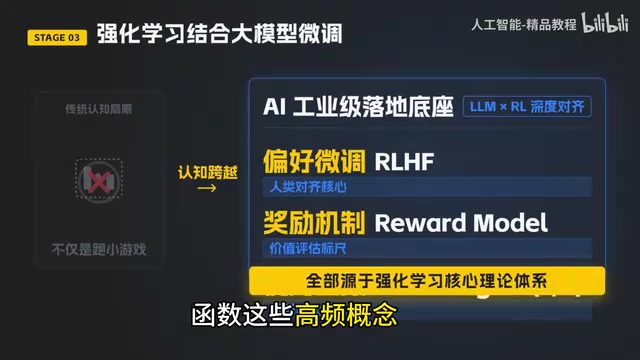
This connection point is well chosen. RLHF (Reinforcement Learning from Human Feedback) is essentially applying algorithms like PPO to language models, using a reward model to replace environment returns. Once you understand PPO's clip mechanism and advantage function estimation, it becomes logically clear why DPO can bypass the reward model and directly optimize preferences. First understand policy updates in small games, then transfer to LLM scenarios—the learning cost will be much lower.
Comparison of RLHF and DPO: RLHF (Reinforcement Learning from Human Feedback) usually involves three steps: collecting human preference data to train a reward model, using algorithms like PPO to optimize the language model based on the reward model, and iterative fine-tuning. In this process, PPO uses a clipping mechanism to limit the magnitude of policy updates, ensuring training stability. DPO (Direct Preference Optimization) takes a different approach: through mathematical transformations, it implicitly expresses the reward model in the policy, thereby directly using preference data to optimize the language model, avoiding explicit reward model training and the reinforcement learning loop. Understanding PPO's clipping and advantage function estimation helps grasp why DPO can simplify the process while maintaining performance—this is a key trade-off in the current field of LLM alignment.
A complete loop in three days?
The complete roadmap given by the tutorial is: first master DQN and PPO to build the theoretical foundation, then thoroughly understand hands-on practice through game simulation cases, and finally combine with LLMs for fine-tuning实战 to connect to implementation scenarios.

The "three days" claim should be taken with a grain of salt—for zero-base learners, a more realistic goal for three days is to build a complete cognitive map and run through demos, not to truly master. But the closed-loop structure itself holds: theory → small environment practice → real scenario transfer. After these three steps, at least you'll know what problem each algorithm solves, what the code looks like, and what to supplement next.
The tutorial also mentions a companion learning roadmap, covering basic algorithms, a project list, and extension plans for the two employment directions of CV and NLP.
A few supplementary suggestions
This roadmap emphasizes "quick onboarding," but there are a few areas worth supplementing yourself: first, mathematical foundations—deriving policy gradients inevitably involves probability and expectation; when you get stuck, it's better to go back and fill the gaps than to push through; second, don't just run the tutorial code—try modifying reward functions and network structures, and observe behavioral changes; this is the truly interesting part of reinforcement learning; third, for new algorithms like DPO, understanding its trade-offs with PPO is more valuable than memorizing concepts in isolation.
The roadmap belongs to others, but debugging is your own踩. There are no shortcuts in reinforcement learning, but choosing the right order can save you many detours.
Related articles

Nothing CMF Buds 2A Drops to $17.89 on Black Friday: A New Low for ANC Earbuds
Nothing CMF Buds 2A wireless earbuds Black Friday deal: just $17.89 on Amazon, about $11 off retail and a record low. ANC earbuds at an entry-level price.

When AI Creation Gets Accused of "Spitting": Hacker News Heats Up Over the Glaude Controversy
A Hacker News post, "Spitting in the Face of Glaude," sparks debate on AI creation transparency and attribution ethics. This analysis examines the blurred creator identity behind the controversy and offers practical advice for AI content production.

Akai Embraces Custom Firmware: MPC Sample 1.4 Lets Users AI-Program Their Sampler
Akai embraces the modding community with MPC Sample 1.4 firmware, supporting vibe-coded custom firmware and effects. We analyze the impact of this open strategy on music hardware and AI-assisted programming.