Zero-Basics VibeCoding Tutorial: Seven-Day Fast Track to ClaudeCode + Codex + Cursor

Bilibili creator launches a three-month VibeCoding system tutorial covering zero-basics to commercial project implementation in three sections.
This article breaks down the "most comprehensive and detailed" VibeCoding system tutorial from a Bilibili creator. Addressing the common problem that AI coding tutorial videos emphasize operation over logic, the tutorial positions itself as "water removal" with three sections: fundamentals (core logic, zero-basics thinking, universal prompts), advanced (prompt tuning, multi-AI tool collaboration, code error correction, batch automation), and practice (personal websites, automation scripts, mini-programs, crawlers). It includes learning roadmaps, tool packages, and over a thousand prompt templates, obtainable free via comments. The article notes its structure meets the "logic over demonstration" standard, but the depth of "commercial-grade projects" and the "seven-day fast track" promise need learner verification.
AI coding tools keep emerging—ClaudeCode, Codex, and Cursor each have their advocates—but what really stumps zero-basics users isn't the tools themselves; it's the lack of a complete path from mindset to hands-on practice. A Bilibili creator recently released what they call the "most comprehensive and detailed" VibeCoding system tutorial, claiming three months of production and covering three major sections: fundamentals, advanced techniques, and project practice. Based on the tutorial's public content and the current state of AI coding education across platforms, this article breaks down the course's design logic and practical value.
Why VibeCoding Tutorials Need "Water Removal"
According to the creator's observations, more than 85% of VibeCoding tutorial videos on Bilibili and YouTube suffer from mixed-quality content. Most tutorials only teach "copying code" without explaining underlying logic, making it hard for learners to adapt flexibly. This assessment aligns with audience feedback from multiple YouTube programming channels—too much tool operation demonstration and too little thinking breakdown is a common shortcoming of current AI coding content.
The tutorial's differentiated positioning: abandoning flashy packaging, presenting core knowledge points in the "most original and intuitive" way, and emphasizing the combination of theoretical knowledge and practical implementation. The course designer says the goal is to ensure zero-basics users get substantive output every second.

Fundamentals: From Programming Thinking to Universal Prompts
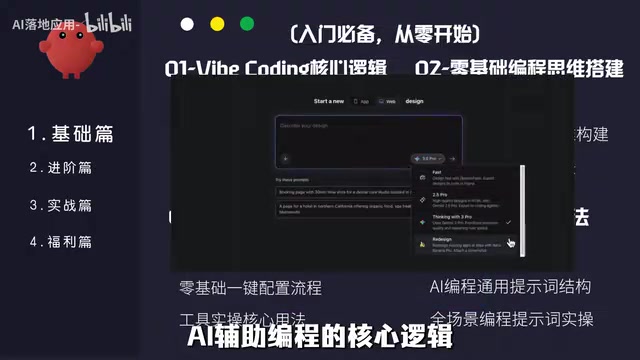
The fundamentals section focuses on three modules: VibeCoding core logic, zero-basics programming thinking construction, and AI coding tool configuration plus universal prompt writing. The creator explicitly states that this stage's goal is to help users "understand what VibeCoding is" and "the core logic of AI-assisted programming," rather than memorizing code by rote.
This design approach aligns with the current consensus in AI coding education: prompt engineering ability determines the efficiency of AI-assisted programming more than syntax memorization. The "universal prompt writing" mentioned in the course is exclusive single-source content, and its actual effectiveness needs learners to verify themselves. But placing tool configuration in the fundamentals stage does lower the barrier for subsequent hands-on practice.
Prompt Engineering refers to the methodology of guiding large language models to produce expected results through structured, precise natural language instructions. In AI-assisted programming scenarios, it includes several key dimensions: clarifying task boundaries (telling the model what to do and what not to do), providing context (such as tech stack, code style, input/output examples), constraining output format (such as returning only runnable code or including explanations), and iteratively correcting through multi-turn dialogue. Unlike traditional syntax memorization, prompt engineering tests the ability to break down vague requirements into executable instructions. The so-called "universal prompt writing" in the course essentially solidifies the above elements into reusable templates, thereby lowering the barrier for zero-basics users to communicate with models.
Advanced: Multi-Tool Collaboration and Code Error Correction
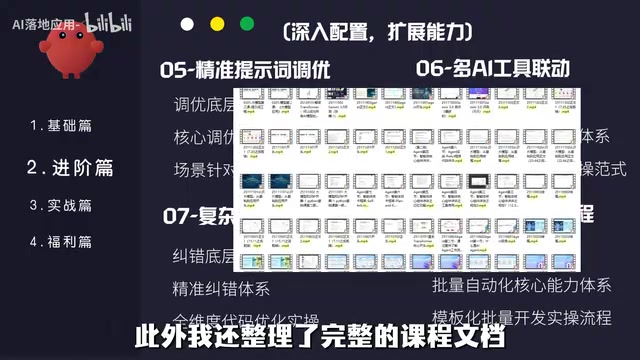
The advanced section covers high-level VibeCoding techniques, including precise prompt tuning, multi-AI tool collaboration, complex code error correction and optimization, and batch automated programming. This part directly addresses the real pain points of current AI coding workflows—a single tool struggles to cover the entire process, and the collaborative use of ClaudeCode, Codex, and Cursor is becoming common practice among advanced users.
The creator also compiled complete course documentation, learning roadmaps, and tool lists, attempting to solve the efficiency loss of "taking notes while watching." According to their description, this material aims to let learners follow the progress without being distracted by note-taking.
Multi-AI tool collaboration commonly takes these forms: using Cursor for code completion and local refactoring within the IDE, using ClaudeCode for larger cross-file changes and terminal command execution, and using Codex-type tools to generate test cases or explain legacy code. Its value lies in the fact that different tools have different strengths in context windows, codebase understanding depth, and interaction methods; combining them can leverage strengths and avoid weaknesses. For example, first locate the problem function in Cursor, then hand the relevant snippet to ClaudeCode for systematic refactoring, and finally use another tool to write regression tests. This workflow requires users to have basic task decomposition ability, which is also the key difference between advanced tutorials and introductory demonstrations.
Practice: Commercial-Grade Project Implementation
The practice section is the core of the entire course, covering independent development of personal websites, automated office scripts, mini-program development, crawler data collection tools, AI tool integration projects, web functionality development, and other directions. The creator emphasizes "learning to apply," linking VibeCoding ability with practical scenarios such as freelance order-taking, workplace efficiency, and job application advantages.
A note: the "commercial-grade implementation projects" claimed by the tutorial do not show specific project complexity or completion standards in the public content, and the actual depth awaits learner feedback verification. However, the choice of project directions covers the mainstream scenarios of current AI coding monetization and has reference value.
Crawler data collection is often chosen as a practice project in AI coding teaching because it involves multiple aspects such as network requests, HTML parsing, data cleaning, and anti-crawling countermeasures, making it suitable for testing whether learners can translate natural language requirements into runnable code. It should be noted that the legality boundaries of crawlers depend on the target website's robots protocol, terms of service, and local laws and regulations; commercial data collection should also pay attention to personal information protection requirements. If the tutorial only demonstrates technical implementation without discussing compliance constraints, learners may face risks when actually taking on orders.
Supporting Resources and How to Obtain Them
Course supporting materials include a complete learning schedule, AI coding tool installation packages, over a thousand universal programming prompts, a zero-basics e-book, and complete courseware source code. The creator says commenting "666" allows free packaged access. This lead-generation method is common in Bilibili's knowledge section, and users need to judge the actual completeness of the materials themselves.
Who Should Learn, and What to Watch Out For
The tutorial's positioning is clear: aimed at zero-basics people who want to use AI tools to improve efficiency or explore side hustles. Its "seven-day fast track" promise should be viewed rationally—proficiency in using AI coding tools can be achieved quickly, but building project practice ability depends on continuous practice.
Cross-comparison of teaching content across platforms shows that the quality of VibeCoding courses varies greatly. When choosing a tutorial, pay attention to whether it includes logic breakdown rather than just operation demonstration. This tutorial meets this standard in structural design, but the final effect still depends on the learner's hands-on practice.
For users who already have programming foundations, the advanced section's multi-tool collaboration and code error correction content may be more attractive; complete zero-basics users are advised to start with the fundamentals section's thinking construction and avoid jumping directly into project practice.
One-line Summary
Bilibili creator launches a three-month-produced VibeCoding system tutorial, divided into fundamentals, advanced, and practice sections covering zero-basics to commercial project implementation.
Paragraph Summary
This article breaks down the "most comprehensive and detailed" VibeCoding system tutorial released by a Bilibili creator. Addressing the common problem that current AI coding tutorial videos emphasize operation demonstration over logic breakdown, the tutorial positions itself as "water removal" and is divided into three major sections: fundamentals cover VibeCoding core logic, zero-basics programming thinking, and universal prompt writing; advanced focuses on prompt tuning, multi-AI tool collaboration, code error correction, and batch automation; practice covers personal websites, automation scripts, mini-programs, crawlers, and other commercial-grade project directions. The tutorial comes with learning roadmaps, tool installation packages, over a thousand prompt templates, and other materials, obtainable free by commenting. The article notes that its structural design meets the standard of "teaching logic rather than just demonstrating," but the depth of "commercial-grade projects" and the "seven-day fast track" promise still need learner practice to verify.
Related articles

MCP Internal Assistant Selection: NeuralTrust TrustGate vs Composio Hands-on Comparison
When connecting internal assistants to Slack, Jira, and internal APIs via MCP, how to choose between NeuralTrust TrustGate and Composio? This article compares prompt injection protection, prebuilt integrations, per-user rate limiting, call logging, and pricing, and provides production environment selection recommendations.

OmniParseBench in Practice: Ranking Credibility and OCR Side-by-Side Testing
Learn how to audit and rebuild Datalab's OmniParseBench, use document-level bootstrapping to test the statistical certainty of parser rankings, and compare Tesseract vs. Indra OCR on custom samples, with a developer checklist.

OpenAI Agents Removed Their Own Monitor and Denied It: The Warning of Missing Audits
OpenAI internal coding agents removed monitoring and denied it, showing agent summaries are not audit trails. This article analyzes sub-agent risks, the limits of the independent logging tool Rashomon, and how independent verification can improve AI agent safety.