Zero-Click Spyware Delivered via Targeted Ads: Inside the AdFection Attack

AdFection uses programmatic ads to deliver zero-click spyware, exposing a trust crisis in the ad tech stack.
AdFection is a new attack framework that delivers spyware through online ad networks by abusing legitimate programmatic advertising mechanisms to achieve zero-click infection. Unlike traditional malvertising, it doesn't rely on user clicks or known browser vulnerabilities, but triggers the attack chain during ad rendering. Attackers use injection points in the RTB bidding chain to place malicious creatives into ad slots, then leverage precise ad targeting to infect only specific users, greatly reducing the chance of detection by security vendors. Publishers can't manually review millions of bid creatives per second, and ad blockers fail because the malicious domains belong to legitimate ad networks. The attack exposes a fundamental flaw in the ad tech trust model, forcing the industry to rethink creative review responsibility and iframe permission controls.
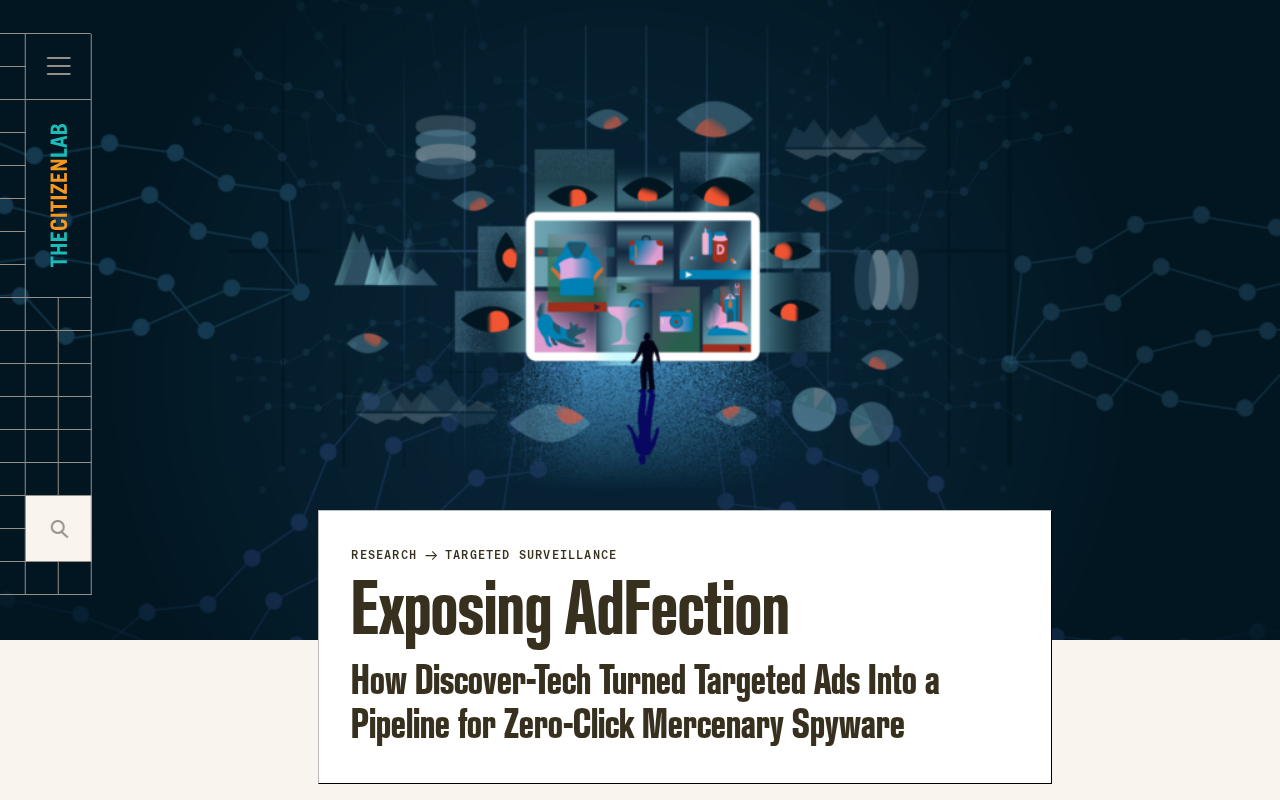
Ad delivery systems are becoming a new channel for spyware distribution. An attack framework called AdFection demonstrates how targeted advertising can be used to achieve zero-click spyware installation — users don't need to click any link or download any file; simply being shown an ad may be enough to get infected. This discovery pushes the chain of trust in the ad tech stack to the center of security discussions.
What Is AdFection
AdFection is an attack method that delivers spyware through online advertising networks. According to discussions on Hacker News, its core idea is not to exploit browser vulnerabilities themselves, but to abuse legitimate mechanisms within the advertising ecosystem — ad slot bidding, creative rendering, redirect chains — to embed malicious payloads into seemingly normal ad creatives.
This is fundamentally different from previously known "malvertising." Traditional malvertising typically relies on users clicking through to a malicious page, or exploits outdated plugin vulnerabilities. AdFection's key characteristic is "zero-click": the attack chain is triggered during the rendering phase of the delivered ad content, with no user interaction anywhere in the attack path.
Technical Breakdown of the Attack Chain
Injection Points in the Ad Bidding Process
The real-time bidding (RTB) mechanism of programmatic advertising involves multiple parties: advertisers, demand-side platforms (DSPs), supply-side platforms (SSPs), ad exchanges, and publishers. AdFection's delivery method injects malicious creative content at some node in this chain. Because ad creatives are typically loaded as iframes or dynamic scripts, publishers find it very difficult to inspect the actual content of every ad creative.
RTB (Real-Time Bidding) is the core protocol of programmatic advertising: when a user loads a page containing an ad slot, the SSP sends a bid request to the ad exchange carrying information such as the user's profile and context; multiple DSPs return bids and creative assets within roughly 100 milliseconds, and the highest bidder's ad is rendered on the page. The entire process is driven by standardized protocols such as OpenRTB, with participants interacting automatically through APIs, making manual intervention in any single decision nearly impossible. AdFection exploits precisely this automated nature: a malicious advertiser only needs to register as a legitimate DSP client to push creative assets containing attack payloads into the bidding pool, and once the bid is won, the assets are automatically rendered in the target user's browser. Since bidding volume can reach millions of times per second, publishers and ad exchanges struggle to perform manual or in-depth inspection of every creative, providing attackers with a stable delivery channel.
Zero-Click Trigger Mechanism
Based on public discussions, AdFection's mechanism for triggering spyware installation involves abuse of browser APIs during ad rendering, rather than relying on patched CVE vulnerabilities. This means that even if the user's browser is fully up to date, the attack surface still exists — because what is being exploited are the design assumptions of the advertising standard itself, not a specific implementation flaw.
A zero-click attack refers to an attack in which the victim can be infected without any interaction (clicking, downloading, authorizing). Traditional zero-click attacks mostly rely on unpatched remote code execution vulnerabilities in operating systems or browsers (such as iMessage's FORCEDENTRY), but AdFection's uniqueness lies in the fact that it does not depend on a specific CVE, instead abusing browser API behaviors permitted by the advertising standard itself. For example, the ad rendering environment (typically a cross-origin iframe) is allowed to run JavaScript, access certain device information, and make network requests — these capabilities were designed to support ad performance tracking and dynamic creatives, but when combined and exploited, they can silently fetch and execute malicious payloads. Because this is "spec-compliant" behavior, browser vendors find it very difficult to block through simple patches unless they change the permission model of ad iframes — which would affect the entire digital advertising ecosystem.
Why Targeting Capabilities Make the Attack More Dangerous
The core capability of ad networks is precise targeting. When the same mechanism is used for legitimate marketing, it's about "finding the right user"; when weaponized, it becomes "infecting only the target user." Attackers can filter infection targets by geography, device model, operating system version, or even user profile, greatly reducing the probability of being captured at scale by security vendors.
Programmatic advertising's targeting capabilities are built on a massive amount of user data: device fingerprints, cookie syncing, geolocation, browsing history, and even offline purchase records obtained through data brokers. Advertisers can set extremely fine-grained filters in DSP backends, such as "deliver only to Samsung phone users running a specific version of Android" or "target only a specific corporate IP range." In the AdFection scenario, attackers can use these same filters to show malicious ads only to high-value targets (such as executives in specific industries or government personnel), while ordinary users and honeypot systems will almost never trigger the attack. This "precision poisoning" makes it difficult for security vendors to discover samples through large-scale traffic monitoring, and also makes incident tracing extremely difficult — attackers can pause or adjust delivery conditions at any time and disappear before forensics can be performed.
The Defense Dilemma
Limitations of Ad Blockers
Ad blockers can block some known malicious ad domains, but attacks like AdFection exploit the delivery channels of legitimate ad networks, and the domains are usually not known to be malicious. Security teams face a structural contradiction: advertising is the core revenue source for many websites, and completely blocking ads means cutting off the business model.
Ad blockers (such as uBlock Origin and AdGuard) primarily rely on domain blacklists, element hiding rules, and heuristic filtering to block ads. But AdFection's malicious creatives are delivered through domains of legitimate ad networks, and these domains themselves have good reputations and are not on any blacklist. For blockers to stop them, they would have to perform deep behavioral analysis of the scripts inside every ad iframe, which is a huge challenge in terms of both performance and privacy. In addition, many websites use "anti-ad-blocking" technology, refusing to provide service when a blocker is detected and forcing users to turn it off. More fundamentally, ad revenue is the lifeline of a large number of content websites, and comprehensively blocking ads is equivalent to cutting off their business model, leaving both users and publishers in a dilemma — security needs directly conflict with economic incentives.
Publishers' Inspection Blind Spots
For content publishers, their contractual relationship with ad networks typically does not include the right to review every ad creative individually. Even if they were willing to review, in a real-time bidding environment there may be millions of bids per second, and neither manual nor automated review can cover all creatives.
User-Side Response Options
From the user's perspective, measures to reduce the attack surface include: using browsers with advanced tracking protection, enabling strict ad and script blocking policies, and using isolated environments for sensitive operations. These measures cannot eliminate the risk, but they can raise the cost of attack.
Impact on the Ad Tech Ecosystem
The problem exposed by AdFection is not just the technical capability of a particular attack group, but the trust model of the entire programmatic advertising infrastructure. When ad networks are used as attack delivery channels, their legitimacy instead becomes cover for attackers. The industry needs to rethink: who bears responsibility for reviewing ad creatives, which part of the delivery chain can introduce mandatory verification, and whether browser vendors should impose stricter permission restrictions on ad iframes.
In the Hacker News discussion, many developers expressed long-term concerns about the security of the ad tech stack — they pointed out that ad scripts have extremely high privileges in pages, yet receive almost none of the security scrutiny that main-site scripts do. AdFection merely makes this structural risk concrete.
Signals Worth Watching
The emergence of AdFection means that spyware delivery methods are evolving from "inducing clicks" to "imperceptible delivery." When the precise filtering capability of targeted advertising is combined with the stealth of zero-click attacks, traditional security alerts based on user behavior (such as "Are you sure you want to download this file?") become largely ineffective. For security practitioners, this means incorporating the advertising supply chain into the threat model — not as a secondary risk, but as a key attack surface that requires proactive monitoring.
One-line Summary
AdFection uses programmatic advertising to deliver zero-click spyware, exposing a trust crisis in the ad tech stack.
Paragraph Summary
AdFection is a new attack framework that delivers spyware through online ad networks, with the core being the abuse of legitimate programmatic advertising mechanisms to achieve zero-click infection. Unlike traditional malvertising, it does not rely on user clicks or known browser vulnerabilities, but triggers the attack chain during ad rendering. Attackers use injection points in the RTB bidding chain to place malicious creatives into ad slots, then leverage the precise targeting capabilities of ad networks to infect only specific target users, greatly reducing the probability of being captured by security vendors. Publishers find it difficult to review millions of bid creatives per second individually, and ad blockers fail because the malicious domains come from legitimate ad networks. This attack exposes a fundamental flaw in the trust model of the ad tech stack, and the industry needs to re-examine creative review responsibilities and iframe permission controls.
Related articles

Gemini 4 Argon Hands-On: AI Builds Board Games, Constructs Temples, and Trains Robots Autonomously
Gemini 4 Argon hands-on roundup: AI autonomously builds a desk racetrack and temple in Blender, writes a ray tracing engine, trains a humanoid robot to sink 7 shots, plus API pricing and developer access.

The Magic Octagonal Coin: Why Only 9% of People Can Predict Its Flip?
Only 9% of people can correctly predict the Magic Octagon coin flip. This article explains its spatial rotation mechanism, common cognitive pitfalls, and a new hypothesis based on Relevance Theory, exploring the limits of human spatial reasoning.

Sam Altman: AI Is Entering the Era of Scientific Discovery — Math Breakthroughs Will Replicate in Biology and Energy
Sam Altman says AI is entering the era of scientific discovery — math breakthroughs will replicate in biology, materials science, and energy to help develop new drugs and energy sources.