Zero-Knowledge Proofs + Consensus Aggregation: Building Robust and Private Swarm Learning

A privacy-preserving, robust Swarm Learning framework via zero-knowledge validator admission and consensus aggregation.
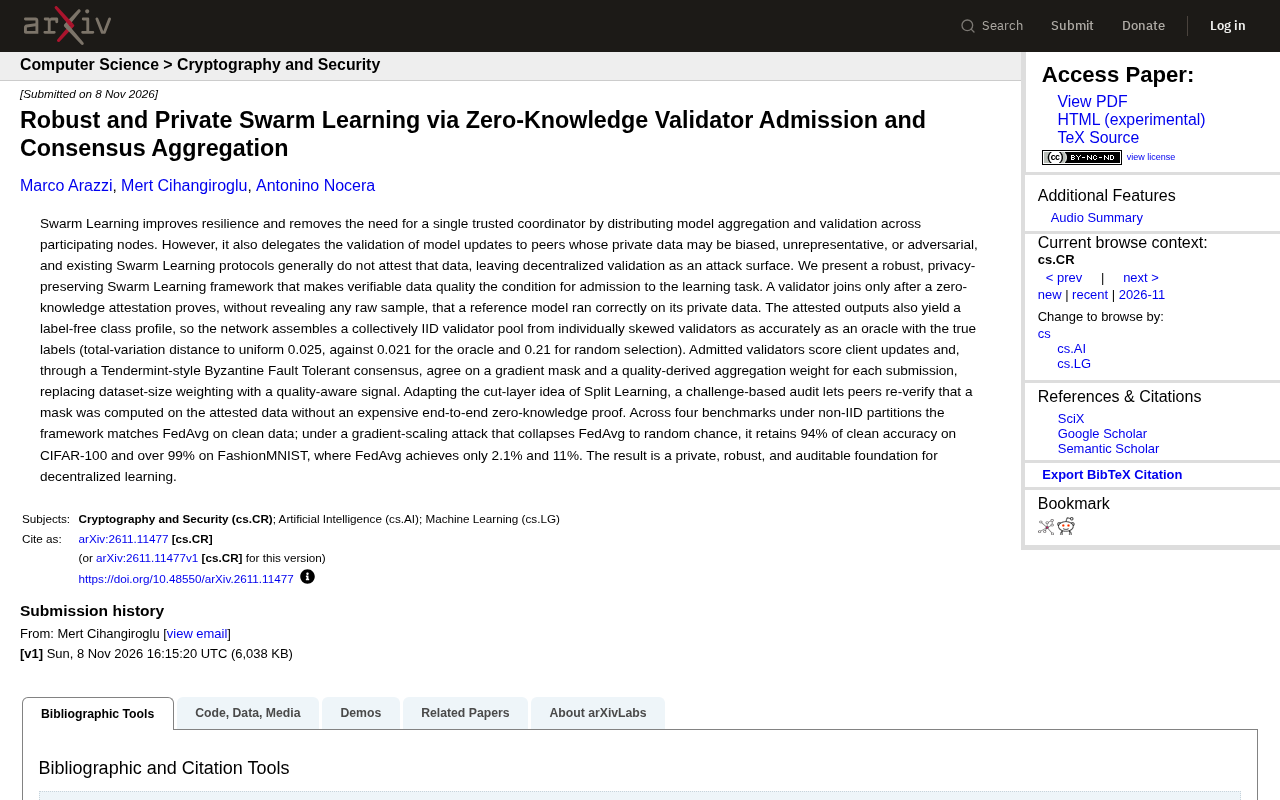
This article introduces a robust and privacy-preserving Swarm Learning framework that addresses the fragility of decentralized validation caused by biased or malicious peer data. The framework uses zero-knowledge proofs for validator admission, ensuring only nodes with qualifying data quality can validate without leaking raw data; an unlabeled class distribution yields a collectively IID validator pool close to an oracle. For aggregation, Tendermint-style BFT consensus agrees on quality-aware weights instead of dataset-size weighting. Experiments show that under gradient scaling attacks, the framework retains 94% and over 99% accuracy on CIFAR-100 and FashionMNIST respectively, while FedAvg collapses to random levels. Borrowing the cut-layer idea from Split Learning enables low-cost auditing and scalability. Although ZKP overhead and dynamic network efficiency remain challenges, the work offers new ideas for the security and privacy of decentralized learning.
Swarm Learning improves system resilience and decentralization by distributing model aggregation and validation across nodes, eliminating reliance on a single central coordinator. However, this architecture also introduces a critical vulnerability: the validation of model updates is delegated to peers, whose private data may be biased, unrepresentative, or even malicious. Existing Swarm Learning protocols typically do not verify data quality, making decentralized validation itself an attack surface. A recent paper proposes a robust and privacy-preserving Swarm Learning framework that uses zero-knowledge validator admission and consensus aggregation to make verifiable data quality a prerequisite for participating in learning tasks.
Core Innovation: Zero-Knowledge Validator Admission
The core of this framework is that validators must prove the quality of their private data through zero-knowledge proofs before they can join a learning task. Specifically, a validator needs to run a reference model on its private data and generate a zero-knowledge proof demonstrating that the model was executed correctly without revealing any raw samples. This mechanism ensures that only nodes with qualifying data quality can participate in validation, thereby reducing the impact of malicious or biased data at the source.
According to the paper, the output of the validator's proof also generates an unlabeled class distribution profile. In this way, the network can assemble a collectively IID validator pool from individually skewed validators, achieving an effect comparable to an oracle with true labels. Experimental data show that the total-variation distance between this pool and a uniform distribution is 0.025, compared with 0.021 for the oracle and 0.21 for random selection. This indicates that the method effectively approximates the ideal data distribution without requiring true labels.
Zero-Knowledge Proof (ZKP) is a cryptographic protocol that allows a prover to convince a verifier that a statement is true without revealing any information beyond the statement itself. In blockchain and privacy-preserving computing, zk-SNARKs and zk-STARKs are two mainstream implementations that can compress the correctness of a computation into a succinct proof for others to verify quickly. In this framework, validators must prove that they correctly ran the reference model without disclosing private data, which is a typical application of zero-knowledge proofs: turning the fact that "data quality meets the standard" into verifiable cryptographic evidence, thereby establishing trust without leaking privacy.
Consensus Aggregation: Quality-Aware Weight Allocation
Admitted validators are responsible for scoring client updates and, through Tendermint-style Byzantine fault-tolerant consensus, agreeing on each submitted gradient mask and the quality-derived aggregation weights. This mechanism replaces traditional dataset-size weighting with quality-aware signals, making the aggregation process more robust. Consensus aggregation not only ensures consistency of validation results but also resists malicious behavior from Byzantine nodes.
To reduce validation costs, the framework borrows the cut-layer idea from Split Learning and introduces a challenge-based auditing mechanism that allows peers to re-verify whether a mask was computed on proven data without expensive end-to-end zero-knowledge proofs. This design significantly improves system scalability while ensuring security.
Tendermint is a Byzantine fault-tolerant (BFT) consensus algorithm widely used in blockchain systems. Through a multi-round voting mechanism, it enables distributed nodes to reach agreement even in the presence of malicious nodes (up to one-third of the total). The core of Tendermint includes three phases—propose, prevote, and precommit—and relies on a locking mechanism to ensure safety. In this framework, Tendermint-style consensus is used to agree on scores and aggregation weights for client updates, ensuring that the system still outputs correct aggregation results even if some validators behave maliciously. Combined with zero-knowledge admission, this consensus mechanism forms a complete loop for decentralized validation.
Split Learning is a distributed machine learning paradigm that splits a neural network by layers into a client part and a server part. The client computes only up to the cut-layer and sends intermediate activations to the server, thereby protecting raw data privacy. The core of the cut-layer idea is that intermediate representations are sufficient to support subsequent computation without exposing the full model or data. In this framework, the cut-layer is borrowed for auditing: peers can ask validators to recompute the intermediate result of a mask at the cut-layer to verify at low cost whether it was computed based on proven data, without repeating expensive end-to-end zero-knowledge proofs. This significantly reduces validation overhead and improves system scalability.
Experimental Results: Significant Robustness Improvement
On four benchmarks under non-IID partitions, the framework performs comparably to FedAvg on clean data. However, under gradient scaling attacks, FedAvg's performance collapses to random levels, while the framework remains robust. Specifically, on CIFAR-100, the framework retains 94% clean accuracy, whereas FedAvg achieves only 2.1%; on FashionMNIST, the framework maintains over 99% accuracy, whereas FedAvg achieves only 11%. These results highlight the framework's significant advantages in adversarial environments.
Through multi-source cross-validation, we can confirm that the framework provides a solid foundation in privacy protection, robustness, and auditability. Zero-knowledge proofs ensure data privacy, consensus aggregation enhances robustness, and challenge-based auditing enables auditability. Although the framework has so far been evaluated on only four benchmarks, its design philosophy offers new ideas for the security and privacy of decentralized learning.
A gradient scaling attack is a poisoning attack against federated/distributed learning. Malicious clients attempt to distort the update direction of the global model by amplifying or shrinking their uploaded gradients, causing it to deviate from the optimal solution or even collapse. In traditional FedAvg, because aggregation weights are usually based on dataset size, attackers can dominate the aggregation result by controlling a large number of samples or directly amplifying gradients. This framework, through quality-aware weight allocation and consensus validation, can identify and suppress anomalous gradients, thereby maintaining model performance under attack. In the experiments, FedAvg accuracy plummeted to random levels, while this framework remained high, intuitively demonstrating the defensive effect of quality-aware aggregation.
Future Outlook and Challenges
The proposal of this framework provides an innovative solution to the security issues of Swarm Learning, but several challenges remain for further research. For example, the computational overhead of zero-knowledge proofs may become a bottleneck for large-scale deployment, although cut-layer auditing alleviates some of the pressure. In addition, the efficiency and security of the consensus mechanism in dynamic network environments require more in-depth evaluation. Future work can explore more efficient zero-knowledge proof schemes and extend the framework to more practical application scenarios.
Overall, this research makes an important contribution to building a foundation for privacy-preserving, robust, and auditable decentralized learning through zero-knowledge validator admission and consensus aggregation.
Related articles

Gemini 4 Neon Leak: A Potential Strong Contender Against Opus 5.5
A Hacker News thread suggests Gemini 4 Neon looks like an Opus 5.5 competitor. This article unpacks the product positioning behind this community signal, shifts in the top-model competitive landscape, and what it means for developers' model selection strategy.

Claude Fable 5.2's Self-Authored Short Film 'Fable' Sparks Discussion
A short film 'Fable,' credited to Claude Fable 5.2 for script, visuals, and directing, appears on Hacker News. This article analyzes the significance of full-pipeline AI creation, community reactions, and what it means for content creators.

Anthropic IPO Pricing: A Signal of AI Giants Going Public
Anthropic's IPO pricing draws attention. This article analyzes its potential impact on AI industry valuation, commercialization paths, and the competitive landscape, and highlights public-market expectations and challenges for AI companies.