Zero-Mem: How Zero-Token Memory Solutions Reduce LLM Agent Costs

Zero-Mem decouples LLM agent memory from token consumption to slash costs and boost scalability.
Zero-Mem proposes a zero-token memory approach for LLM agents, addressing the escalating token costs of traditional memory mechanisms like RAG and context stuffing. By pushing memory operations to the system layer—through techniques like KV cache persistence, parameterized memory, and structured state management—it aims to break the linear relationship between memory scale and token consumption, enabling cost-effective scaling of agent applications.
The Hidden Cost of Agent Memory: Why Token Overhead Matters
When we talk about large language model (LLM) agents, the conversation typically centers on reasoning capabilities, tool calling, and multi-turn dialogue quality. However, a long-overlooked yet increasingly prominent issue is: the token overhead of memory management. Every time an agent "recalls" historical context, it means stuffing large amounts of text back into the context window, which not only consumes precious token budgets but also directly increases inference latency and API costs.
Tokens are the fundamental unit of measurement for how large language models process text. Typically, one English word corresponds to 1-2 tokens, and one Chinese character corresponds to 1-2 tokens. Taking OpenAI GPT-4o as an example, its input token price is $2.5-5 per million tokens, with output tokens priced even higher. For an agent application processing tens of thousands of conversations daily, memory-related token consumption alone could constitute thousands of dollars in daily expenses. The Context Window is the maximum number of tokens a model can process in a single inference pass, equivalent to the model's "working memory" capacity — even though models like Claude and GPT-4 have expanded their windows to 128K or even 200K tokens, this capacity still falls short when facing complex agent tasks that require accessing extensive historical memory.
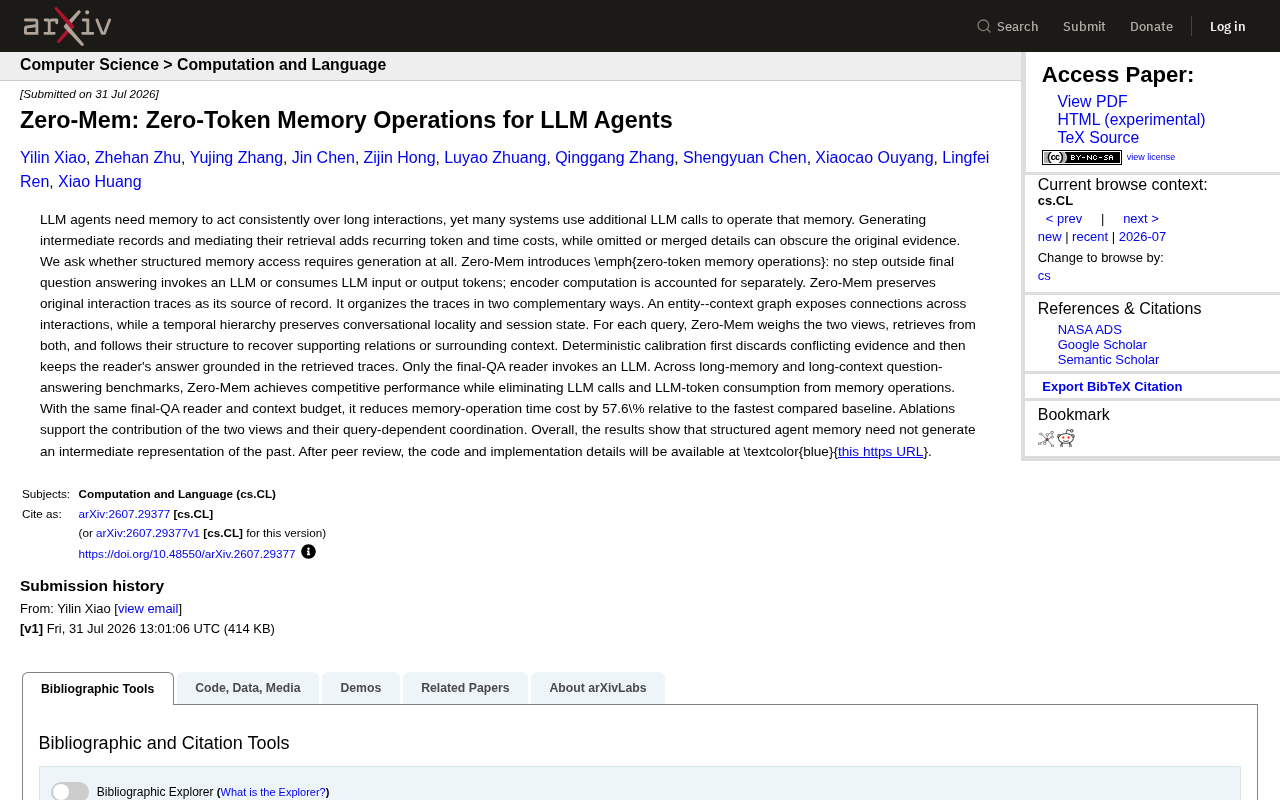
Zero-Mem is a solution designed specifically for this pain point. As the name suggests, its core goal is to achieve "Zero-Token Memory Operations" — providing LLM agents with persistent memory read/write capabilities without occupying tokens in the model's context window.
The Dilemma Facing Traditional Agent Memory Mechanisms
The Scarcity Problem of Context Windows
Currently, mainstream agent memory implementations mostly rely on concatenating historical information into prompts. Whether it's simple conversation history lookback or memory recall based on vector retrieval (RAG), the retrieved content ultimately needs to be injected as text into the context.
This creates several direct problems:
- Linear cost growth: Each interaction round requires retransmitting historical tokens, and as conversations grow longer, cumulative costs skyrocket.
- Increased latency: Longer context means slower Time To First Token (TTFT). The attention computation complexity in Transformer architecture scales quadratically with sequence length. While various optimizations (such as Flash Attention, Ring Attention) mitigate this at the engineering level, longer inputs still mean more computation.
- Context pollution: Excessive historical memory crowds out the "thinking space" needed for the current task, potentially degrading output quality.
The Limitations of Retrieval-Augmented Generation (RAG)
Even with external memory mechanisms like RAG, retrieval results still need to enter the model's reasoning pipeline in text form. In other words, "external storage" solves the memory capacity problem but doesn't solve the token cost problem of memory recall.
RAG's workflow is: first, knowledge documents are chunked and converted into vectors via embedding models, then stored in vector databases (such as Pinecone, Milvus, Chroma). When a user asks a question, the system vectorizes the query similarly, performs similarity matching, and recalls the most relevant document fragments, which are then concatenated into the prompt for the model's reference. While RAG solves model knowledge timeliness and capacity issues, its "last mile" still relies on token injection — each recalled document fragment typically ranges from 500-2000 tokens, and multi-path retrieval can easily reach thousands of tokens. This overhead accumulates linearly with interaction frequency. This is precisely the critical bottleneck Zero-Mem aims to break through.
Core Design Philosophy of Zero-Mem
From the project's naming and positioning, Zero-Mem's design philosophy is to "decouple" memory operations from token consumption. Its core principle is: let memory storage, updates, and retrieval happen outside the model's inference pipeline, rather than through occupying the context window.
How Memory Operations Achieve "Zero-Token" Status
So-called "zero-token memory operations" essentially push memory management logic down to the system layer, rather than exposing it to the model itself. When an agent executes tasks, memory writing, updating, and retrieval are handled by an external framework, and only the minimum necessary information truly needed for current reasoning enters the context.
From a technical pathway perspective, there are several possible implementation approaches for pushing memory management down to the system layer: one is through persistent KV Cache (key-value cache) reuse, allowing the model to directly load pre-computed intermediate representations without reprocessing tokens corresponding to existing memory; another is through parameterized memory (such as LoRA fine-tuning or Memory Token techniques), encoding key memories as model parameters or special learnable vectors, thus avoiding occupying context in natural language form; a third is utilizing structured state management systems that maintain agent state graphs at the framework level, injecting only minimal necessary state summaries at decision nodes. These methods each have their trade-offs, but their common goal is to break the linear relationship of "memory volume ∝ token consumption."
The value of this design lies in:
- Reduced marginal cost: Expanding memory scale no longer directly translates to token overhead.
- Keeping context clean: The model's attention focuses on the current task rather than being overwhelmed by lengthy history.
- Improved scalability: Agents can maintain long-term memory far exceeding context window capacity.
Implications for Agent Architecture Design
The approach represented by Zero-Mem reflects how agent engineering is evolving from "brute-force context stuffing" toward "refined memory management." This aligns with the industry's growing emphasis on Context Engineering — how to maximize information value density within a limited context budget.
Context Engineering is one of the core paradigms in agent development for 2024-2025, popularized by figures like Shopify CEO Tobi Lütke. Its core principle is: model capabilities are already powerful enough; the real differentiation lies in how you carefully construct the context fed to the model. Specific practices include: dynamic prompt assembly (selectively loading different system prompts and tool descriptions based on task type), hierarchical summarization strategies (compressing long-term memory into summaries while keeping recent memory in original form), and attention guidance (placing the most critical information at the beginning and end of context to combat the "lost in the middle" effect). Teams like Anthropic, LangChain, and CrewAI have all built varying degrees of context management capabilities into their respective frameworks.
Why the Zero-Token Memory Direction Deserves Attention
Scaling Cost-Sensitive Scenarios to Production
For agent applications that need to run long-term and continuously accumulate state (such as personal assistants, customer service bots, and automated workflows), the token cost of memory is a real barrier to scaling. If solutions like Zero-Mem can effectively reduce this overhead, they will directly improve the unit economics of agent products.
The unit economics of agent products involve the total cost per interaction, primarily composed of: model inference token fees (typically 60-80% of total cost), vector retrieval and storage fees, tool calling fees (such as search APIs, code execution, etc.), and infrastructure fees. Taking a typical customer service agent as an example, if an average of 2,000 tokens of historical memory needs to be loaded per conversation turn, and a complete conversation spans 10 turns, memory loading alone consumes approximately 20,000 tokens. If the system handles 100,000 conversations daily, the annualized token cost related to memory can reach hundreds of thousands of dollars. This is why even though the token cost of a single API call seems minimal, differences in memory management efficiency get amplified into significant business cost gaps at scale.
Complementary Relationship with Long Context Window Trends
Some might ask: since model context windows have expanded to the million-token level, is dedicated memory management still necessary? The answer is yes. A larger window doesn't mean a free window — more tokens mean higher costs and latency, and research shows that the "lost in the middle" problem still persists in ultra-long contexts.
"Lost in the Middle" is a phenomenon revealed in research published by Stanford University and other institutions in 2023: when large amounts of information fill a long context window, the model's attention to information positioned in the middle of the context drops significantly, primarily relying on information at the beginning and end for reasoning. This means that even if a million-token context is technically supported, the model's utilization efficiency of information within it is not uniformly distributed. Subsequent research (including multiple evaluations in 2024) shows that while newer-generation models have somewhat mitigated this issue, information retrieval accuracy still declines under extremely long contexts. This provides additional justification for dedicated memory management solutions — rather than having the model search for a "needle in a haystack" among massive tokens, it's better to deliver information precisely at the system layer.
Therefore, intelligent memory management and long context capabilities are complementary rather than substitutive.
A Realistic View: Current Status and Limitations of an Early-Stage Project
It's worth noting that Zero-Mem currently has relatively limited discussion momentum in the community and remains an early-stage project. This means:
- Its actual effectiveness and engineering maturity still need further community validation.
- "Zero-token" is more of a design goal statement; specific implementation details and applicability boundaries need to be evaluated against actual documentation.
- For production environment adoption, it's recommended to start with small-scale validation before gradually expanding.
Nevertheless, the problem it points to is real and universal, and its approach holds reference value for developers building agent systems.
Conclusion: Memory Management Will Become a Key Competitive Advantage for Agents
Zero-Mem represents a technical direction worth watching: liberating memory management from the token economy. As agent applications transition from demos to production at scale, cost efficiency will become one of the decisive factors. Whether Zero-Mem or another solution ultimately prevails, the concept of "zero-token memory operations" reminds us that excellent agent architecture isn't about how much information you stuff into context, but about how to carry the most valuable memories with the fewest tokens.
For developers, closely following the evolution of this field and examining the cost structure of memory mechanisms in your own projects may be one of the most cost-effective investments you can make right now.
Related articles

Deep Dive into Cloudflare's Server State Synchronization Tool: A New Approach to Distributed Consistency
An in-depth analysis of Cloudflare's server state synchronization tool, exploring its technical implementation (CRDT, Gossip protocol), product synergies, and impact on edge computing competition.

How Nashville Used Eminent Domain to Block a Data Center Near Its Zoo
Nashville invoked eminent domain to block a data center near its zoo, sparking debate over AI compute expansion vs. community interests and reshaping tech siting strategies.

The Rise and Fall of Programming Languages: The Interplay of Ecosystems, Markets, and Communities
An in-depth analysis of the forces driving programming language rise and fall—ecosystems, market shifts, corporate backing, and technical inertia—to help developers make rational technology choices.