Zero-Token Multi-Agent Monitoring: Wake Your Orchestrator with a Pipe

Replace timer polling with blocking pipe reads to wake the multi-agent orchestrator at zero token cost.
The article addresses the efficiency of orchestrator monitoring of background agents in multi-agent systems, noting that traditional timer polling may trigger a model call on every check, consuming tokens while making response latency hard to balance. It introduces an alternative: using an OS pipe as the communication mechanism, where background agents write messages on state changes and the orchestrator blocks on a pipe read and is woken instantly—no model calls, hence "zero-token." It also notes the approach relies on local IPC, is less flexible than message queues in distributed settings, and requires handling pipe blocking and error edge cases; given the brief original post and lack of performance data, it recommends validating in a single-machine multi-process scenario and offers practical advice such as preferring event-driven design, reusing system primitives, and evaluating distributed reliability.
Zero-Token Multi-Agent Monitoring: Wake Your Orchestrator with a Pipe
Multi-agent systems are becoming increasingly common in automated workflows, but efficiently monitoring background agents (BG agents) and dispatching the orchestrator has always been a pain point. Traditional solutions rely on timer-based polling, which not only consumes tokens but also introduces latency. Recently, a developer on Reddit shared a "zero-token" solution—using a pipe instead of a timer to wake the orchestrator—which sparked considerable discussion.
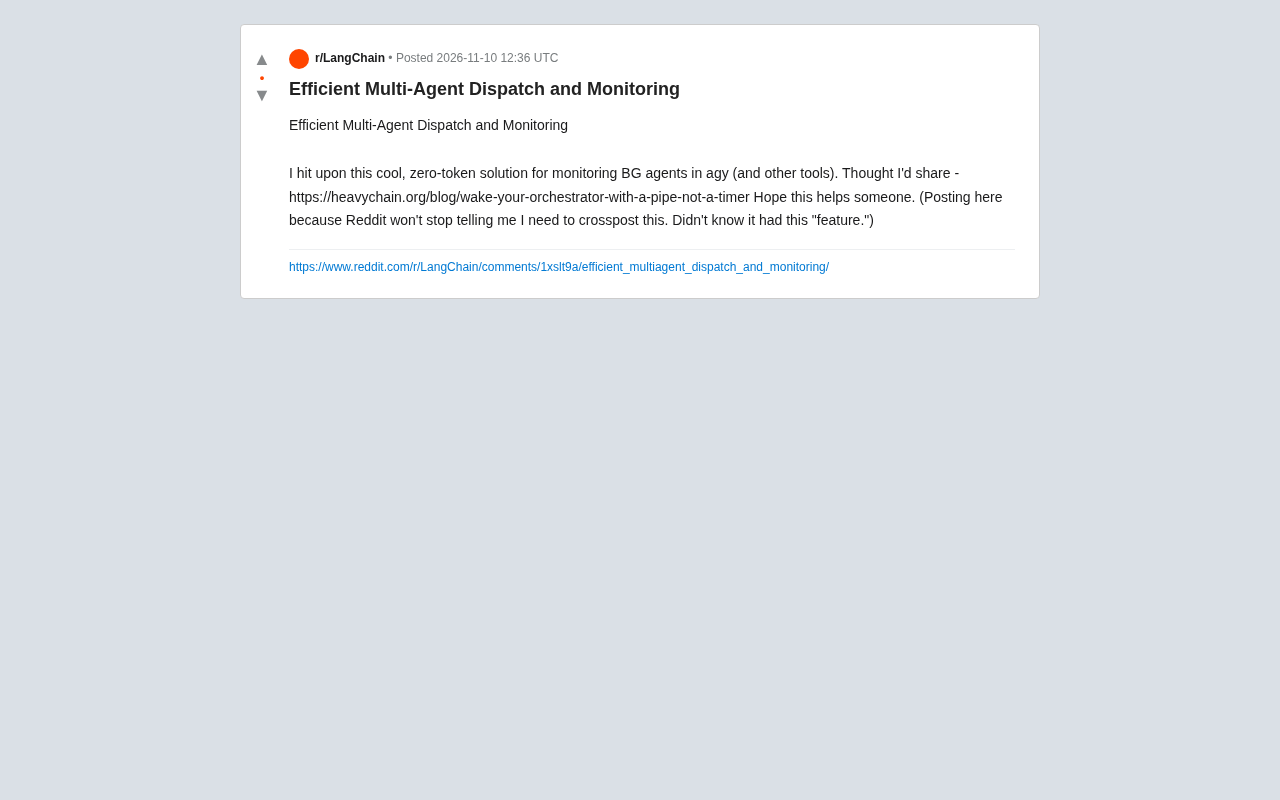
The Cost of Timer Polling
In agy (and similar tools), the orchestrator is responsible for dispatching tasks and collecting results. If a timer is used to periodically check the status of background agents, each check may trigger a model call, incurring token consumption. In addition, the polling interval is hard to balance: too short wastes resources, too long causes sluggish responses.
The developer summarized this pain point as an inherent flaw of "waking the orchestrator with a timer" and proposed an alternative approach.
Pipe-Based Wakeup: An Event-Driven, Zero-Token Solution
The core idea is to use an operating system–level pipe as the communication mechanism. When a background agent completes or changes state, it writes a message to the pipe; the orchestrator blocks on a pipe read and is woken immediately once data arrives. The entire process involves no model calls, making it "zero-token."
According to the original poster, this approach is explained in detail on their blog (link: heavychain.org/blog/wake-your-orchestrator-with-a-pipe-not-a-timer). Although the post doesn't elaborate on technical details, event-driven architecture is nothing new in systems programming—bringing it into multi-agent dispatch is a clever cross-domain application.
A pipe is a basic inter-process communication (IPC) primitive provided by Unix/Linux systems, essentially a ring buffer maintained by the kernel: the write end (write fd) appends bytes, and the read end (read fd) removes bytes in order. Anonymous pipes can only be used between related processes (such as parent and child), while named pipes (FIFO, created via mkfifo) allow unrelated processes to connect through a filesystem path. The key characteristic of pipes is blocking semantics: when the buffer is empty, a read operation suspends the process until data is written; conversely, the write end also blocks when the buffer is full. It is precisely this characteristic that enables the "orchestrator blocks on read, background agents write events" model to work without any polling.
Event-driven architecture (EDA) is the opposite of polling: polling has the consumer actively query state at regular intervals, while event-driven has the producer actively notify when state changes. EDA is generally superior in latency and resource usage because idle periods incur zero overhead and notifications can be delivered instantly. The trade-off is inversion of control—consumers need to organize code around callbacks or blocking waits, and must handle edge cases such as lost events, out-of-order delivery, and backpressure.
Multi-Source Perspectives and Community Feedback
The post was originally published on Reddit, and the author mentioned that due to Reddit's cross-subreddit posting requirements, the content was moved to the current subreddit. Judging from community reactions, this lightweight approach is appealing for resource-constrained scenarios. However, there are reasons for caution: the pipe approach relies on local inter-process communication and may be less flexible than message queues in distributed multi-agent environments; in addition, error handling and edge cases around pipe blocking require extra consideration.
Currently, the approach is only mentioned in the context of agy and "other tools," and no large-scale production validation has been seen. For developers who want to try it, it's advisable to test in a single-machine multi-process scenario first.
The core difference between message queues (such as RabbitMQ, Kafka, Redis Streams) and pipes is that pipes are native kernel primitives whose lifecycle is tied to processes and the filesystem, with no persistence, delivery acknowledgment, retry, or cross-host capability; message queues, on the other hand, are independent middleware that provide persistence, at-least-once/exactly-once delivery semantics, consumer groups, and horizontal scaling. Pipes win on zero dependencies, microsecond-level latency, and minimal implementation; message queues win on reliability, decoupling, and distributed support.
Backpressure and blocking boundaries: pipe buffers are fixed in size (64KB by default on Linux). If the orchestrator can't keep up with the write rate, background agents will block on writes, potentially slowing down their task completion. Mitigation options include increasing the buffer size, using non-blocking writes with select/epoll, or adopting a hybrid strategy of "write and return, discard on failure and fall back to polling." You also need to handle the problem of the read end blocking forever if the write-end process exits abnormally—a common practice is to have the read end receive EOF when all write ends close and trigger reinitialization.
Practical Recommendations and Limitations
If you're building a multi-agent system, you can draw on the following ideas:
- Prefer event-driven over polling to reduce unnecessary model calls;
- Leverage existing system primitives (such as pipes and signals) for lightweight notifications;
- In distributed scenarios, evaluate whether the pipe approach meets reliability and scalability requirements.
A note: the original post is brief, with limited technical detail and no performance data. Readers should validate it against their own architecture before adopting it.
Conclusion
"Use a pipe, not a timer" offers a new perspective on reducing the overhead of multi-agent monitoring. In development environments sensitive to token costs, zero-token techniques like this are worth watching, but their applicable boundaries still need to be tested in practice.
One-line Summary
Replace timer polling with blocking pipe reads to wake the multi-agent orchestrator at zero token cost.
Paragraph Summary
The article focuses on the efficiency of orchestrator monitoring of background agents in multi-agent systems, pointing out that traditional timer polling may trigger a model call on every check, consuming tokens while making response latency hard to balance. The author introduces an alternative proposed by a developer: using an operating system pipe as the communication mechanism, where background agents write messages on state changes and the orchestrator blocks on a pipe read and is woken instantly, with no model calls involved—hence "zero-token." The article also notes that this approach relies on local inter-process communication, is less flexible than message queues in distributed environments, and requires handling edge cases such as pipe blocking and error handling. Because the original post is brief and lacks performance data, the author recommends validating in a single-machine multi-process scenario first, and offers practical advice such as preferring event-driven design, reusing system primitives, and evaluating distributed reliability.
Related articles

Gemini 4 Neon Leak: A Potential Strong Contender Against Opus 5.5
A Hacker News thread suggests Gemini 4 Neon looks like an Opus 5.5 competitor. This article unpacks the product positioning behind this community signal, shifts in the top-model competitive landscape, and what it means for developers' model selection strategy.

Claude Fable 5.2's Self-Authored Short Film 'Fable' Sparks Discussion
A short film 'Fable,' credited to Claude Fable 5.2 for script, visuals, and directing, appears on Hacker News. This article analyzes the significance of full-pipeline AI creation, community reactions, and what it means for content creators.

Anthropic IPO Pricing: A Signal of AI Giants Going Public
Anthropic's IPO pricing draws attention. This article analyzes its potential impact on AI industry valuation, commercialization paths, and the competitive landscape, and highlights public-market expectations and challenges for AI companies.