Zeroth-Order Langevin Dynamics: Curvature Regularization and Non-Asymptotic Guarantees

Gaussian smoothing in zeroth-order optimization implicitly introduces Hessian trace regularization; ZOLD provides excess risk guarantees in non-convex settings.
The article points out that Gaussian smoothing commonly used in zeroth-order optimization is not merely a gradient estimation trick: at leading order, the smoothed objective is equivalent to the original objective plus a Hessian trace regularization term (η²/2) tr(∇²f(x)), so zeroth-order methods actually optimize a curvature-regularized objective. Around this observation, the paper studies stochastic Zeroth-Order Langevin Dynamics (ZOLD), which uses only noisy function evaluations and establishes non-asymptotic excess risk guarantees for the curvature-regularized objective in non-convex settings. The analysis first uses Wasserstein distance to control how close the iterate distribution is to the Gibbs measure of the smoothed objective, then explicitly couples the smoothing parameter with the inverse temperature parameter, ultimately converting this into an excess risk bound. The constants in this bound do not depend on log-Sobolev or Poincaré inequalities, and evaluations are allowed to have non-uniform dependence on the data stream.
The Hidden Cost of Zeroth-Order Optimization: How Gaussian Smoothing Introduces Curvature Regularization
Zeroth-order optimization methods rely only on noisy function value evaluations, without accessing gradients or higher-order derivatives, making them popular in scenarios such as black-box optimization and reinforcement learning policy search. However, this approach has an often-overlooked side effect: the smoothing operation in the gradient estimator silently alters the objective function being optimized.
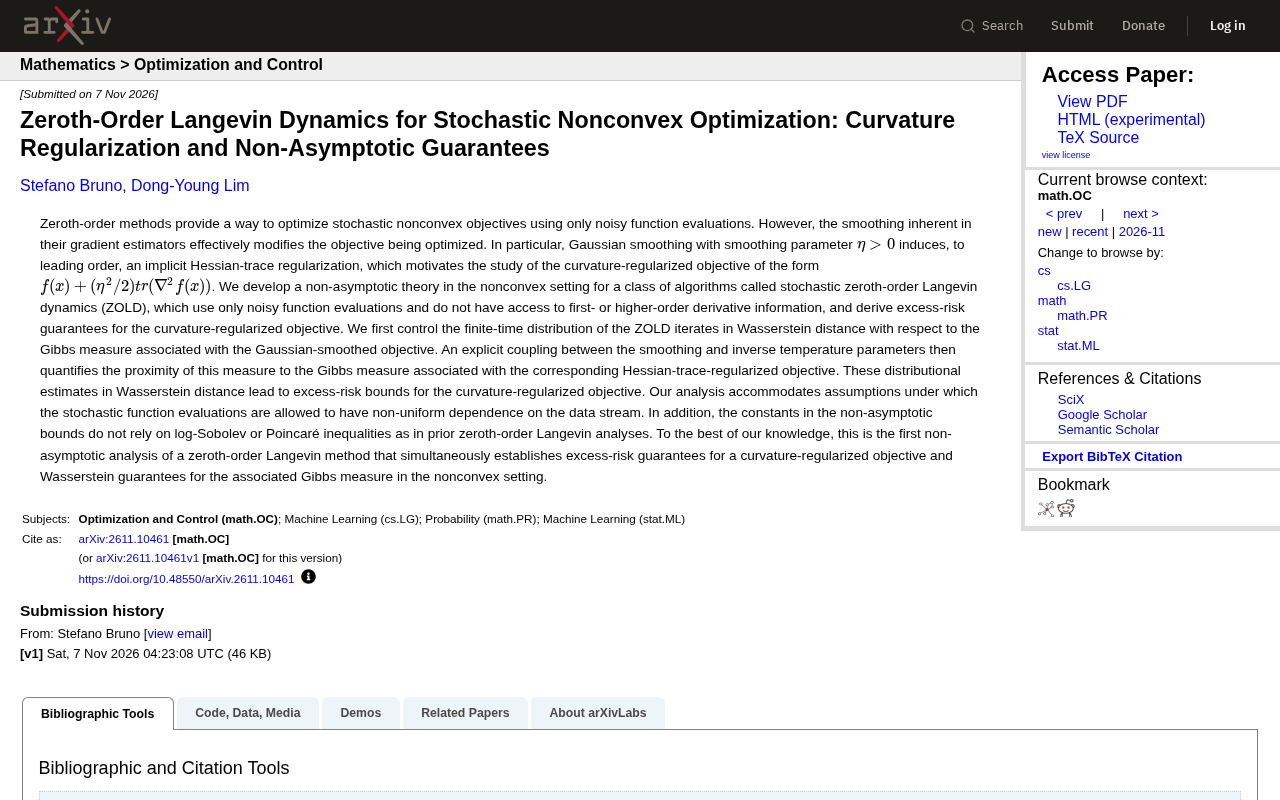
According to the study's analysis, when Gaussian smoothing with parameter η>0 is used, the smoothed objective is equivalent, at leading order, to implicitly adding a Hessian trace regularization term to the original objective, i.e., f(x) + (η²/2) tr(∇²f(x)). This means that zeroth-order methods do not actually optimize the original objective, but rather a curvature-regularized version of it. This observation forms the starting point of the entire paper: rather than treating smoothing as a mere estimation trick, it confronts the objective shift it introduces and establishes a rigorous theoretical characterization of it.
The ZOLD Algorithm and Non-Asymptotic Analysis Framework
The paper studies a class of algorithms called stochastic Zeroth-Order Langevin Dynamics (ZOLD). These algorithms use only noisy function value evaluations, relying entirely on neither first-order nor higher-order derivative information, yet operate in non-convex settings. The authors establish non-asymptotic excess risk guarantees for the curvature-regularized objective.
The analysis proceeds in two steps. First, Wasserstein distance is used to control the finite-time distribution of ZOLD iterates, comparing it with the Gibbs measure corresponding to the Gaussian-smoothed objective. Second, the coupling relationship between the smoothing parameter and the inverse temperature parameter is explicitly established, thereby quantifying how close this measure is to the Gibbs measure corresponding to the Hessian-trace-regularized objective. These two distributional estimates are ultimately converted into an excess risk bound for the curvature-regularized objective.
According to the original text, this is the first non-asymptotic analysis of zeroth-order Langevin methods that simultaneously provides excess risk guarantees for the curvature-regularized objective and Wasserstein guarantees for the associated Gibbs measure in non-convex settings.
Escaping log-Sobolev and Poincaré Assumptions
Previous zeroth-order Langevin analyses often rely on log-Sobolev inequalities or Poincaré inequalities to obtain convergence. A technical contribution of this paper is that the constants in its non-asymptotic bounds do not depend on these inequalities. This broadens the range of objective functions to which the theory applies, enabling the analysis to cover more general non-convex scenarios.
The log-Sobolev inequality and the Poincaré inequality are two classes of functional inequalities that characterize the convergence rate of Markov semigroups. The former controls the decay of relative entropy, while the latter controls the decay of (L^2) variance; both can imply that Langevin dynamics converges to the Gibbs measure at an exponential rate, but they require the objective function to have strong convexity or satisfy uniform conditions. Many non-convex objectives do not satisfy these inequalities, and imposing them as assumptions narrows the scope of the theory. The non-asymptotic bounds in this paper do not rely on them, meaning that convergence guarantees can cover more general non-convex landscapes, at the cost of polynomial factors related to dimension or time that may appear in the bounds.
Non-Uniform Data Dependence
The paper's assumptions allow stochastic function evaluations to have non-uniform dependence on the data stream. That is, noise evaluations at different times can depend on historical data in different ways, without requiring independence or uniform sampling. This setting is closer to the practical situations of online learning and streaming optimization.
Wasserstein distance measures the optimal transport cost between two probability distributions: the minimum work required to move a pile of "sand" from one distribution to another. In algorithm analysis, it is often used to quantify the overall difference between the iterate distribution and the target Gibbs measure, and it better reflects the geometric closeness of distributions in high-dimensional spaces than total variation distance. This paper uses it to control the distance between the finite-time distribution of ZOLD iterates and the Gibbs measure of the smoothed objective precisely because it is sensitive to differences in distribution tails and support sets, making it suitable for non-asymptotic characterization in non-convex, heavy-tailed scenarios.
The Gibbs measure is a probability distribution of the form (\mu(dx) \propto \exp(-\beta f(x))dx), where (\beta) is the inverse temperature. It can be viewed as the equilibrium distribution on the "energy landscape" of the objective function (f) after thermal fluctuations at temperature (1/\beta): the larger (\beta) is, the more the mass concentrates in regions where (f) is low. The long-term behavior of Langevin dynamics is precisely convergence to the corresponding Gibbs measure, so using it as a comparison benchmark allows one to translate "whether the algorithm finds a good solution" into "how close the iterate distribution is to the Gibbs measure."
Significance of the Method and Scope of Applicability
This work elevates the "smoothing bias" of zeroth-order methods from an engineering detail to a theoretical object. Practitioners can thereby obtain a clear criterion for judgment: the curvature regularization induced by Gaussian smoothing is not purely an error; at leading order it is an analyzable and controllable implicit regularization term. For researchers concerned with black-box non-convex optimization, the distributional estimation approach of ZOLD provides an analysis template that does not rely on strong convexity or functional inequality assumptions.
It should be noted that the paper's guarantees target the curvature-regularized objective, not the original objective. The gap between the two is controlled by the smoothing parameter η, and the choice of η simultaneously affects the regularization strength and the distributional approximation accuracy, constituting a design variable that requires trade-offs. The original text does not provide specific value recommendations, and practical applications still require adjustment based on the problem scale.
Key Points at a Glance
- Gaussian smoothing is equivalent, at leading order, to adding a Hessian trace regularization term (η²/2) tr(∇²f(x)) to the objective.
- ZOLD uses only noisy function evaluations and obtains excess risk bounds for the curvature-regularized objective in non-convex settings.
- The analysis controls the iterate distribution via Wasserstein distance and explicitly couples the smoothing parameter with the inverse temperature parameter.
- The constants in the non-asymptotic bounds do not depend on log-Sobolev or Poincaré inequalities, and evaluations are allowed to have non-uniform dependence on the data stream.
One-line Summary
Gaussian smoothing in zeroth-order optimization implicitly introduces Hessian trace regularization; ZOLD provides excess risk guarantees in non-convex settings.
Paragraph Summary
The article points out that Gaussian smoothing commonly used in zeroth-order optimization is not merely a gradient estimation trick: at leading order, the smoothed objective is equivalent to the original objective plus a Hessian trace regularization term (η²/2) tr(∇²f(x)), so zeroth-order methods actually optimize a curvature-regularized objective. Around this observation, the paper studies stochastic Zeroth-Order Langevin Dynamics (ZOLD), which uses only noisy function evaluations and establishes non-asymptotic excess risk guarantees for the curvature-regularized objective in non-convex settings. The analysis first uses Wasserstein distance to control how close the iterate distribution is to the Gibbs measure of the smoothed objective, then explicitly couples the smoothing parameter with the inverse temperature parameter, ultimately converting this into an excess risk bound. The constants in this bound do not depend on log-Sobolev or Poincaré inequalities, and evaluations are allowed to have non-uniform dependence on the data stream.
Related articles

Inkling 2 Mini Released: A New Contender in Small Models?
Thinking Machines releases the small model Inkling 2 Mini, sparking heated discussion in the Hacker News community. This article analyzes the release, community reaction, and the small model trend.

Will GTA VI Be the Last "Purely Human" AAA Blockbuster?
What does calling GTA 6 "the last game of its kind" really mean? This article interprets the video's view: it refers to a historic work built by thousands of people without AI, with the full force of an entire company—not the end of big-budget games—using the Ocarina of Time remake as a counterexample of low cost and high quality.

Inkling 2 Mini Lands on Ollama: How a 5.4B Model Achieves Deep Reasoning
ThinkyMachines' Inkling 2 Mini is now on Ollama's pre-release. With only 5.4B activated parameters, it achieves deep reasoning by cycling through middle layers three times per token, runs locally on a 32GB Mac, and targets coding, agents, and vision tasks.