Zinley: An AI Clone That Answers Your Phone and Reads Your Email, Redefining AI Assistants

Zinley is an AI agent with its own phone and email that acts as your personal representative in the real world.
Zinley is a new AI product that topped Product Hunt's daily chart, distinguishing itself from traditional chatbots by having its own phone number and email address. It can answer calls, handle emails, make bookings, and report back — all within user-defined rules. With built-in memory for relationships and context, Zinley represents the shift from passive conversational AI to proactive AI agents that act on your behalf in the real world.
When AI Steps Out of the Chat Box: Zinley Introduces a New Interaction Paradigm
For the past two years, AI assistants have lived in essentially one place — the chat window. You open a dialog, type a question, wait for a response, and close the page. While powerful, this interaction model has always had a fundamental limitation: AI only exists when you actively summon it. It cannot "show up on your behalf" in the real world.
Since ChatGPT ignited the generative AI wave in late 2022, virtually all mainstream AI products — including ChatGPT, Claude, Gemini, ERNIE Bot, and others — have adopted a "conversational" interface. This design stems from the long research tradition in Natural Language Processing (NLP), built on a core assumption: users express intent through natural language, and models generate text responses. While this paradigm dramatically lowered the barrier to using AI, it fundamentally confines AI to the role of a "passive responder" — AI has no communication channels of its own, no independent identity, and cannot be proactively contacted by third parties. This means AI can only serve as a user's "internal advisor" but never as their "external representative."
Zinley, which recently topped the Product Hunt daily chart, aims to break this paradigm. Its positioning is quite direct — "Your Personal AI Representative for calls, email, and tasks." With 150 upvotes and 32 comments earning it the #1 spot for the day, Zinley has clearly struck a nerve.
Product Hunt is one of the world's most influential platforms for launching new tech products. Founded by Ryan Hoover in 2013, it has become a crucial channel for startups to validate market demand. On the platform, products earn rankings through community upvotes and comments, and topping the daily chart means gaining high recognition among global tech early adopters. Historically, well-known products like Notion, Figma, and Loom all gained early traction through Product Hunt. A score of 150 upvotes for a daily #1 ranking is above average in the recently competitive AI category, suggesting the product addresses a genuine need rather than relying purely on marketing.
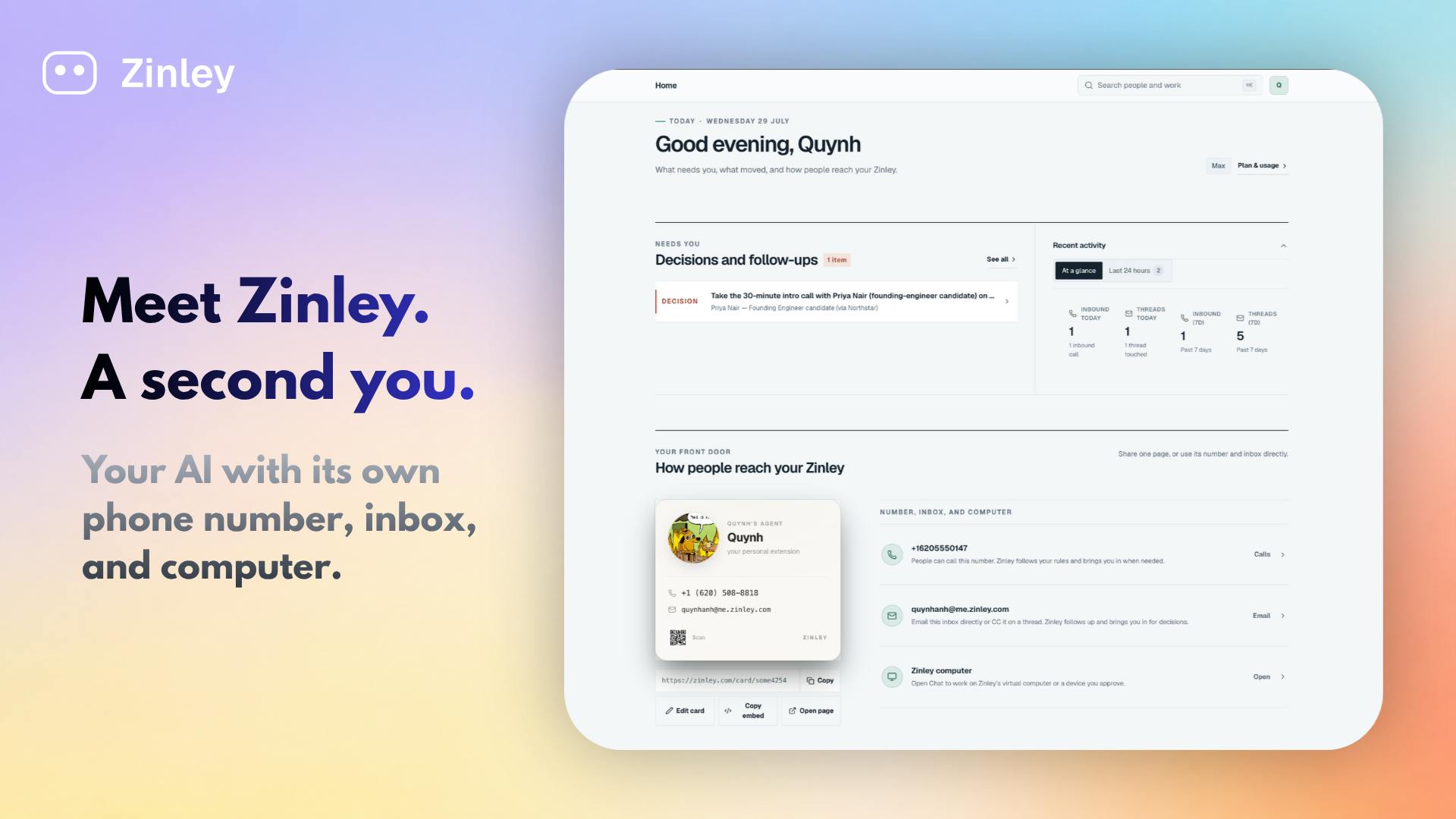
In the company's own words: "Most AIs wait in chat. Zinley is reachable by you and the people around you." This statement captures its most essential difference from traditional chatbots — Zinley isn't passively responsive; it actively "shows up."
Zinley's Core Features: A "Second You" with Its Own Phone Number and Email
Zinley's most striking design choice is that it has its own phone number and email address. This means it's no longer a tool sealed inside an app, but an entity that can communicate directly with the outside world.
What Zinley Can Do
According to the official description, Zinley has the following core capabilities:
- AI Phone Answering: Handles incoming calls on your behalf using its dedicated phone number
- AI Email Management: Autonomously handles email correspondence
- Booking Tasks: Makes reservations, places orders, and arranges various matters for you
- Working Within Rules: All actions follow the boundaries and rules you've set
In other words, when someone calls you or sends you an email, Zinley can step in and handle it first, without requiring you to be glued to your screen. This "representative" model elevates AI from a query tool to a genuine "task executor."
The company describes it as "A second you that shows up" — a second version of yourself that actually appears in real-world scenarios. This metaphor precisely captures the product's ambition: not thinking for you, but acting for you.
AI Memory: Remembering Your Relationships and Context
Another key feature of Zinley is its memory capability. The company emphasizes that it "remembers your people and relationships, then reports back in your voice."
Long-term memory in AI is one of the industry's core technical challenges. Traditional Large Language Models (LLMs) are limited by their context window and can only "remember" limited information within a single conversation. Achieving persistent memory across conversations and scenarios typically requires combining vector databases (such as Pinecone or Weaviate), Retrieval-Augmented Generation (RAG) technology, and structured knowledge graphs. For a product like Zinley specifically, the memory system needs to store and index user contact relationships, historical interaction records, personal preferences, and rule settings, then retrieve relevant context in real-time during each agent action. This is similar to how a human personal assistant gradually learns their employer's habits through extended interaction — just accelerated through data engineering.
This is crucial for the practicality of an AI representative. A truly useful representative must understand your relationships with different contacts — who's a client, who's family, who's a partner requiring careful handling. Only with this contextual memory can AI make socially appropriate judgments when answering calls or replying to emails on your behalf, rather than delivering uniform, mechanical responses.
After completing tasks, Zinley reports back to you "in your voice." This creates a complete loop: Receive request → Process according to rules → Record relationships → Report back. The entire workflow attempts to simulate how a truly competent personal assistant operates.
From Chatbots to AI Agents: The Trend Toward Action-Oriented Agents
Zinley's emergence reflects a clear direction in AI product evolution: moving from "conversation" to "agency" (Agent).
The AI Agent concept originated in the early stages of artificial intelligence research, first systematically defined by scholars Russell and Norvig in the classic textbook Artificial Intelligence: A Modern Approach as "an entity that can perceive its environment and take actions to achieve goals." However, it wasn't until Large Language Models (LLMs) developed powerful reasoning, planning, and tool-calling capabilities that AI Agents became practically viable. Since 2023, open-source projects like AutoGPT and BabyAGI have pioneered LLM-driven autonomous agents, while API capabilities like OpenAI's Function Calling and Anthropic's Tool Use have provided the technical foundation for agents to invoke external tools (such as making phone calls or sending emails). Zinley can be seen as a concrete consumer-level implementation of this technological wave.
A Fundamental Shift in Interaction Paradigm
Traditional AI chat tools are essentially "pull" interactions — users initiate, AI responds passively. Zinley represents a hybrid "push" and "proactive" model: it can be reached by the outside world and can proactively complete tasks. This shift truly embeds AI into people's daily workflow.
New Questions Worth Considering
This category of products also raises new dimensions of thought:
-
Trust Boundaries: Letting AI answer calls and reply to emails on your behalf means granting it considerable autonomy. The company repeatedly emphasizes "within your rules," indicating the team recognizes the importance of control. In the AI agent space, "Human-in-the-Loop" is a widely discussed design principle, referring to preserving human approval or intervention before AI executes critical decisions. Different products vary in how much autonomy they grant: some adopt a "fully automated execution + post-hoc reporting" model, while others require human confirmation at every step. Zinley's emphasis on "within your rules" is essentially a rule-based permission control system where users pre-define what the AI can and cannot do, with the AI acting autonomously within those boundaries. This design attempts to balance efficiency (reducing human intervention) with safety (preventing unauthorized actions).
-
Identity Proxying: When AI has its own phone number and email, it becomes, in a sense, your digital extension. This boosts efficiency but also raises new questions about privacy and accountability. For example, when an email replied by AI on your behalf has legal force, does responsibility fall on the user or the AI service provider? Such questions have no clear answers under current legal frameworks.
-
Relationship Memory Security: AI holding your social network data makes its security and usage boundaries a long-term concern for users. Social relationship graphs are highly sensitive personal data — a breach would not only affect the user's own privacy but could also impact the rights of all related parties in their social network.
Conclusion: AI Assistants Are Moving from Conversation to Action
Zinley was built by a team including Jason Chen, Khoi Nguyen, and Peter Bakas, and is categorized under "Productivity," "Artificial Intelligence," and "Virtual Assistants." Its rise to the top of the Product Hunt daily chart demonstrates genuine, strong market demand for "proactive AI agents."
Of course, products like this are still in early stages, and the actual quality of call handling, judgment accuracy, and privacy protection mechanisms all need to be tested in real-world scenarios. But the vision Zinley paints — a "second you" that can show up on your behalf in the real world — undoubtedly points toward an immensely imaginative future for AI assistants.
AI is moving from "intelligence in a chat box" to "an actor in the real world." Whether Zinley can deliver on this promise is well worth watching.
Related articles

Meta Returns to Open Source: 30B Model Muse Glimmer Runs on a Single 24GB GPU
Meta returns to open source with Muse Glimmer, a 30B open-weight model running on a single 24GB GPU. Apache 2.0 licensed, 233 tokens/sec with speculative decoding.

AI + SRC Automated Vulnerability Hunting: Rebuilding the Three-Step Method with AI Agents
A complete guide to AI+SRC automated vulnerability hunting — comparing traditional methods with AI Agent-powered workflows covering asset recon, false positive filtering, and report generation.

Testing DeepSeek Desktop Agent: Auto-Generate a Full Video for Just $0.35
A blogger tested DeepSeek Harness desktop Agent: auto-generated a full video for $0.35, built a daily briefing, and an app from plain English — all for $0.59 total.