#AlphaFold3
59 related articles
·3 min
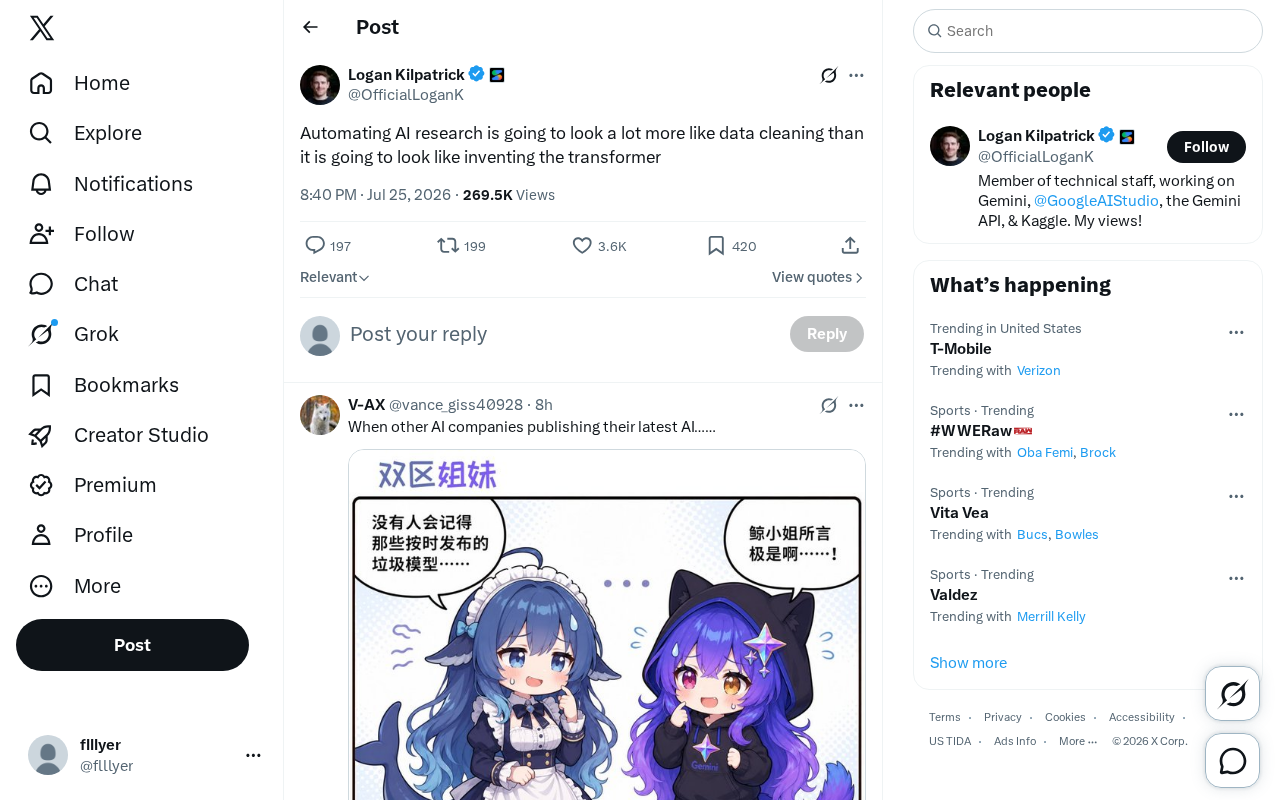
AI Research Automation: More Like Data Cleaning Than Inventing the Transformer
Why AI research automation looks more like data cleaning than inventing the Transformer. Exploring the value of automating 60%-80% of repetitive research work and how human-AI collaboration reshapes the research paradigm.
Read more →
·3 min
AI Research Automation: More Like Data Cleaning Than Inventing the Transformer
AI research automation will look more like data cleaning than inventing the Transformer. Explore how automating 60%-80% of repetitive research work reshapes the AI research paradigm.
Read more →

·3 min
Five Major AI Stories: Model Failures, Data Leaks, and Capital Concentration
GPT-5.6 deletes files, Grok leaks codebases, DeepSeek's founder hits $36B net worth — five AI stories reveal deepening safety risks and capital concentration.
Read more →

·2 min
High Schooler Builds Pokémon AI Solo: A Technical Breakdown of a Top-1% Ladder Climb
A high schooler's solo Pokémon Showdown bot reached top-1% globally using MCTS and a value network. We break down the hybrid search+learning architecture behind its 2137 Elo rating.
Read more →
The Biggest Bottleneck in AI-Driven Re…
·2 min
The Biggest Bottleneck in AI-Driven Research: How the Validation Problem Constrains Scientific Discovery
AI generates scientific hypotheses fast, but experimental validation can't keep up. Explore the validation bottleneck in AI-driven research and four strategic solutions.
Read more →
Hassabis's AI Safety Blueprint: How De…
·2 min
Hassabis's AI Safety Blueprint: How DeepMind Is Tackling the Risks of Superintelligence
Demis Hassabis outlines a multi-layered AI safety framework covering technical alignment, institutional governance, and international cooperation for the AGI era.
Read more →
How NVIDIA BioNeMo Breaks Through Co-F…
·2 min
How NVIDIA BioNeMo Breaks Through Co-Folding End-to-End Performance Bottlenecks
How NVIDIA BioNeMo Agent Toolkit uses agent-based orchestration to solve MSA preprocessing, pipeline scheduling, and end-to-end bottlenecks in OpenFold3 co-folding workloads for drug discovery.
Read more →
After Getting Started with AI/ML: Shou…
·3 min
After Getting Started with AI/ML: Should You Pursue an Internship or Continue Studying?
Already trained models and implemented neural nets from scratch — should you apply for internships or keep studying? A practical guide to entry-level AI roles and how to advance.
Read more →

·5 min
From CNN to Transformer: How AI Evolved to Understand Human Language
From CNN and RNN to Transformer, a complete breakdown of the core evolution of AI natural language processing. Understand attention, BERT vs. GPT, and the architecture behind large models.
Read more →

·3 min
GLM-5.2 Coming Soon? Domestic GPU Code LLM MUSA Coder Goes Open Source
GLM-5.2 enters internal testing; Moore Threads open-sources MUSA Coder, China's first code LLM trained on domestic GPUs; Google backs Anthropic with $35B in guarantees.
Read more →

·5 min
GPT-5.6 Explained: Sol, Terra & Luna — Tiered Positioning and Capability Comparison
OpenAI releases the GPT-5.6 series with flagship Sol, balanced Terra, and lightweight Luna. An in-depth look at each model's positioning, use cases, pricing, and the multi-agent Ultra architecture.
Read more →

·6 min
OpenAI's Head of Evals: We've Been Consistently Underestimating What AI Models Can Really Do
OpenAI Frontier Evals lead Tejal Patwardhan reveals AI models are systematically underestimated — reasoning breakthroughs, wet lab records, the internal AGI Index, and a progress curve far steeper than most realize.
Read more →

·7 min
Tripadvisor AI Summaries 'Whitewashing' Problematic Hotels? Essential Safety Concerns for Travelers
Tripadvisor's AI review summaries are generating positive assessments for hotels with safety hazards while downplaying critical warnings. Deep analysis of causes and practical user protection tips.
Read more →

·4 min
Claude Science Launch: Anthropic's AI Assistant Built for End-to-End Scientific Research
Anthropic launches Claude Science (beta), a research-focused AI app with artifact traceability, on-demand environments, and 60+ scientific database integrations.
Read more →

·5 min
How an MD Is Reshaping Biological Research with AI Codex: A Practical Path to Accelerating the Fight Against Cancer
Immunologist Derya Unutmaz shares how he used OpenAI Codex to build research-grade apps for flow cytometry analysis and CRISPR design, exploring AI-driven digital twins and personalized cancer treatment.
Read more →

·7 min
Agentic AI Reshapes Genomic Interpretation: A SOTA Case Study in Interstitial Lung Disease Diagnosis
How Agentic AI achieves SOTA performance in interstitial lung disease (ILD) genomic interpretation through autonomous planning, multi-step reasoning, and tool calling—and its clinical impact.
Read more →

·5 min
Anthropic Updates Cybersecurity Safeguards: How AI Safety Governance Balances Security and Usability
Anthropic updates AI cybersecurity safeguards after U.S. government dialogue. New measures slightly raise false positive rates, with flagged requests downgraded to Opus 4.8 responses. Deep analysis of the security-usability balance in AI governance.
Read more →

·6 min
Anthropic Launches Life Sciences Hackathon with $100K to Empower AI-Driven Research
Anthropic launches a global life sciences hackathon with Gladstone Institutes, offering $100K in API credits to advance AI-driven scientific research using Claude Science and Claude Code.
Read more →
The Diffusion Model Revolution: The Ne…
·2 min
The Diffusion Model Revolution: The Next Frontier in AI Drug Discovery
Former Meta Llama lead Sergey Edunov joins Genesis Molecular AI, betting on diffusion models for drug discovery. PEARL achieves zero-shot top results on OpenBind.
Read more →
GPT-5.6 Sol Deep Dive: Major Upgrades …
·3 min
GPT-5.6 Sol Deep Dive: Major Upgrades Across Coding, Science, and Cybersecurity
OpenAI previews GPT-5.6 Sol, featuring major upgrades in coding, scientific research, and cybersecurity alongside its most advanced safety stack yet.
Read more →