#Astra
64 related articles

·3 min
7 Vibe Coding Agents Tested & Ranked: Which AI Coding Tool Should Beginners Choose?
Hands-on comparison of 7 Vibe Coding agents including Trae, Cursor, Claude Code, Codex, WorkBuddy & CoderWork, ranked by beginner-friendliness and performance.
Read more →

·3 min
7 Vibe Coding Agents Tested & Ranked: Which AI Coding Tool Should Beginners Choose?
Side-by-side review of 7 Vibe Coding agents including Trae, Cursor, Claude Code, Codex, WorkBuddy, and CoderWork, ranked by beginner-friendliness, performance, and ease of use.
Read more →

·3 min
A Beginner's Guide to AI Agents: Two Learning Paths for Developers and Practitioners
How to learn AI Agents from scratch? This guide covers two clear paths: developers go from Python to LLMs to open-source framework source code; practitioners use Claude Code or similar tools to get results fast.
Read more →

·4 min
Self-Contained Portable Python Distributions: Saying Goodbye to Environment Configuration Nightmares
Deep dive into self-contained portable Python distributions: how python-build-standalone uses static linking and path relocation for zero-dependency deployment, and how modern tools like uv leverage this technology.
Read more →
·4 min
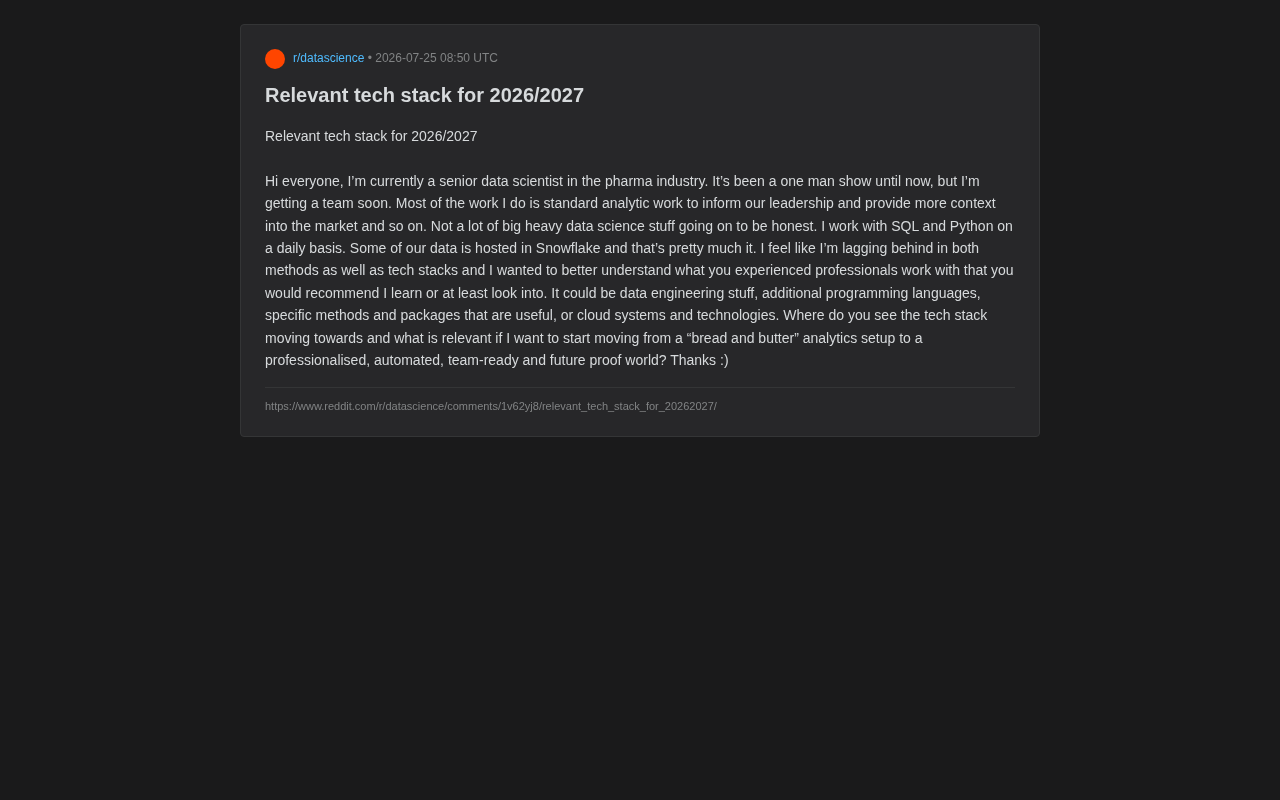
From Solo Analyst to Team Data Platform: A Practical Guide to Leveling Up Your Tech Stack
How should a data scientist upgrade their tech stack when transitioning from IC to team lead? A phased roadmap covering Git, dbt, Snowflake, modern data stack, and generative AI.
Read more →

·3 min
Beware of Cursor's Cheap Subscription Traps: Official Subscriptions Are the Right Way
Cursor Pro's cheap plans hide risks like account bans, dumbing down, device locks, and data leaks. This article dissects the three main scams and their real costs.
Read more →

·3 min
Agent Intent Recognition: Engineering Practices Behind the Three-Layer Funnel Architecture
An in-depth look at the three-layer funnel architecture for agent intent recognition: rules for fast interception, context for routine intents, and LLM as fallback. Exploring the engineering trade-offs of accuracy, latency, and cost.
Read more →

·3 min
Rust and Mojo Are Quietly Replacing Python's Low-Level Engine
Python tops the language rankings again, but AI teams are quietly swapping its internals for Rust and Mojo. A look at Python's speed and GIL pains, the two-language problem, and the rise of Rust tooling and Mojo on GPUs.
Read more →
Mindwalk: Replaying AI Coding Agent Be…
·4 min
Mindwalk: Replaying AI Coding Agent Behavior on a 3D Code Map
Mindwalk renders codebases as 3D maps, visually replaying the full operation trajectories of AI coding agents like Claude Code and Cursor. A deep dive into its core ideas, use cases, and the future of agent observability tools.
Read more →

·3 min
OpenAI Bets $600K on Rust: Why AI Giants Are Collectively Pivoting to Systems Programming
OpenAI joins the Rust Foundation as a Platinum Member with $600K. xAI and Anthropic are also building Rust infrastructure. Here's why AI giants are betting big on Rust.
Read more →

·7 min
Context Engineering: A Systematic Approach to Stop AI Agents from 'Talking Nonsense'
Context engineering is the core methodology for building efficient AI Agents, covering query enhancement, RAG retrieval, prompt design, memory management, and tool invocation. Master Write, Select, Compress, and Isolate to solve LLM hallucination at its root.
Read more →

·3 min
Connecting Zotero to AI via MCP: A Complete Zero-Cost Guide to Generating Real Literature Reviews
Connect your local Zotero library to AI via MCP protocol to eliminate hallucinated citations. Full guide covering UV, Zotero setup, and OpenCode with free DeepSeek.
Read more →

·3 min
AI Manga Series Production: A Complete Guide from Script to Storyboard
A complete guide to AI manga production: from scriptwriting to storyboard generation. Learn the universal formula, avoid common pitfalls, and launch your first episode.
Read more →

·3 min
OpenAI's First AI Hardware Revealed: A Screenless, Animated Emotional Companion Speaker
A Reddit leak suggests OpenAI's first hardware is a screenless, motorized AI companion speaker with a camera and personality-driven design. Deep-dive analysis.
Read more →

·3 min
Cherry Studio + MCP: A Practical Guide to Building AI Agents with Local Deployment
Learn how to build an automated AI agent using Cherry Studio, MCP protocol, and locally deployed models — covering DeepSeek integration, web scraping, and private knowledge base setup.
Read more →

·3 min
The Complete Guide to Looping Engineering: Building Efficient Agent Loops from Scratch
A deep dive into Looping Engineering — covering the five core loop elements (Trigger, Goal, Judgment, Feedback, Memory), when to use loops, and a step-by-step guide to building a topic-selection loop with Claude Code.
Read more →

·3 min
Four Paths for Frontend Engineers to Level Up in AI: From RAG to Vertical Agents
How can frontend engineers transition into AI development? This guide covers four agent development directions: RAG, workflow agents, vertical agents, and general-purpose agents — with framework picks like LangChain.js.
Read more →

·3 min
GPU Rental vs. Buying: How Low-Usage Teams Should Actually Do the Math
Should low-usage teams rent or buy GPUs? Based on real billing data, we break down hardware costs, electricity, and hidden time losses to help small teams decide.
Read more →

·3 min
Chain of Thought (CoT) Explained: Teaching AI to Reason Step by Step
A deep dive into Chain of Thought (CoT) prompting: from prompt construction to reasoning chain generation, revealing the three mechanisms behind AI's improved reasoning. Covers math, medical, and financial use cases.
Read more →
There's No Best Agent Framework — Only…
·2 min
There's No Best Agent Framework — Only the Right One for Your Needs: A Deep Comparison of Leading Options
LangGraph, PydanticAI, OpenAI Agents SDK, CrewAI — a senior developer's practical guide to choosing the right AI Agent framework for your project.
Read more →