#Deep Agent
3088 related articles

·2 min
ag-kit: A Deep Dive into the TypeScript-Based AI Agent Development Toolkit
An in-depth analysis of ag-kit, a TypeScript-based AI Agent development toolkit covering core architecture, modular design, use cases, and tech selection advice for full-stack developers.
Read more →

·2 min
Deep Dive into Agent Skills Architecture: How to Extend AI Agent Capabilities
Agent Skills is a lightweight open-source format that extends AI agent capabilities with plug-and-play skill packages. This article dives deep into the Skills architecture, progressive disclosure, and how it differs from Multi-Agent design.
Read more →

·2 min
DeepAgents in Practice: A Deep Dive into Sandbox Backends and Agent Skills
A deep dive into DeepAgents' sandbox backend and Agent Skills: why Agents need sandboxes to isolate code execution, how Skills enable modular capability reuse, and how the two work together to build reliable AI Agent systems.
Read more →

·2 min
DeepAgents in Practice: A Deep Dive into Sandbox Backends and Agent Skills
A deep dive into DeepAgents' sandbox backend and Agent Skills: why Agents need sandbox isolation to run code, how Skills enable modular capability reuse, and how the two combine to build reliable AI Agent systems.
Read more →

·2 min
Deep Dive into Agent Skills Architecture: How to Extend AI Agent Capabilities
Agent Skills is a lightweight open-source format that extends AI agent capabilities via plug-and-play skill packages. Learn its architecture, progressive disclosure, and how it differs from Multi-Agent.
Read more →

·2 min
Deep Dive into the OpenClaw Multi-Agent Framework: From Dify Workflows to Autonomous AI Execution
An in-depth analysis of the OpenClaw multi-agent framework: its TypeScript single-process gateway design, inter-agent scheduling, advantages over Dify workflows, and the three evolutions of AI execution.
Read more →
·3 min
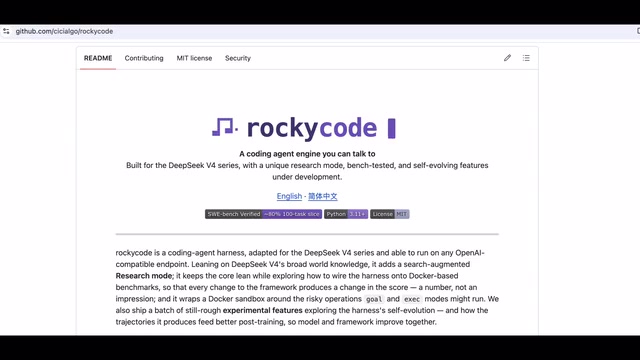
Rocky: An Open-Source Coding Agent with Minimal Architecture and Native DeepSeek Integration
Rocky is a minimal, transparent open-source coding agent with a core loop under a few hundred lines of Python, native DeepSeek search, Research mode, and built-in SWE benchmarking for reproducible agent experiments.
Read more →

·4 min
OpenAI Merges Codex and ChatGPT: Deep Dive into Three New Models + Agent Workflows
OpenAI merges Codex and ChatGPT into a unified platform while launching three new models: SOUL, TERRA, and LUNA. Deep dive into Computer Use, loop workflows, multi-threading, and the Agent Native strategy.
Read more →

·2 min
Voice AI Agent Architecture: Pipecat Flows vs Vapi Squad — A Deep Comparison
A deep comparison of Pipecat Flows and Vapi Squad for voice AI agent architecture — covering latency, accuracy, multi-agent handoffs, and when to use each.
Read more →

·3 min
Qwen 3.8 Open Source Incoming, DeepSeek Coding Agent, and the Latest in China's AI Ecosystem
Qwen 3.8 open source incoming, DeepSeek Resonics native coding agent debuts, Kimi pauses new subscriptions amid compute pressure, and Qiyimole shows domestic GPU interconnect solution at WAIC.
Read more →

·3 min
LangChain v1.3 Hands-On Tutorial: Deep Dive into Agents, RAG, and Local Model Deployment
Deep dive into LangChain v1.3: compare LangChain, LangGraph, and DeepAgent paradigms, explore RAG pipelines, multi-agent systems, and local LLM deployment for enterprise AI apps.
Read more →

·6 min
GPT-5.6 Hands-On Deep Dive: Three-Tier Models + Ultra Multi-Agent, Codex Fully Evolved
OpenAI launches GPT-5.6 with three tiered models—Sol, Terra, and Luna—Ultra multi-agent parallel collaboration, Codex integrated into ChatGPT desktop, and an upgraded Computer Use.
Read more →
Open Deep Research: A Complete Guide t…
·2 min
Open Deep Research: A Complete Guide to LangChain's Open-Source AI Research Agent
A deep dive into LangChain's open-source project open_deep_research: an AI deep research agent built on LangGraph, supporting flexible multi-model and multi-search tool configuration, with 12,000+ stars.
Read more →

·3 min
Coze Deep Dive: A Complete Guide to the Agent Building Platform vs. Dify
A deep dive into ByteDance's Coze platform: tool categories, positioning vs. Dify, skill store, multi-agent collaboration, and workflow building — your AI Agent selection guide.
Read more →
AstrBot: A Deep Dive into the Multi-Pl…
·2 min
AstrBot: A Deep Dive into the Multi-Platform AI Agent Development Framework
AstrBot is an open-source AI Agent framework supporting WeChat, QQ, Telegram and more, with multi-LLM compatibility and plugin extensibility. Full technical breakdown inside.
Read more →
jcode Deep Dive: Why Rust Is the Ideal…
·3 min
jcode Deep Dive: Why Rust Is the Ideal Foundation for a Coding Agent Framework
jcode is an open-source Coding Agent framework built in Rust, gaining nearly 200 GitHub Stars in a day. Explore its architecture, Rust advantages, and application potential.
Read more →

·2 min
How to Choose Long-Horizon AI Workflow Tools? A Deep Comparison and Decision Framework for Leading Agent Solutions
Why do chatbots fail at long-horizon workflows? We compare Manus, Perplexity Comet, Claude, ChatGPT and more across task type, total cost, and automation level.
Read more →

·4 min
Can AI Discover Alpha? A Deep Dive into Qlib and RD-Agent
Can AI truly discover Alpha automatically? This deep dive into Microsoft's open-source Qlib and RD-Agent reveals the 3 critical backtest pitfalls and 6 overfitting prevention gates every quant researcher needs to know.
Read more →

·3 min
OWASP Agentic Security Top 10 Deep Dive: Understanding ASI01–ASI10 Risks and Mitigations
A comprehensive breakdown of the OWASP Agentic Security Top 10 framework, covering ASI01–ASI10 risks including goal hijacking, tool misuse, identity abuse, supply chain vulnerabilities, and cascading failures — with practical mitigations for AI agent systems.
Read more →

·4 min
Pi Agent Deep Dive: Four Core Advantages of a Minimalist Open-Source Framework
Pi is a minimalist open-source Agent framework with just 4 default tools and under 1,000 tokens in its system prompt, with 70K GitHub stars. Deep dive into its 4 core advantages vs. Claude Code and Codex.
Read more →