#Explainable AI
64 related articles

·2 min
Vox's Science Podcast 'Unexplainable' Lands on Netflix: Visualizing the Great Unknowns of Science
Vox's science podcast 'Unexplainable' officially arrives on Netflix, with new episodes every Monday. It explores the unsolved mysteries at science's frontier.
Read more →

·4 min
What Is the True Nature of Large Language Models? A Super Compressor Analogy to Help You Fully Understand
Large models aren't search engines — they're more like super compressors. This article explains how LLMs compress data to learn semantic patterns, and explores the phenomenon of intelligent emergence.
Read more →

·4 min
What Is the True Nature of Large Language Models? A Super Compressor Analogy That Makes Everything Click
LLMs aren't search engines — they're more like super compressors. This article explains how large models compress corpora to learn semantic patterns, and explores the principles and limitations of emergent intelligence.
Read more →

·3 min
Record AI Lobbying Spending: How Tech Giants Are Shaping Washington's Policy Agenda
AI industry lobbying in Washington hits record highs as OpenAI, Google, Meta, and other giants spend heavily to shape legislation. A deep analysis of the forces, landscape, and policy implications.
Read more →

·3 min
The Jargon Trap: Why Engineers Can Never Seem to Speak Plain Language
Why do engineers struggle to communicate in plain language? Exploring the curse of knowledge, jargon as identity, and practical tips for clearer technical communication.
Read more →

·3 min
14-Byte AI Brain Takes on a Maze: Pushing the Intelligence Limits of Minimalist Neural Networks
A tiny 14-byte AI brain attempts to solve a 2D maze, exploring the limits of information compression and intelligence. Discover evolutionary algorithms, memory constraints, and the value of minimal AI.
Read more →

·3 min
Deepfake Detection Datasets: A Complete Guide to AI-Generated Faces, Face Swaps, and Real Face Public Resources
A systematic guide to public face datasets for deepfake detection research, covering FaceForensics++, Celeb-DF, FFHQ, and more, organized by AI-generated, deepfake, and real face categories.
Read more →
·3 min
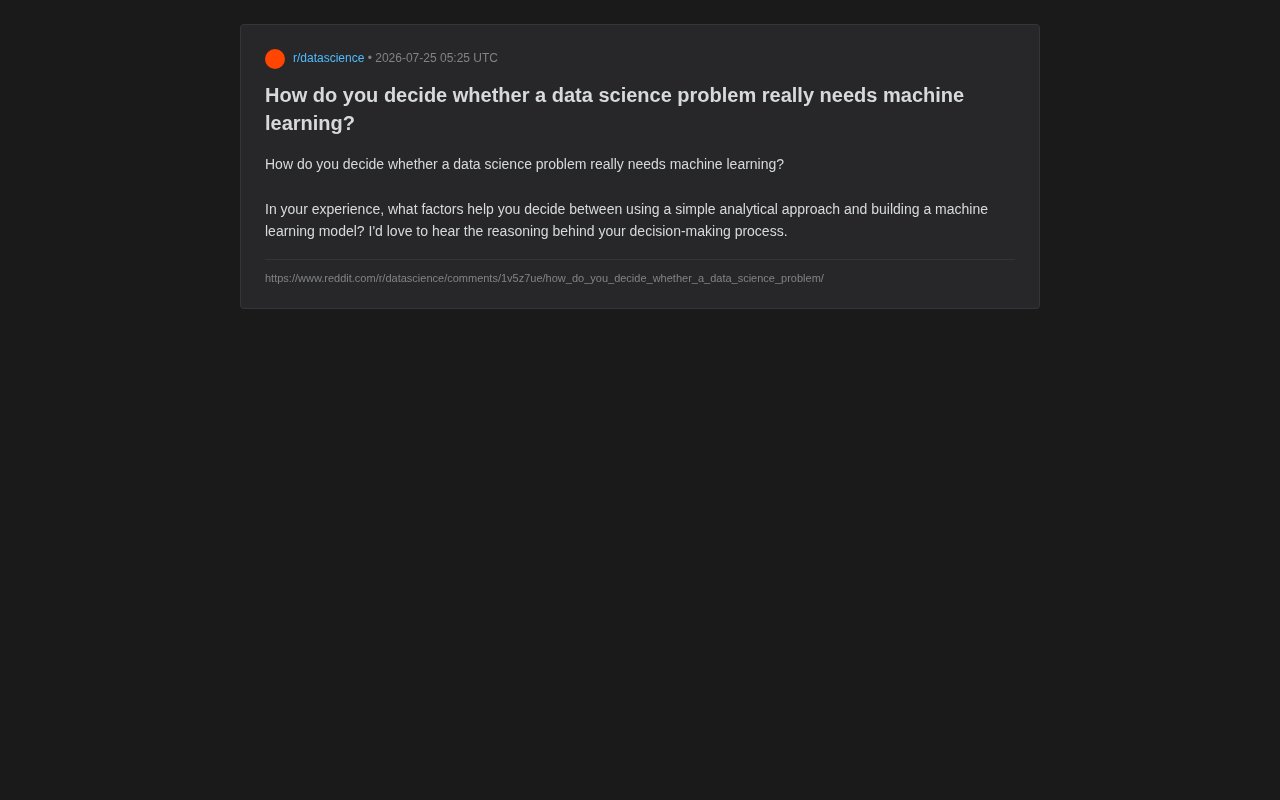
When Should You Use Machine Learning? A Pragmatic Decision Guide for Data Scientists
Not every data science problem needs ML. This guide offers a decision framework across four dimensions — rule complexity, data quality, prediction needs, and interpretability — to avoid over-engineering.
Read more →
ChatGPT Work Deep Dive: The Cloud-Loca…
·3 min
ChatGPT Work Deep Dive: The Cloud-Local Split and What It Means for Users
ChatGPT Work runs in the cloud on web/mobile but accesses local files on desktop — and they don't sync. A deep dive into the split design, UX tradeoffs, and broader AI agent challenges.
Read more →
Kronos Financial Foundation Model: Usi…
·7 min
Kronos Financial Foundation Model: Using AI to Read the Market Language of Candlesticks
Kronos is the first open-source foundation model treating candlestick data as the "language of financial markets," using an autoregressive Transformer and earning 32K GitHub Stars. A deep dive into its principles, applications, and limits.
Read more →

·7 min
The Complete Guide to LLM Application Engineer Interviews: Six High-Frequency Topics in the Agent Domain
A focused guide to the core interview topics for LLM application engineers, covering agent architecture, Multi-Agent, Langfuse evaluation & tracing, security, and RAG optimization.
Read more →
Human-Centered AI: Real-World Implemen…
·6 min
Human-Centered AI: Real-World Implementation in Healthcare and Design
An MSR workshop reveals the truth about AI deployment: from a $20 corneal diagnostic device to expert-in-the-loop chatbots, researchers share real-world experiences of AI in healthcare and design within resource-scarce environments.
Read more →

·7 min
From Chat to Agent Platform: A Practical Guide to Engineering AI Applications
A deep dive into engineering AI applications: from a simple chat page to a multi-layer Agent platform, covering RAG knowledge bases, Workflow scheduling, multi-model management, and run tracing.
Read more →

·4 min
Teaching AI to Have "Taste": Exploring Multi-Agent Design with Open-Source Skill Taste
Why does AI-generated UI all look the same? Designer SEN open-sourced a Skill called Taste that uses a four-agent pipeline to reverse-engineer website "taste" into verifiable design principles called Taste DNA.
Read more →

·4 min
How Engineers Can Avoid Becoming Mere Code Reviewers in the AI Era: Addy Osmani's Answer
Google's Addy Osmani at AI Engineer conference: as AI agents outpace human review, engineers' core value lies in the "verdict" — deciding what's worth building and owning outcomes.
Read more →

·2 min
nuReasoning: A Next-Generation Dataset for Visualizing Autonomous Driving Reasoning
nuReasoning is an autonomous driving dataset by Motional & UCLA with ~20K long-tail clips annotated for spatial, decision, and counterfactual reasoning, explorable via FiftyOne.
Read more →

·4 min
Cursor Designer: Why Software Must Retain Its Human Touch in the Age of AI Acceleration
Cursor designer Rio: AI compresses build loops dramatically, but risks flooding the world with mediocrity. From Glass UI principles to the migration of craft — why human agency, taste, and responsibility remain software's true core.
Read more →
"AI Is Just a Tool"? This Phrase Is Hi…
·3 min
"AI Is Just a Tool"? This Phrase Is Hiding a Dangerous Cognitive Trap
"AI is just a tool" sounds rational but conceals real dangers. This article dissects the limits of tool neutrality, design-embedded values, and misplaced responsibility in AI systems.
Read more →

·2 min
Revisiting SHRDLU: The Technical Lineage and Modern Value of Procedural Semantics
From SHRDLU to modern neuro-symbolic AI: explore procedural semantics, CCG grammars, semantic parsing, and interactive fiction engines in today's NLP landscape.
Read more →

·3 min
No-Code Research: Using AI Coding Tools to Complete the Full Machine Learning Pipeline
No coding skills? No problem. Learn how AI tools like Codex and Claude Code let researchers complete ML workflows — data cleaning, model training, visualization — using only natural language.
Read more →