#GPT 5.6
262 related articles
·3 分钟
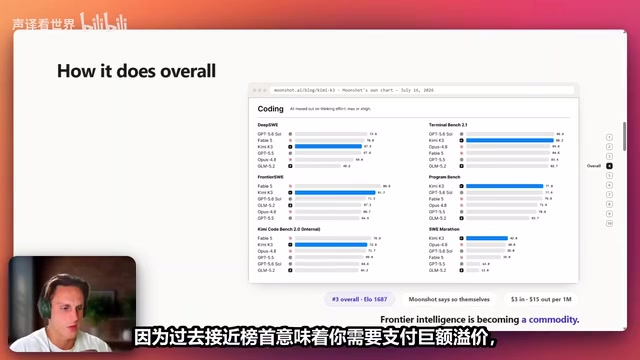
Kimi K3 Hands-On Tutorial: Claude Code Sub-Agent Configuration & GPT-5.6 Comparison Test
Complete guide to configuring Kimi K3 as a Claude Code sub-agent, including API setup, YFlow workflow building, and head-to-head comparison with GPT-5.6 and Claude Fable 5.
阅读全文 →

·2 分钟
GPT-5.6 Hands-On Review: Analyzing the Agent Capabilities Behind Its #1 Ranking on the Frontend Development Leaderboard
GPT-5.6 SoulX High tops the frontend dev leaderboard at 1636 points with Agent Arena rank #2. Hands-on tests of portfolio pages and mystery games reveal its task decomposition and self-correction capabilities.
阅读全文 →

·2 分钟
GPT-5.6 Free Trial Is a Scam: How to Spot AI Marketing Traps
Exposing the "GPT-5.6 free trial" scam circulating on social media. Learn about data risks of third-party AI mirror platforms and how to identify AI marketing traps.
阅读全文 →

·2 分钟
GPT-5.6 Free Trial Is a Scam: How to Spot AI Marketing Traps
Exposing the "GPT-5.6 free trial" scam on social platforms, analyzing data security risks of third-party AI mirror sites, and providing practical tips to identify AI marketing traps.
阅读全文 →

·4 分钟
GPT-5.6 Value Maxing Practical Guide: From Token Stacking to Output Optimization Methodology
Deep dive into OpenAI GPT-5.6 Value Maxing strategies covering Sol/Terra/Luna model selection, KV cache optimization, Prompt compression, and programmatic tool calling to help developers achieve more output with fewer Tokens.
阅读全文 →

·5 分钟
Running GPT-5.6 Inside Claude Code: Best Practices for Subagent Orchestration and System Prompts
Deep dive into running OpenAI GPT-5.6 inside Claude Code: comparing Codex vs Claude Code on subagent orchestration, workflow design, and system prompt quality, revealing how harness engineering determines model output.
阅读全文 →

·4 分钟
Fable 5 vs GPT-5.6: An In-Depth Head-to-Head Comparison of Two Top-Tier Coding Models
In-depth comparison of Fable 5 vs GPT-5.6 (Sol) for AI coding. Real-world data on token efficiency, code quality, design capability, and cost from $10K+ testing.
阅读全文 →

·4 分钟
Fable 5 vs GPT-5.6: An In-Depth Head-to-Head Comparison of Two Top-Tier Coding Models
In-depth comparison of Fable 5 vs GPT-5.6 (Sol) for AI coding. Covering token efficiency, code quality, design, cost, and safety based on $10K+ real usage data.
阅读全文 →

·2 分钟
GPT-5.6 Goes Live with Dual Quota Reset as AI Models Update Rapidly
GPT-5.6 fully launches with enhanced coding, computer operation, and long-horizon agent tasks, plus a dual quota reset. Meanwhile, ByteDance opens its C-Dance 2.5 API and Mistral debuts a single-RGB-camera natural language navigation model.
阅读全文 →

·3 分钟
GPT-5.6 Requires Government Approval: AI Regulation Enters Uncharted Waters
OpenAI released GPT-5.6 but it requires case-by-case government approval, while Claude Mythos was pulled after breaching classified systems. A full breakdown of AI capabilities hitting national security red lines.
阅读全文 →

·3 分钟
GPT-5.6 Requires Government Approval: AI Regulation Enters Deep Waters
OpenAI's GPT-5.6 requires case-by-case government approval, and Claude Mythos was pulled after breaching classified systems. A full breakdown of frontier AI hitting the national security red line.
阅读全文 →

·2 分钟
Why Does GPT-5.6 Perform Better in Claude Code Than in Codex? A Deep Dive
Tech blogger Theo found GPT-5.6 runs better in Claude Code than in OpenAI's own Codex. A deep dive into their differences in system prompt quality and subagent orchestration.
阅读全文 →
·2 分钟
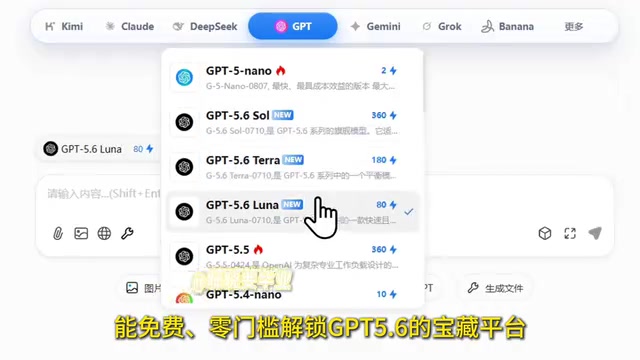
Beware of AI Aggregator Scams: The Truth Behind Fake Models Like "GPT 5.6"
Fake AI platforms claim to offer "GPT 5.6" and "Claude 5" — models that don't exist. Learn the real risks: data theft, scams, and how to safely use AI tools.
阅读全文 →

·3 分钟
OpenAI Releases GPT-5.6 and ChatGPT Work: The Era of Autonomous AI Has Arrived
OpenAI launches GPT-5.6 (Sol, Terra, Luna), ChatGPT Work, a new desktop app, and Sites hosting. AI evolves from a Q&A tool into an autonomous work partner for finance, file management, and more.
阅读全文 →

·6 分钟
The AI Industrial Age Arrives: Compute Wars, Chip Reconstruction, and the GPT-5.6 Cheating Scandal Explained
Five key AI industry trends: Doubao surpasses 180 trillion daily calls, OpenAI's in-house AI chip, NVIDIA's $3-4 trillion compute forecast, China catching up, and the GPT-5.6 cheating scandal.
阅读全文 →

·2 分钟
GPT-5.6 Three-Model Showdown: Sol vs Terra vs Luna — Which One Should You Pick?
OpenAI GPT-5.6 launches Sol, Terra, and Luna simultaneously. We compare benchmarks and real-world coding tests to help you choose the right model for your needs.
阅读全文 →

·3 分钟
GPT-5.6 Released: How Multi-Agent Workflows Are Ending the Chat Box Era
OpenAI releases GPT-5.6 with Sol, Terra, and Luna models plus ChatGPT Work execution environment, shifting AI from chatbots to autonomous multi-agent workflows that directly operate local files and business systems.
阅读全文 →

·2 分钟
GPT-5.6 Sol Tops Frontend Leaderboard · Claude Code Gets Built-in Browser · 50-Year Math Conjecture Solved
GPT-5.6 Sol tops Chatbot Arena's frontend leaderboard, Claude Code gains a built-in browser, Sol Ultra proves a 50-year math conjecture, and Gemma 4 gets 5x faster.
阅读全文 →

·6 分钟
GPT-5.6 Hands-On Deep Dive: Three-Tier Models + Ultra Multi-Agent, Codex Fully Evolved
OpenAI launches GPT-5.6 with three tiered models—Sol, Terra, and Luna—Ultra multi-agent parallel collaboration, Codex integrated into ChatGPT desktop, and an upgraded Computer Use.
阅读全文 →

·4 分钟
Codex Major Upgrade: GPT-5.6 Powers Full-Stack Development from Idea to Deployment
OpenAI Codex gets a major upgrade with GPT-5.6: extended reasoning, multi-agent parallelism, browser control, one-click Sites deployment, task orchestration, and mobile dev support.
阅读全文 →