#MoE architecture
387 related articles

·2 min
MiniMax M3 Local Deployment: 23B Active Parameters ≠ 23GB VRAM — A Complete Guide to MoE Architecture
MiniMax M3 is a 428B MoE model. Its 23B active parameters reflect per-token compute, not VRAM needs. Learn the MoE trade-offs, quantization options, and deployment paths to avoid the most common misconception.
Read more →

·2 min
15-Year-Old Trains 200M MoE Language Model from Scratch: Full Architecture & Hands-On Breakdown
A 15-year-old trained Tiny-MoE, a 200M-parameter MoE language model from scratch using free Kaggle GPUs, featuring MLA attention, RoPE+YaRN, and native PyTorch.
Read more →

·2 min
Tencent Hunyuan V3 Open-Sourced: Full Breakdown of the 295B MoE Architecture — 256K Context Is Its Biggest Weakness
Tencent open-sources Hunyuan V3: 295B MoE model with 21B active params, claims to beat DeepSeek-V4-Pro. Supports FP8, vLLM/SGLang — but 256K context and no multimodal are key drawbacks.
Read more →
 Tech Frontiers
·2 min
Kimi K2.5 Fully Open-Sourced: Deep Dive into 1T Parameter MoE Architecture + Agent Cluster Capabilities
Deep dive into Moonshot AI's fully open-sourced Kimi K2.5: 1T parameter MoE architecture, Vision-to-Code capabilities, and 100-Agent parallel cluster system topping open-source benchmarks.
Read more →

·3 min
Poolside Laguna Model Launch: Can Silicon Valley's Open-Source Push Catch Up to China's AI?
Poolside launches Laguna open-weight model after 18 months of silence, pitting 118B parameters against Kimi K3's 2.8 trillion. Can Silicon Valley's open-source push close the gap with Chinese AI?
Read more →

·3 min
Claude Opus 5 Officially Released: Performance Approaching the Top Tier as the Open-Weight Debate Heats Up Again
Anthropic releases Claude Opus 5 with near-frontier performance at lower prices. Same day, Jensen Huang co-signs open-weight letter with 20+ companies while DeepSeek fundraising rumors surface.
Read more →

·3 min
Kimi K3 Launch: Performance Rivaling Claude at One-Third the Price, US-China AI Gap Narrows to 3 Months
Moonshot AI launches Kimi K3 reasoning model with performance rivaling Claude and OpenAI's top models at one-third the price. The US-China AI gap narrows from 6-12 months to just 3 months.
Read more →

·3 min
DeepSeek Ignites Open Source vs. Closed Source Debate in Silicon Valley, Splitting Tech Giants into Rival Camps
DeepSeek's open source model shakes Silicon Valley. OpenAI defends closed source while Microsoft, NVIDIA, and Meta back open ecosystems. Analysis of the AI open/closed source debate, Apple-Micron chip tensions, and AI-driven historical disinformation.
Read more →

·3 min
Open Source vs. Closed Source: Who Will Win the US-China AI Battle?
Chinese open-source models DeepSeek and Kimi K3 are challenging OpenAI's closed-source dominance. Analyzing the business logic, chip ecosystems, and US-China strategic dynamics behind the open vs. closed AI debate.
Read more →

·3 min
Fields Medal Winner Joins OpenAI: A Triple Signal of Talent, Capital, and Capability
Fields Medal winner Jacob Tsimerman joins OpenAI's safety team on award day, declaring math careers won't survive. Meanwhile, NVIDIA finances a $250B data center and Kimi K3 open-sources 2.8T parameters.
Read more →

·3 min
Fields Medal Winner Joins OpenAI: A Triple Signal of Talent, Capital, and Capability
Fields Medal winner Jacob Tsimerman joins OpenAI's safety team on award day, saying math careers won't survive. NVIDIA finances a $250B data center. Kimi K3 opens a 2.8T-parameter model.
Read more →
·3 min
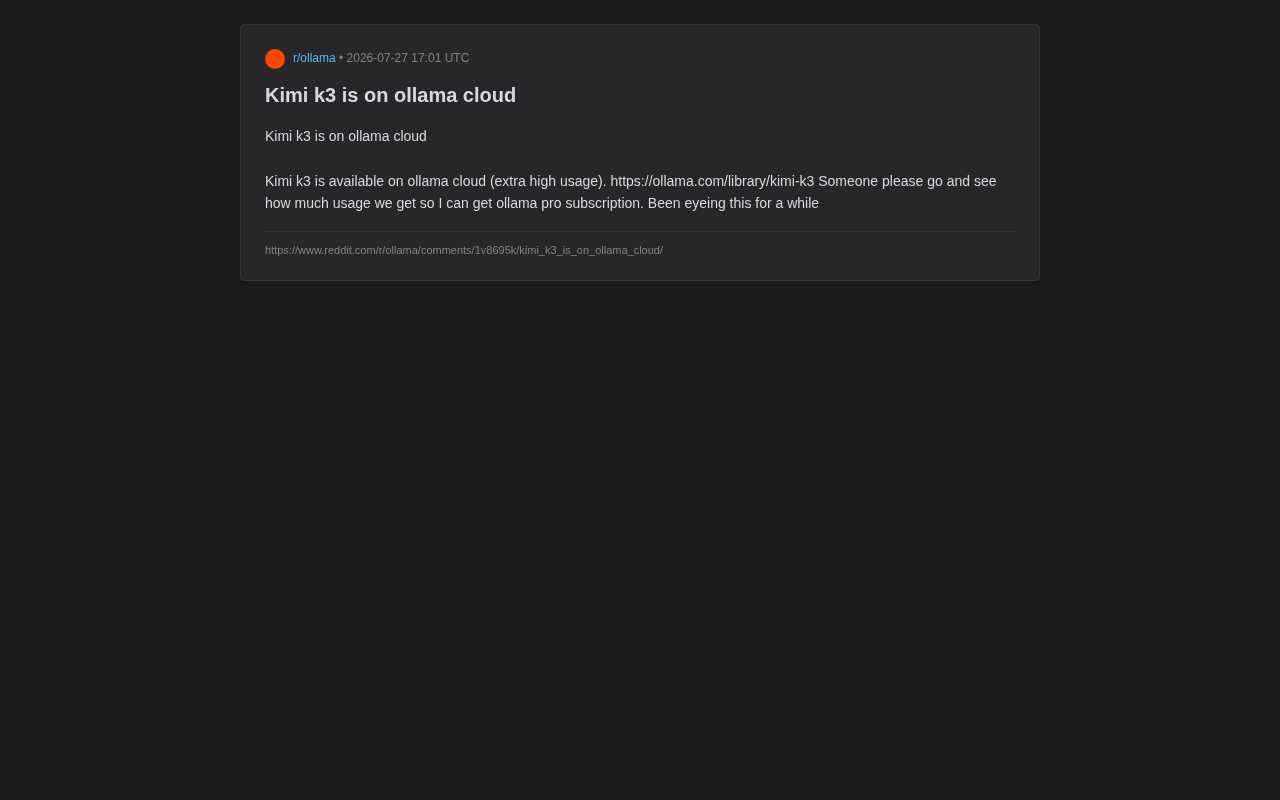
Kimi K3 Launches on Ollama Cloud: Free Tier, User Experience, and Developer Guide
Kimi K3 officially launches on Ollama Cloud as an "extra high usage" model. This guide covers free tier quotas, cloud inference experience, technical advantages, and how developers can seamlessly call this high-performance LLM.
Read more →

·2 min
DeepSeek V4 Official Release Imminent: What 1.6 Trillion Parameters Really Means
DeepSeek V4 official release is imminent. V4 Pro features 1.6 trillion parameters with million-character context. Explore the D-SPARK acceleration framework, dynamic pricing, and V4's leap to production-grade AI.
Read more →

·3 min
Poolside Laguna Model Release: Can Silicon Valley Open Source Catch Up with Chinese AI?
Poolside releases its Laguna open-weight model after 18 months of silence, challenging Moonshot's Kimi K3 with 118B vs 2.8T parameters. Can Silicon Valley close the gap with Chinese AI?
Read more →

·3 min
Ollama Prepares for Trillion-Parameter Open-Source Models as the Open-Source Ecosystem Heats Up
Ollama scales up for trillion-parameter open-source models like Kimi K3 and Qwen 3.8. Hugging Face demands $100M from OpenAI, Alibaba Coder goes mobile, and DeepSeek pauses fundraising.
Read more →

·4 min
The Dao of DeepSeek: Liang Wenfeng on Vision, Restraint, and the Philosophy of Open Source
Analysis of DeepSeek founder Liang Wenfeng's rare investor dialogue, exploring the company's vision-driven culture, strategic restraint toward AGI, and open-source philosophy in the US-China AI race.
Read more →

·5 min
Will Chinese Open-Source Models Burst the US AI Bubble? A Deep Dive into the Transmission Chain
Chinese open-source models like Kimi K3 and DeepSeek approach US closed-source performance at a fraction of the cost. This deep dive analyzes the transmission chain from price competition to valuation reassessment.
Read more →

·2 min
Jensen Huang Champions Open-Source AI: Distillation Is Not Plagiarism, DeepSeek and Kimi Are Excellent
NVIDIA CEO Jensen Huang defends open-source AI, calls distillation legitimate learning, praises DeepSeek and Kimi, and co-signs open letter with 20+ companies while OpenAI and Google stay silent.
Read more →

·4 min
Chinese AI Accounts for 58% of US Compute Consumption: How Open-Source LLMs Are Disrupting Silicon Valley
OpenRouter data shows Chinese AI models now account for 58% of US AI consumption. Silicon Valley giants like DoorDash and Airbnb adopt Kimi, DeepSeek, and Qwen for their low cost and open-weight advantages.
Read more →
·4 min
Chinese AI Accounts for 58% of US Compute Consumption: How Open-Source LLMs Are Disrupting Silicon Valley
OpenRouter data shows Chinese AI models now account for 58% of US AI consumption. Silicon Valley giants like DoorDash and Airbnb adopt Kimi, DeepSeek, and Qwen, leveraging low cost, high performance, and open weights.
Read more →