#P100 GPU
620 related articles

·3 min
V100 GPU Showdown: 4×16G PCIe vs. 2×32G SXM — Which Gives You More Bang for Your Buck?
Benchmarking 4×V100 16G PCIe vs. 2×V100 32G SXM adapter for local LLM inference. Prefill speed, decode speed, power limits, and bandwidth bottlenecks analyzed.
Read more →

·2 min
On-Device LLMs, Custom Silicon, and 100K-GPU Clusters: AI Industry Enters Full-Spectrum Competition
Apple's 1-bit compression fits 27B models on iPhone, Meta builds custom chip Iris, China's 100K-GPU cluster goes live, Samsung enters AI PC — a deep dive into AI's new full-spectrum competition.
Read more →

·3 min
A 9B Model Beats Frontier LLMs After Just $500 in RL Fine-Tuning
Just $500 in RL fine-tuning enables a 9B open-source model to outperform frontier LLMs on catalog review tasks. Analysis of when small-model RL works and its enterprise implications.
Read more →

·3 min
Apple Silicon LLM Inference Speed Benchmarks: A Complete Guide to Local Large Model Performance on Mac
In-depth analysis of Apple Silicon local LLM inference speed benchmarks covering M-series memory bandwidth, model quantization, MLX framework optimization, and Mac configuration guidance.
Read more →

·3 min
Monocular RGB Human Mesh Reconstruction: Real-Time Motion Capture at 18 FPS with Rust + CUDA
A deep dive into a real-time 3D human mesh reconstruction project using a single RGB camera, built with Rust, Candle, and CUDA, achieving 55ms/frame on an RTX 5080.
Read more →

·3 min
Monocular RGB Human Mesh Reconstruction: Real-Time Motion Capture at 18 FPS with Rust + CUDA
Deep dive into a real-time 3D human mesh reconstruction project using a single RGB camera, built with Rust, Candle, and CUDA, achieving 55ms/frame on RTX 5080. Exploring its architecture, Metal porting plans, and applications in VTuber, AR/VR, and sports analysis.
Read more →

·3 min
AMD CDNA5 Architecture Deep Dive: Technical Evolution and the AI Computing Competition Landscape
Deep analysis of AMD's CDNA5 architecture covering Chiplet packaging upgrades, HBM memory evolution, and low-precision compute optimization, examining how AMD challenges NVIDIA's AI chip dominance.
Read more →
·3 min
The Open-Weights Model Debate: Balancing Safety and Openness
An in-depth analysis of the open-weights model debate: public release brings transparency and innovation, but raises safety and misuse risks. Exploring tiered release, red-teaming, and governance challenges.
Read more →
·3 min
The Open-Weights Model Debate: Balancing Safety and Openness
An in-depth analysis of the open-weights model debate: publicly releasing model weights enables transparency and innovation but raises safety risks. Explores tiered release, red-teaming, and the industry dynamics behind open AI governance.
Read more →

·3 min
From RAG to Agent Tuning: A Complete Guide to Deploying LLM Agents
A deep dive into LLM Agent frameworks covering RAG, Agent core components (tools, memory, planning), and Agent Tuning workflows with cost considerations for production deployment.
Read more →

·3 min
Chinese Open-Source AI Conquers Silicon Valley: The Industry Upheaval Behind a 58% Compute Share
Chinese open-source AI models surged from under 10% to 58% of U.S. AI consumption. Kimi K3, DeepSeek, and Qwen are reshaping AI cost structures as DoorDash, Airbnb, and other Silicon Valley giants adopt them at scale.
Read more →

·3 min
Fields Medal Winner Joins OpenAI: A Triple Signal of Talent, Capital, and Capability
Fields Medal winner Jacob Tsimerman joins OpenAI's safety team on award day, saying math careers won't survive. NVIDIA finances a $250B data center. Kimi K3 opens a 2.8T-parameter model.
Read more →

·3 min
Fields Medal Winner Joins OpenAI: A Triple Signal of Talent, Capital, and Capability
Fields Medal winner Jacob Tsimerman joins OpenAI's safety team on award day, declaring math careers won't survive. Meanwhile, NVIDIA finances a $250B data center and Kimi K3 open-sources 2.8T parameters.
Read more →

·3 min
After 6 Billion Tokens, Here's What I've Learned About AI Agents
A power user who consumed over 6 billion Tokens shares real insights on AI Agents, exploring spending money, investing time, and managing life changes with AI.
Read more →

·3 min
How to Fix AI Tool Error 1076? Root Cause Analysis and Solutions
Getting "Something went wrong 1076" from an AI service? This article analyzes common causes including server overload and session issues, with practical troubleshooting steps to restore normal usage.
Read more →

·3 min
The Circular Investment Concerns Behind NVIDIA's $750 Billion in Deals
Deep analysis of circular financing in NVIDIA's $750B partnership deals, examining real AI compute demand, self-reinforcing valuations, and key investor signals.
Read more →
·3 min
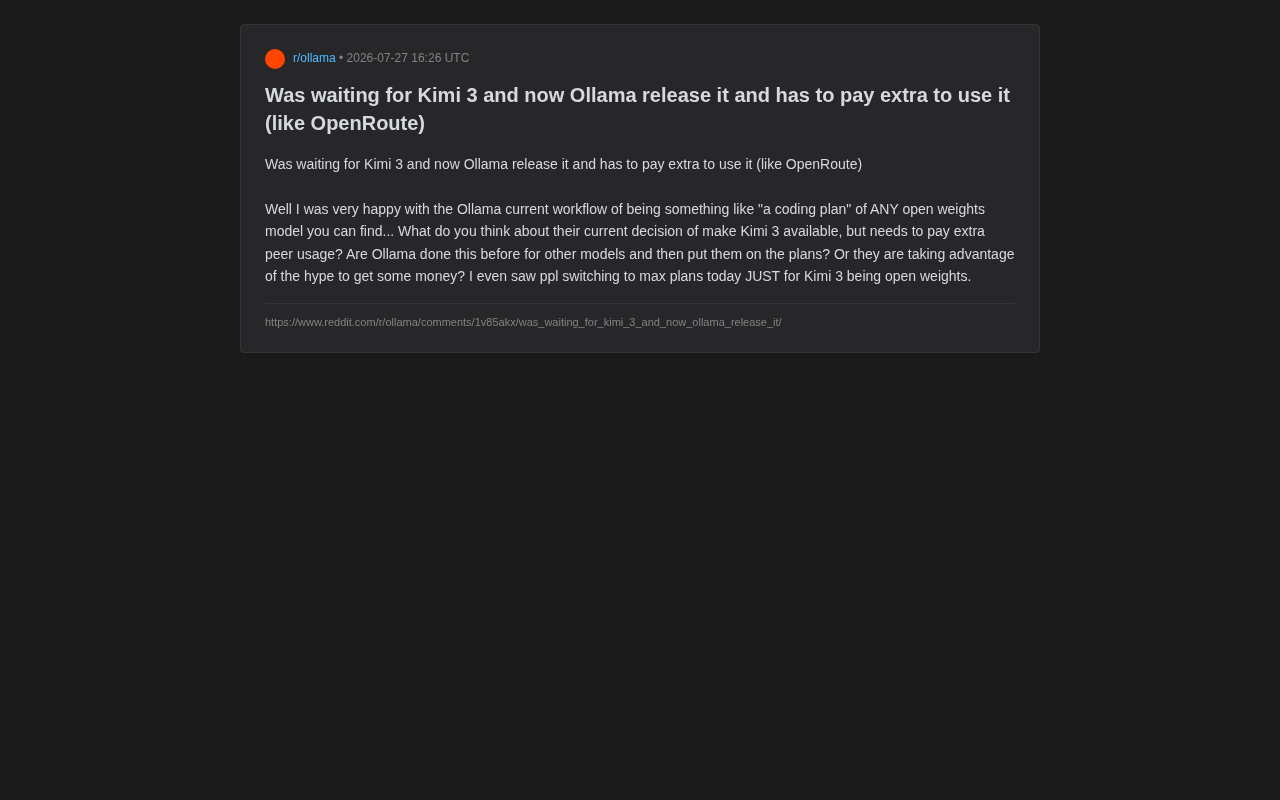
Ollama's Extra Charges for Kimi 3 Spark Community Controversy: Should Open-Source Models Be Free to Use?
Ollama lists Kimi 3 with extra pay-per-use fees, breaking subscription expectations and sparking debate over open-weight models and AI service pricing tiers.
Read more →

·3 min
Is Ollama Pro Worth It? An In-Depth Comparison of the $20 Subscription vs. API Costs
In-depth analysis of Ollama Pro's $20/month subscription value, comparing usage quotas, equivalent API costs, and ZDR privacy policy to help developers decide if it's worth it.
Read more →

·3 min
Self-Hosting Hardware Upgrade Guide: From an Old NUC to a Game Server and Beyond
A detailed guide to self-hosting hardware upgrades: analyzing NUC bottlenecks, comparing used enterprise Mini PCs and ITX builds for Jellyfin, Immich, and Minecraft servers.
Read more →

·3 min
Self-Hosting Hardware Upgrade Guide: From an Old NUC to a Game Server and Beyond
A detailed guide to self-hosting hardware upgrades: analyzing NUC performance bottlenecks, comparing used enterprise Mini PCs and custom ITX builds for Jellyfin, Immich, and Minecraft servers.
Read more →