#agentic loop
350 related articles

·2 min
Agent Loop Explained: Core Principles and Implementation of the Agentic Cycle
A deep dive into the Agent Loop: how agents autonomously cycle through think→act→think, the difference from regular LLMs, ReAct paradigm origins, and how to implement one from a while loop.
Read more →
Agentic Loop Explained: The Three-Loop…
·2 min
Agentic Loop Explained: The Three-Loop Architecture of Reasoning, Tool Use, and Orchestration
A deep dive into the Agentic Loop — breaking down the three-layer architecture of reasoning, tool use, and orchestration to help developers build and debug reliable AI agent systems.
Read more →
·1 min
Agentic Coding in Practice: Test Feedback Loops, LLM Benchmarks, and an Engineering Adoption Guide
An in-depth look at agentic coding: how test-driven loops enable AI self-correction, the real limits of LLM benchmarks, and key engineering lessons on context management and human-AI collaboration.
Read more →
 Tech Frontiers
·1 min
SGLang Hosts Agent Loops Office Hour, Focusing on Agentic Loop Architecture Optimization
SGLang team hosts an Agent Loops Office Hour exploring inference optimization for agentic loops, covering KV Cache reuse, low-latency multi-turn dialogue, and tool calling techniques.
Read more →

·2 min
A Beginner's Guide to Vibe Coding: Building Your Career Moat with AI Programming
A detailed guide to Vibe Coding with AI programming tools like Claude Code, Cursor, and Codex. Learn how to leverage AI-driven development to ship products independently and build lasting career value.
Read more →

·3 min
How AI Agents Are Reshaping Enterprise Work: From Task Automation to Organizational Restructuring
Explore how AI agents are redefining enterprise work—from applied AI partnerships and multi-agent collaboration to structural workflow redesign and organizational transformation.
Read more →

·2 min
ChatGPT Voice Upgrade: Driving Complete Workflows Through Natural Conversation
OpenAI demos ChatGPT voice on desktop driving full workflows — blog drafting, code debugging, and team collaboration through natural conversation.
Read more →

·3 min
From Frontend to Agent Development: A Complete 6-Week Systematic Learning Path
A 6-week systematic learning path for frontend engineers transitioning to AI Agent development, covering core architecture, ReAct, multi-agent collaboration, RAG integration, and deployment.
Read more →
·2 min
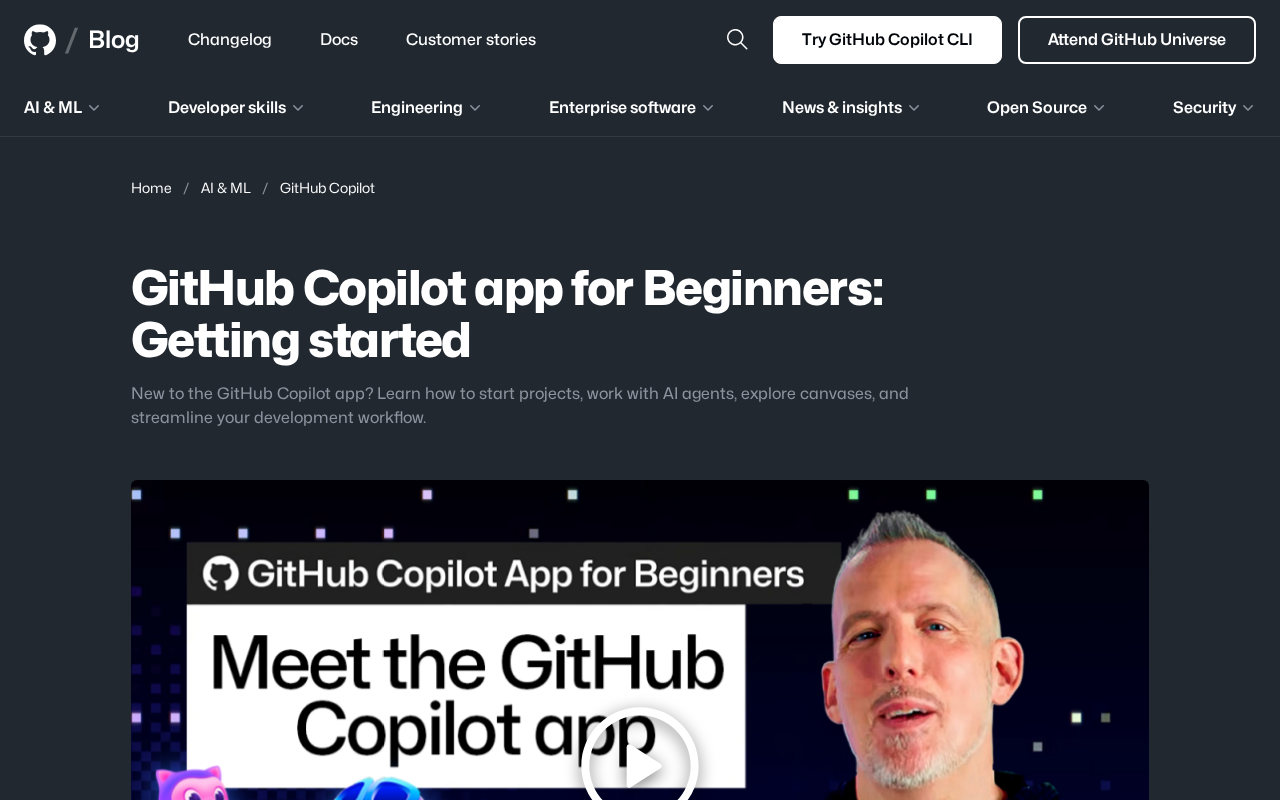
GitHub Copilot App Beginner's Guide: Mastering AI-Assisted Development from Scratch
A detailed guide to the GitHub Copilot standalone app's core features including project creation, AI agent collaboration, and canvases to help developers get started with AI-assisted development.
Read more →

·4 min
Choosing the Wrong Agent Ruins Everything: Why the Same Model Can Perform Like Two Completely Different AIs
The same LLM API performs drastically differently under different Agent frameworks. Through a real database crash case, this article analyzes why choosing the right Agent matters more than switching models.
Read more →
·2 min
Getting Started with GitHub Copilot App: A Beginner's Guide to AI-Assisted Development
A detailed guide to GitHub Copilot's standalone app covering project creation, AI agent collaboration, canvas features, and tips to help developers get started with AI-assisted development.
Read more →

·3 min
GitHub Agentic Workflows in Practice: Automating Cross-Repository Documentation Updates
Learn how GitHub Agentic Workflows automate cross-repo documentation updates. See the Aspire team's AI-driven approach: event triggers, smart drafting, and SME review to keep docs in sync with code.
Read more →

·3 min
Build RAG and AI Agent Projects at Zero Cost: A Practical Guide to Open-Source Tools
Build high-quality AI projects on a budget. Learn how to use Ollama, Groq, Chroma, and other free open-source tools to build RAG systems and multi-Agent workflows from scratch.
Read more →
·3 min
Build RAG and AI Agent Projects at Zero Cost: A Practical Guide to Open-Source Tools
Build high-quality AI projects on a budget. Learn how to use Ollama, Groq, Chroma, and other free open-source tools to build RAG systems and multi-Agent workflows from scratch.
Read more →

·4 min
AI Coding Tools in Practice: Which Ones Actually Stuck with the Team?
A 12-person product team shares real-world experiences with Cursor, Codex, Claude Code, and CodeRabbit—exploring efficiency plateaus, scenario matching, and selection criteria for AI coding tools that actually stick.
Read more →

·4 min
Claude Code from Scratch: A Complete Guide from Installation to Enterprise-Grade Development
A complete guide to Claude Code from beginner to enterprise practice: covering CLI installation, connecting domestic LLMs via CC Switch, basic commands, Git workflow integration, automated bug fixing, and engineering capabilities like MCP and SubAgents.
Read more →

·4 min
Spring AI 2.0: Five Key Updates Explained — Marching Toward the Age of AI Agents
Spring AI 2.0 brings five core updates: mandatory upgrade to Spring Boot 4, Tools parsing moving up, a built-in Agentic mechanism, MCP switching to Streamable HTTP, and an on-demand tool Advisor.
Read more →

·4 min
Spring AI 2.0: Five Key Updates Explained — Stepping into the Agent Era
Spring AI 2.0 brings five core updates: mandatory upgrade to Spring Boot 4, lifted Tools parsing, built-in Agentic mechanism, MCP switch to Streamable HTTP, and an on-demand tool-loading Advisor.
Read more →

·4 min
Spring AI 2.0 Explained: Five Key Updates Ushering in the Age of AI Agents
Spring AI 2.0 brings five core updates: mandatory Spring Boot 4 upgrade, Tools parsing moved up, built-in Agentic mechanism, MCP switch to Streamable HTTP, and on-demand tool-loading Advisor.
Read more →

·2 min
RingCentral Hackathon: Agentic AI Innovation in Practice
The RingCentral China Hackathon, themed on Agentic AI, gathered top engineering teams. This article explores agent AI's evolution, champion team Stargate, and China's developer culture.
Read more →