#nuanced AI assessment
18 related articles
·3 min
The Open-Weights Model Debate: Balancing Safety and Openness
An in-depth analysis of the open-weights model debate: public release brings transparency and innovation, but raises safety and misuse risks. Exploring tiered release, red-teaming, and governance challenges.
Read more →
·3 min
The Open-Weights Model Debate: Balancing Safety and Openness
An in-depth analysis of the open-weights model debate: publicly releasing model weights enables transparency and innovation but raises safety risks. Explores tiered release, red-teaming, and the industry dynamics behind open AI governance.
Read more →
·3 min
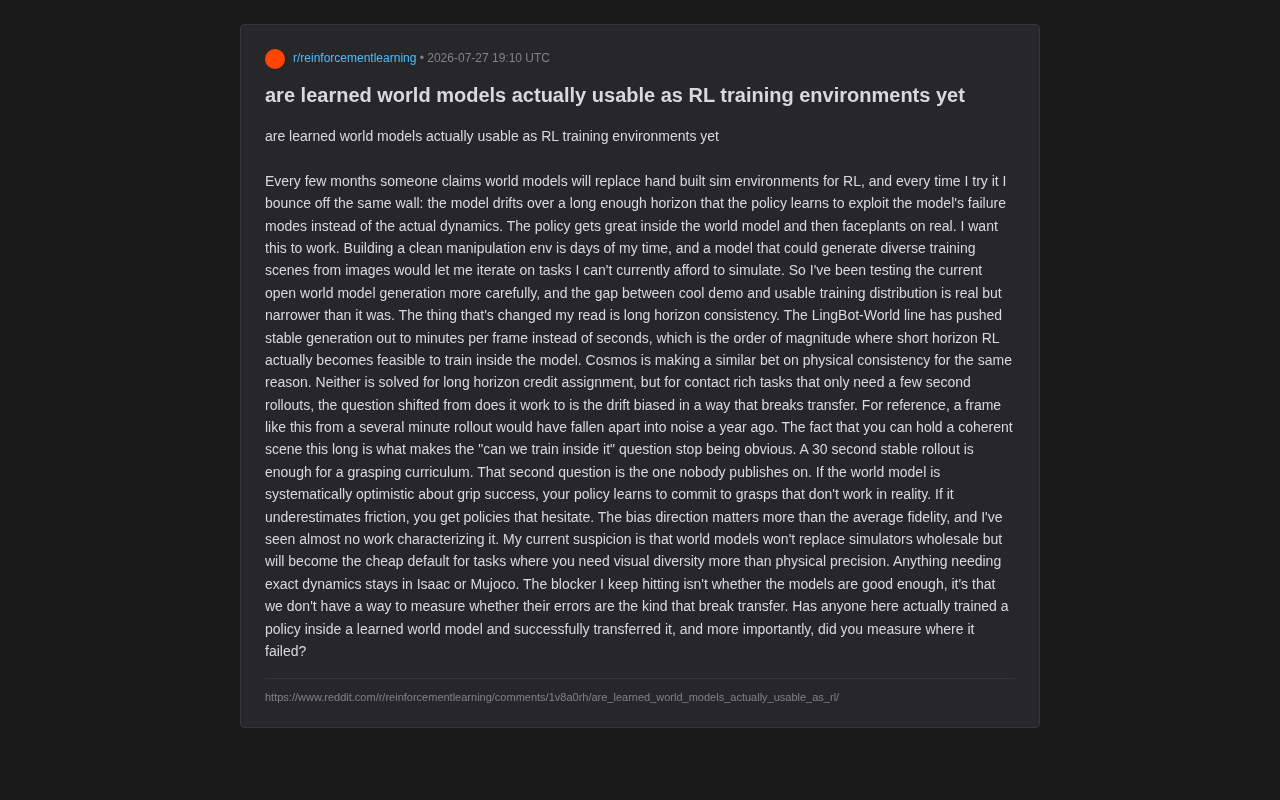
Can World Models Replace RL Training Environments? The Key Lies in the Direction of Error Bias
Analysis of world models as RL training environments: long-horizon consistency progress, how systematic error bias poisons policy transfer, and the emerging division of labor with traditional simulators.
Read more →

·4 min
Remote Surgery at 199ms Latency? What Network Latency Really Means Across Different Scenarios
Gamers struggle above 50ms, yet remote surgery works safely at 199ms latency. This article explains why, covering jitter stability, motion prediction algorithms, and dedicated medical networks.
Read more →

·5 min
Liang Wenfeng's In-Depth Confession: DeepSeek's Philosophy of Restraint, Open-Source Strategy, and AGI Roadmap
DeepSeek founder Liang Wenfeng systematically explains: a KPI-free culture, 10-month break-even pricing, long-term open-source strategy, continual learning to break the AGI bottleneck, and his prediction of a mature domestic chip ecosystem within a year.
Read more →
"AI Is Just a Tool"? This Phrase Is Hi…
·3 min
"AI Is Just a Tool"? This Phrase Is Hiding a Dangerous Cognitive Trap
"AI is just a tool" sounds rational but conceals real dangers. This article dissects the limits of tool neutrality, design-embedded values, and misplaced responsibility in AI systems.
Read more →

·3 min
Zero Brand Loyalty Among AI Users: They'll Use Whoever Gets the Job Done
Reddit discussions reveal a new AI user mindset: no brand loyalty, no ideological allegiance — just results. Explore how over-refusal, API standardization, and composable tool strategies are reshaping the AI market.
Read more →

·2 min
Getting Started with Codex: A Practical Guide to OpenAI's AI Coding Assistant
A practical guide to OpenAI Codex: core features, Codex vs. Claude Code comparison, and why the Codex+DeepSeek combo doesn't work. Avoid common pitfalls and boost your coding productivity.
Read more →

·3 min
The Complete Guide to Looping Engineering: Building Efficient Agent Loops from Scratch
A deep dive into Looping Engineering — covering the five core loop elements (Trigger, Goal, Judgment, Feedback, Memory), when to use loops, and a step-by-step guide to building a topic-selection loop with Claude Code.
Read more →

·4 min
Super El Niño Warning: How Extreme Climate Is Reshaping Our Future
A "Godzilla-class" super El Niño is brewing in the Pacific, and scientists warn it could set records for pushing up global temperatures. A deep look at how El Niño works, its uneven global impacts, climate policy gridlock, and the surprising hope from the green energy transition.
Read more →

·4 min
Hands-On Test of GPT Real-Time Voice: A Comprehensive Review of Dialect Recognition, Emotional Expression, and Role-Play
An in-depth hands-on test of GPT's real-time voice feature, covering Cantonese and Sichuanese dialect recognition, emotional tone switching, complex role-play, and cross-voice contextual memory—objectively presenting the true level and remaining gaps of AI voice interaction.
Read more →

·5 min
Agent Skills Specification: Standardization and Reusability Practices for AI Agent Capabilities
The agentskills open-source project aims to solve AI Agent ecosystem fragmentation through standardized skill specifications enabling portable, composable, and reusable agent capabilities.
Read more →

·5 min
Anthropic Updates Cybersecurity Safeguards: How AI Safety Governance Balances Security and Usability
Anthropic updates AI cybersecurity safeguards after U.S. government dialogue. New measures slightly raise false positive rates, with flagged requests downgraded to Opus 4.8 responses. Deep analysis of the security-usability balance in AI governance.
Read more →

·6 min
Claude Comes to Azure: Three Enterprise-Grade Advantages of Microsoft Foundry's Anthropic Model Integration
Microsoft Foundry integrates Anthropic Claude models. Azure customers can now access Claude Opus 4.8 and Haiku 4.5 with unified identity auth, billing, and commitment credit deduction.
Read more →
Morph Reflexes: Building Real-Time Beh…
·4 min
Morph Reflexes: Building Real-Time Behavioral Guardrails for AI Agents with Multi-Head Classifiers
Morph Reflexes is an open-source AI agent monitoring tool that uses multi-head classifiers for real-time trace classification — enabling safety guardrails, quality scoring, and training data filtering.
Read more →
Should Frontier AI Models Like GPT-5.6…
·4 min
Should Frontier AI Models Like GPT-5.6 Be Open-Sourced? A Deep Dive into the Open vs. Closed Debate
Should frontier AI models be open-sourced? This deep dive explores the key debates around democratization, misuse risks, commercial sustainability, and governance — and the middle paths between open and closed.
Read more →

·2 min
AI Progress Demands a More Nuanced Examination: A Rational Framework Beyond Hype and Panic
Current AI discourse is trapped in polarization. This article explores how to rationally assess AI's real progress, analyzes the gap between benchmarks and actual capabilities, and offers a pragmatic evaluation framework.
Read more →

·2 min
An Anthropic Employee's Firsthand Account: How Claude Fable 5 Evolved from Tool to Collaborative Partner
A veteran Anthropic employee shares observations on Claude's evolution from Opus 3 to Fable 5, highlighting four milestone releases and how Fable 5 marks the shift from tool to collaborative partner.
Read more →