#observability platform
224 related articles

·3 min
Unified Prompt Management, Evaluation & Observability: A Comprehensive Comparison of LangSmith and Other Leading Platforms
In-depth comparison of LangSmith, Langfuse, PromptLayer, Helicone, and Orq.ai across Prompt management, Evals, and observability to help teams choose the best unified LLM Ops platform.
Read more →
PostHog Deep Dive: The Open-Source All…
·2 min
PostHog Deep Dive: The Open-Source All-in-One Platform for Product Analytics and AI Observability
PostHog is an open-source all-in-one platform combining product analytics, session replay, feature flags, A/B testing, and AI Observability. Supports self-hosting and MCP protocol.
Read more →
 Product Reviews
·1 min
Tracea: Open-Source Observability Platform for AI Agents with One-Click Self-Hosted Deployment
Tracea is an open-source AI Agent observability platform offering end-to-end tracing, cost monitoring, automated RCA, and a team memory system. Self-hosted via Docker with data staying on-premise.
Read more →
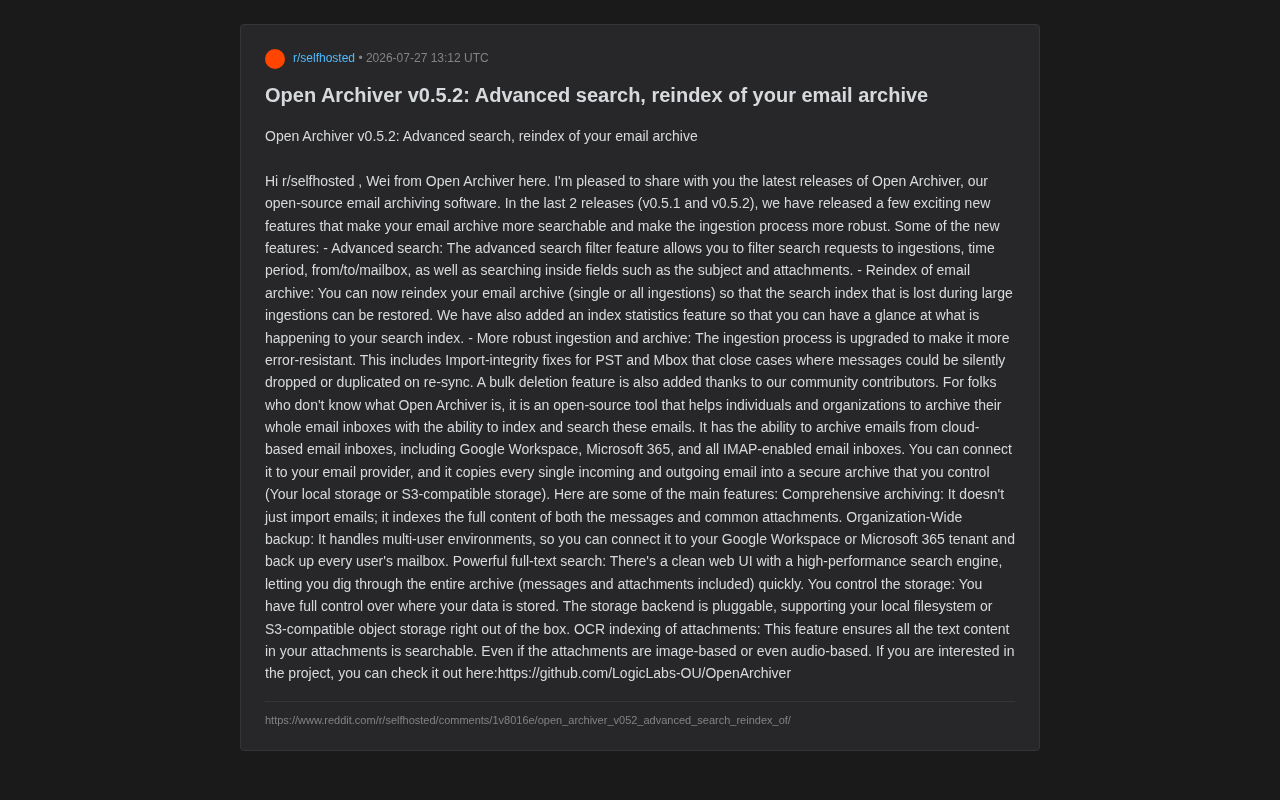
·3 min
Open Archiver v0.5.2 Deep Dive: A Comprehensive Look at the New Features of This Open-Source Email Archiving Tool
Deep dive into Open Archiver v0.5.2: advanced search, index rebuilding, PST/Mbox import fixes, and more features for self-hosted email archiving and compliance.
Read more →

·3 min
How to Fix AI Tool Error 1076? Root Cause Analysis and Solutions
Getting "Something went wrong 1076" from an AI service? This article analyzes common causes including server overload and session issues, with practical troubleshooting steps to restore normal usage.
Read more →

·3 min
Open Archiver v0.5.2 Deep Dive: A Complete Look at the New Features of This Open-Source Email Archiving Tool
Deep dive into Open Archiver v0.5.2: advanced search, index rebuilding, PST/Mbox import fixes, and more for self-hosted enterprise email archiving.
Read more →

·3 min
HuggingHack Update: S3 Storage, Dual-Engine Scheduling, and GGUF Inspection Get Major Upgrades
HuggingHack releases major updates with S3/MinIO storage, Ollama + vLLM dual-engine scheduling, GGUF inspection, and local accounts for enterprise-grade local LLM management.
Read more →

·3 min
Build RAG and AI Agent Projects at Zero Cost: A Practical Guide to Open-Source Tools
Build high-quality AI projects on a budget. Learn how to use Ollama, Groq, Chroma, and other free open-source tools to build RAG systems and multi-Agent workflows from scratch.
Read more →
·3 min
Build RAG and AI Agent Projects at Zero Cost: A Practical Guide to Open-Source Tools
Build high-quality AI projects on a budget. Learn how to use Ollama, Groq, Chroma, and other free open-source tools to build RAG systems and multi-Agent workflows from scratch.
Read more →

·3 min
Wattage: An AI Agent Token Cost Profiling and Regression Protection Tool
Deep dive into Wattage, an AI Agent token consumption profiling and cost regression protection tool, exploring its core features, industry context, and value for developers.
Read more →

·3 min
Herder: The Open-Source Terminal Tool for Unified Management of Multiple AI Coding Agents
Herder is an open-source terminal multiplexer for macOS and Windows that unifies management of Claude Code, Codex, OpenCode, and other AI coding agents—with persistence and remote reconnection.
Read more →

·3 min
Anthropic's Hands-On Guide: How to Scientifically Choose and Evaluate AI Models
Anthropic's Applied AI team breaks down a methodology for choosing AI models: building custom evals, avoiding three common pitfalls, measuring value by cost per success, and cutting costs with prompt caching and context engineering.
Read more →

·2 min
Can One Skill Transform All Skills? The Boundary Debate Between Dify Workflows and Agents
A recursive technical proposition: Can we build a "meta-Skill" that auto-transforms any Skill into a Dify workflow? This article dissects the boundary between deterministic orchestration and autonomous Agent decisions.
Read more →
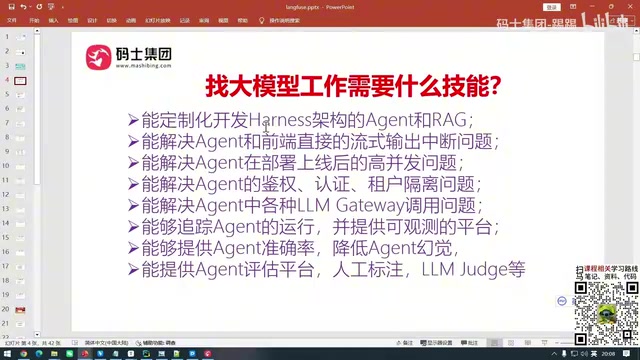
·2 min
The New Bar for AI/LLM Roles: A Practical Guide to Agent Observability and Evaluation
Enterprise AI/LLM roles now demand engineering skills: streaming recovery, high concurrency, multi-tenancy, LLM gateways, Langfuse observability, and evaluation platforms. Master these 8 core competencies.
Read more →

·3 min
Pinterest Medic: Engineering an AI Agent for Automated Spark Failure Diagnosis
How Pinterest engineers built Medic for Apache Spark — a multi-agent auto-diagnosis tool — covering the evolution from a single ReAct agent, observability, log denoising, and end-to-end testing.
Read more →

·7 min
Enterprise AI Agent Security Isolation and Memory Design: NanoClaw Founder Breaks Down Real-World Lessons
NanoClaw founder David Boyd breaks down the core engineering of enterprise autonomous Agents: a triple security isolation model, LLM Wiki memory design, and the real-world path from personal Agents to team-scale deployment.
Read more →

·8 min
A Complete Guide to Agent Testing: Five Core Dimensions and Automation in Practice
In-depth analysis of the five core dimensions of AI Agent testing: command safety, tool-calling accuracy, task planning, output consistency, and error self-repair. Master automated testing and the transition path for test engineers.
Read more →

·8 min
The Complete Guide to Agent Testing: Five Core Dimensions and Automation in Practice
An in-depth analysis of the five core dimensions of AI Agent testing: command safety, tool-calling accuracy, task planning, output consistency, and error self-repair. Master automated testing methods and the transition path for test engineers.
Read more →
Intelligent Model Routing: The Core Te…
·3 min
Intelligent Model Routing: The Core Technology and Implementation Guide for AI Cost Reduction and Efficiency
Intelligent Model Routing is becoming key AI infrastructure. This article explores its principles, solution types, technical challenges, and implementation considerations to help developers balance cost, latency, and quality.
Read more →
Mindwalk: Replaying AI Coding Agent Be…
·4 min
Mindwalk: Replaying AI Coding Agent Behavior on a 3D Code Map
Mindwalk renders codebases as 3D maps, visually replaying the full operation trajectories of AI coding agents like Claude Code and Cursor. A deep dive into its core ideas, use cases, and the future of agent observability tools.
Read more →