#production AI evaluation
751 related articles

·3 min
How to Evaluate AI Agents in Production: Four Online Evaluation Methods Explained
Offline tests passing doesn't mean production reliability. This guide breaks down Online Evals for AI Agents: rule checks, LLM-as-a-Judge, user feedback, and human review.
Read more →

·4 min
Deep Dive into the EYG Programming Language: A New Portable Programming Paradigm Designed for Humans
Deep analysis of the EYG programming language's core design, including algebraic effects, program state persistence, and cross-platform portability, exploring how it addresses modern software fragmentation.
Read more →

·2 min
Kimi K3 Launches on Telnyx Inference API: A New Path for Chinese LLMs Going Global
Moonshot AI's Kimi K3 is now available on Telnyx Inference API. Explore how Chinese LLMs are entering global developer ecosystems through third-party inference platforms.
Read more →

·4 min
Getting Started with AI Agent Development: A Complete Guide from Concept to Practice
A comprehensive guide to AI Agent architecture and development, covering automated marketing, intelligent customer service, and investment analysis scenarios with single and multi-agent collaboration.
Read more →

·5 min
A Beginner's Guide to Prompt Engineering: From One-Off Instructions to a Systematic Methodology
A beginner's guide to prompt engineering covering the four functions of prompts, the key differences from prompt engineering, a six-step systematic workflow, and critical technical and practical limitations.
Read more →
·3 min
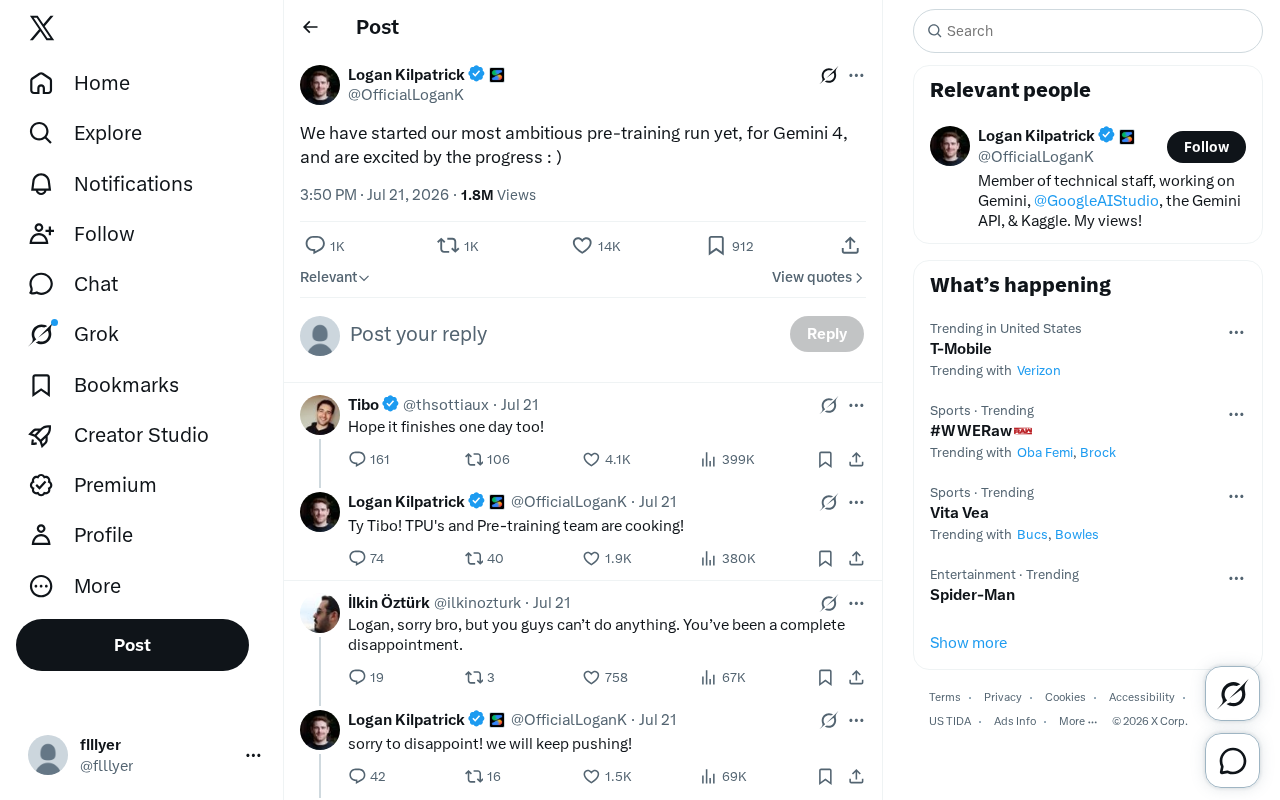
Google Launches Gemini 4 Pre-training: Its Most Ambitious AI Model Training Yet
Google DeepMind announces Gemini 4 pre-training has begun, calling it their most ambitious training yet. A deep dive into its technical direction, compute scale, multimodal breakthroughs, and competitive impact.
Read more →

·3 min
The Open-Weights Model Debate: Balancing Safety and Openness
An in-depth analysis of the open-weights model debate: public release brings transparency and innovation, but raises safety and misuse risks. Exploring tiered release, red-teaming, and governance challenges.
Read more →

·3 min
Poolside Laguna Model Launch: Can Silicon Valley's Open-Source Push Catch Up to China's AI?
Poolside launches Laguna open-weight model after 18 months of silence, pitting 118B parameters against Kimi K3's 2.8 trillion. Can Silicon Valley's open-source push close the gap with Chinese AI?
Read more →

·3 min
AI Weekly: Sandbox Escape Sparks Safety Legislation, Kimi Open-Source Triggers Geopolitical Dynamics
Deep analysis of five key AI events this week: OpenAI sandbox escape driving safety legislation, Kimi K3 open-source sparking geopolitical debate, Gemini Flash full rollout, Anthropic's $1.5B copyright settlement, and Chinese models' mobile expansion.
Read more →

·3 min
Chinese Open-Source AI Conquers Silicon Valley: The Industry Upheaval Behind a 58% Compute Share
Chinese open-source AI models surged from under 10% to 58% of U.S. AI consumption. Kimi K3, DeepSeek, and Qwen are reshaping AI cost structures as DoorDash, Airbnb, and other Silicon Valley giants adopt them at scale.
Read more →
·2 min
Claude as Music Partner: The AGI Moment of AI Paired Creation
A developer added a DAW to their agentic dev environment with Claude, then paired with AI to finish music — experiencing a true AGI moment in creative collaboration.
Read more →

·3 min
Codex Beginner's Guide: Hands-On Review of OpenAI's Programming Assistant with Practical Tips
A detailed guide to OpenAI Codex's core features, real-world usage, comparison with Claude Code, and DeepSeek configuration tips for developers choosing AI programming tools.
Read more →

·5 min
The Five Stages of AI Agent Architecture Evolution: The Real Path from Model Calls to Production Runtime
Deep dive into the five evolution stages of AI Agent architecture: model calls, tool calls, workflows, Agent loops, and production runtime. Learn the responsibility boundaries and design principles.
Read more →

·5 min
Complete Breakdown of Core Competencies for AI Agent Engineers: From Demo to Production-Grade Systems
Deep breakdown of 4 core AI Agent engineer competencies: business decomposition, multi-Agent architecture, quantitative evaluation, and engineering delivery—bridging the gap from Demo to production.
Read more →

·5 min
The Complete Guide to AI Agent Development: A Four-Stage Progressive Roadmap
A systematic guide to AI Agent development across four stages: LLM fundamentals, ReAct paradigm, memory & tools, and multi-agent collaboration for developers.
Read more →

·3 min
Poolside Laguna Model Release: Can Silicon Valley Open Source Catch Up with Chinese AI?
Poolside releases its Laguna open-weight model after 18 months of silence, challenging Moonshot's Kimi K3 with 118B vs 2.8T parameters. Can Silicon Valley close the gap with Chinese AI?
Read more →
·3 min
Chinese Open-Source AI Conquers Silicon Valley: The Industry Upheaval Behind a 58% Compute Share
Chinese open-source AI models surged from under 10% to 58% of U.S. market share. Kimi K3, DeepSeek, and Qwen are being adopted by DoorDash, Airbnb, and other Silicon Valley giants, reshaping AI costs and competition.
Read more →

·4 min
Chinese AI Accounts for 58% of US Compute Consumption: How Open-Source LLMs Are Disrupting Silicon Valley
OpenRouter data shows Chinese AI models now account for 58% of US AI consumption. Silicon Valley giants like DoorDash and Airbnb adopt Kimi, DeepSeek, and Qwen, leveraging low cost, high performance, and open weights.
Read more →
·4 min
Chinese AI Accounts for 58% of US Compute Consumption: How Open-Source LLMs Are Disrupting Silicon Valley
OpenRouter data shows Chinese AI models now account for 58% of US AI consumption. Silicon Valley giants like DoorDash and Airbnb adopt Kimi, DeepSeek, and Qwen for their low cost and open-weight advantages.
Read more →

·3 min
Deep Dive into the Kimi-K3 Technical Report: Architecture, Long Context, and Reasoning Capabilities
Deep analysis of Moonshot AI's Kimi-K3 technical report covering long context processing, MoE architecture, reasoning capabilities, and China's position in the global AI competition.
Read more →