Agent Monitor: An AI Agent Session Monitoring Daemon Written in Rust

Agent Monitor: a Rust daemon for unified monitoring of multiple AI coding agent sessions
Agent Monitor is an open-source project on GitHub that implements a background daemon in Rust to unify monitoring of session activity across multiple AI programming agents including Claude Code, Cursor, and Aider. It addresses the monitoring challenges created by fragmentation in the AI coding tool ecosystem, supports custom agent extensions, and provides data support for development efficiency visualization, team security compliance, and AI workflow optimization—representing an important trend in the rise of AI agent infrastructure.
Project Overview
As AI programming assistants become mainstream, developers routinely use multiple AI agent tools simultaneously in their daily work. Claude Code, Cursor, Aider, and other tools each have their strengths, but there has long been no effective solution for unified monitoring of these scattered AI agent sessions. An open-source project on GitHub called Agent Monitor is attempting to fill this gap.
Agent Monitor is a background daemon written in Rust, specifically designed to monitor session activity across multiple AI agents. It supports Claude Code, Cursor, Aider, and custom agents, providing developers with a unified monitoring perspective.
Core Features and Design Philosophy
Background Daemon Architecture
Agent Monitor adopts the classic daemon design pattern, running silently in the background without interfering with developers' normal workflows.
A daemon is a long-standing background service program pattern in Unix/Linux systems, with its name derived from the spirits (daemons) in Greek mythology that exist between gods and humans. Unlike regular foreground processes, daemons detach from terminal control and run continuously after system startup. Typical examples include system services like Nginx, MySQL, and syslogd. Daemons typically complete their "daemonization" through steps such as creating child processes via the fork() system call, closing standard I/O, and creating new session groups. In modern systems, process managers like systemd further simplify daemon lifecycle management, providing capabilities such as automatic restart, log collection, and resource limiting. Agent Monitor's adoption of this pattern means it can continuously collect data without the developer's awareness, without occupying a terminal window or affecting normal IDE operation.
The choice of Rust as the development language reflects the project's emphasis on performance and resource consumption—as a monitoring tool that needs to run continuously, low memory usage and efficient system resource utilization are critical.
Unified Multi-AI Agent Monitoring
The project's core value lies in its "cross-platform" monitoring capability. The current AI programming tool ecosystem is trending toward fragmentation:
- Claude Code: Anthropic's command-line AI programming assistant
- Cursor: An AI-enhanced IDE based on VS Code
- Aider: An open-source command-line AI pair programming tool
- Custom agents: Developer-built AI workflows
The AI programming assistant market is currently experiencing explosive growth, but the technical approaches and interaction methods of various tools differ significantly. Claude Code is based on Anthropic's Claude model, uses the terminal command line as its primary interaction interface, and excels at understanding entire codebase context and executing multi-step programming tasks. Cursor deeply integrates AI capabilities on top of VS Code, lowering the barrier to entry through Tab completion, inline editing, and multi-file refactoring via graphical interactions. Aider is an open-source project developed by Paul Gauthier that emphasizes deep integration with Git workflows, automatically generating commit messages and managing code changes. Additionally, there are numerous competitors including GitHub Copilot, Windsurf (formerly Codeium), and Amazon CodeWhisperer. Session data from these tools is stored in different locations—some write to local SQLite databases, some record in JSON log files, and some communicate with editors via the LSP protocol. This fragmentation makes unified cross-tool monitoring a real technical challenge.
Agent Monitor's goal is precisely to unify the collection and presentation of these heterogeneous session data.
Extensibility Design
The project explicitly supports "custom agents," indicating that its architecture is designed with good extensibility. As the AI agent ecosystem evolves rapidly with new tools emerging constantly, this open design philosophy reserves space for future compatibility.
Technical Choice Analysis: Why Rust
For a background monitoring daemon, Rust is a very reasonable technical choice:
- Zero-cost abstractions: Monitoring programs need to run for extended periods, and Rust's zero-GC characteristic avoids performance jitter caused by garbage collection
- Memory safety: Daemon stability is crucial, and Rust's ownership system eliminates memory leaks and similar issues at compile time
- System-level access: Monitoring file system changes, process states, and other operations require low-level system calls, where Rust has a natural advantage
- Cross-platform compilation: Native binaries can be conveniently built for different operating systems
Rust's "Zero-Cost Abstractions" principle originates from C++ creator Bjarne Stroustrup's design philosophy: features you don't use should incur no runtime overhead, and features you do use cannot be hand-coded more efficiently. In practice, this means Rust's generics, traits, iterators, and other high-level abstractions are optimized after compilation into machine instructions equivalent to hand-written low-level code. Meanwhile, Rust has no garbage collector (GC), instead managing memory at compile time through three mechanisms: Ownership, Borrowing, and Lifetime. In contrast, GCs in languages like Go and Java periodically pause program execution (Stop-The-World). Although modern GC pause times have been reduced to the millisecond level, for monitoring daemons that need to run 24/7, any unpredictable delay could cause timestamp deviation in data collection or event loss. This makes Rust the ideal choice for such scenarios.
Use Cases and Practical Value
Development Efficiency Visualization
For developers and teams that heavily use AI programming tools, Agent Monitor can help answer key questions: What is the usage frequency of each AI agent? Which sessions produced actual value? What percentage of overall development time is spent on AI-assisted programming?
Team Management and Security Compliance
In enterprise environments, understanding how team members use AI tools and which codebases are involved in sessions is important for security compliance and cost management.
AI Workflow Optimization
Through the accumulation of monitoring data, developers can analyze the performance of different AI agents on different task types, thereby optimizing their AI tool usage strategies.
From Code Completion to Autonomous Agents: Why Monitoring Has Become Indispensable
AI programming tools are undergoing a paradigm shift from "passive assistance" to "active execution." First-generation tools (such as early GitHub Copilot) primarily provided single-line or multi-line code completion, with developers retaining complete control. Second-generation tools introduced conversational interaction, capable of understanding natural language instructions and generating code snippets. The third generation currently emerging—AI Agents—possess capabilities for autonomous planning, tool invocation, and multi-step execution. For example, Claude Code can autonomously analyze codebase structure, formulate modification plans, edit multiple files, run tests, and iteratively fix issues based on results.
This autonomy brings tremendous productivity gains but also introduces new risks: agents may modify critical files, execute system commands, or access sensitive data without the developer's full awareness. Therefore, real-time monitoring and post-hoc auditing of AI agent behavior has become indispensable—this is precisely the fundamental reason tools like Agent Monitor exist.
Ecosystem Position and Future Outlook
The project is still in its early stages, but the problem it targets—unified monitoring of AI agent sessions—is a real and growing need. As AI agents evolve from simple code completion to autonomous agents capable of executing complex tasks, monitoring, auditing, and managing their behavior will become increasingly important.
This project represents a trend worth watching: the rise of the AI agent infrastructure layer. Just as containerization gave rise to orchestration tools like Kubernetes, the proliferation of AI agents will also spawn a series of monitoring, management, and orchestration tools.
This analogy has profound historical reference value. Docker's emergence in 2013 brought containerization technology into the mainstream, but as container numbers exploded, manually managing hundreds or even thousands of containers became infeasible. This gave rise to Kubernetes (open-sourced by Google in 2014) as a container orchestration platform, along with the massive ecosystem that formed around it: Prometheus for monitoring, Istio for service mesh, and Helm for package management. The AI agent domain is undergoing a similar evolutionary trajectory. When developers progress from using a single AI tool to simultaneously running multiple AI agents—each of which may spawn subtasks—similar infrastructure is needed to address observability, resource scheduling, permission control, and cost accounting. The toolchain at this layer is still very scarce. Besides Agent Monitor, LangSmith (an observability platform for LLM applications) and OpenTelemetry's AI extensions are also attempting to fill this gap.
Although Agent Monitor is still small in scale, its direction is correct and its development is worth continued attention.
Key Takeaways
- Agent Monitor is a background daemon written in Rust for unified monitoring of session activity across multiple AI agents including Claude Code, Cursor, and Aider
- Developed in Rust, it balances low resource consumption, memory safety, and system-level access capability, making it suitable for long-running background monitoring scenarios
- It supports custom agent integration with good extensibility, adapting to the rapidly evolving AI tool ecosystem
- The project targets AI agent infrastructure layer needs, providing data support for development efficiency visualization, team compliance management, and AI workflow optimization
- As AI agents evolve from passive completion to autonomous execution, behavior monitoring and auditing shifts from "optional" to "essential"—Agent Monitor represents an important direction in the rise of infrastructure tools under this trend
Related articles
 Product Reviews
The Programmer's Desk Setup Guide: Building a Workspace That Feels Like Home
Discover how programmers build productive, comfortable workspaces. From multi-monitor setups to ergonomic design, explore the desk philosophy that drives focus and flow.
 Product Reviews
Qoder vs Cursor Real-World Comparison: Which $20/Month AI IDE Is Better?
Hands-on comparison of Qoder vs Cursor AI IDEs: Agent autonomy, human interaction count, and architecture decisions. Qoder needed only 2 interactions vs Cursor's 8.
 Product Reviews
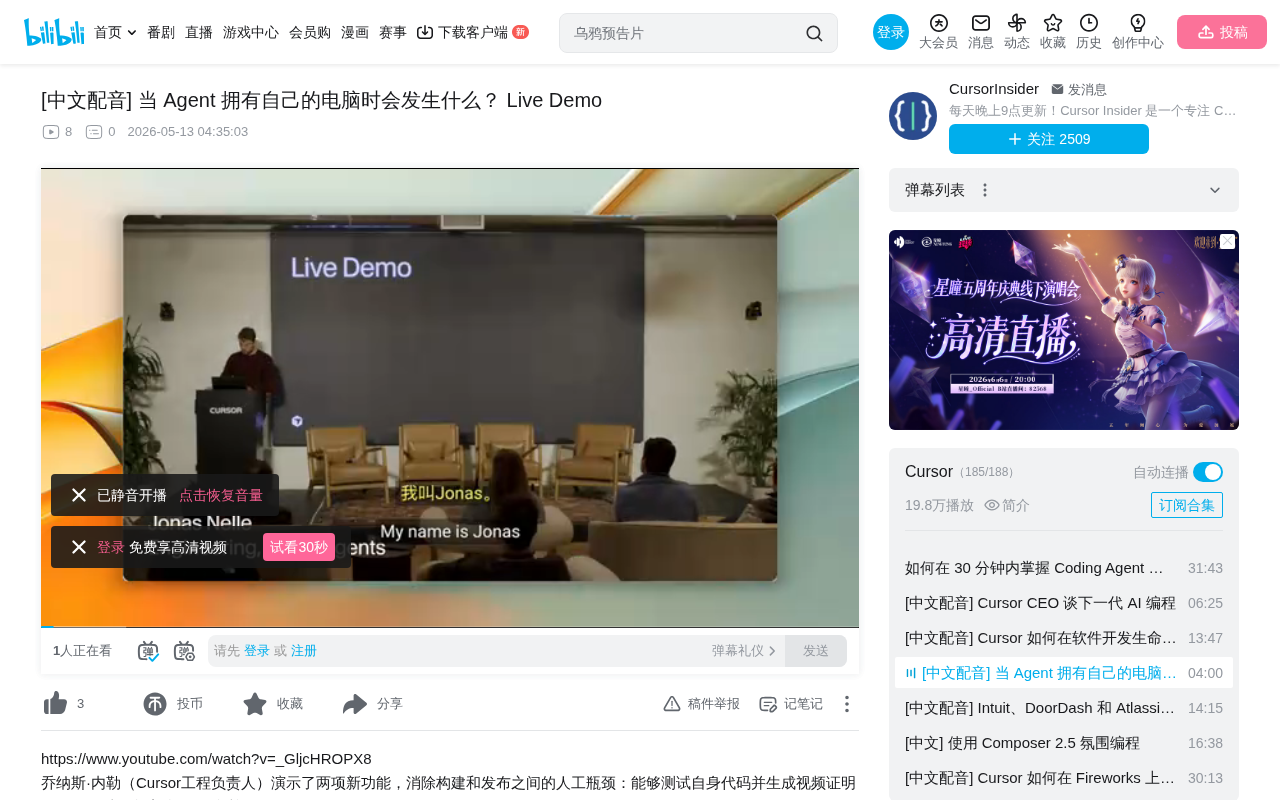
Cursor Cloud Agent Demo: Eliminating Bottlenecks Across the Entire Software Development Lifecycle
Deep analysis of Cursor's Cloud Agent demo showing how cloud VMs, automated test artifacts, and a full-chain control plane systematically eliminate human bottlenecks across the software development lifecycle.