AI Agent Auto-Generates Test Cases in Practice: A Hands-On Guide with MCP Server and Dify

AI agent architecture explained with practical test case auto-generation using MCP Server and Dify
This article explains AI agent fundamentals and how they differ from large models: Agent = LLM + Workflow + Knowledge Base, with perception, decision-making, action, and memory capabilities. It compares mainstream tools like Dify, Coze, and LangChain for agent development, and introduces how the MCP protocol enables standardized external tool invocation—ultimately achieving automated test case generation, test platform integration, and CI/CD pipeline connectivity.
Introduction: AI Is Reshaping the Software Testing Industry
Since 2025, AI technology has been rapidly penetrating every industry. From NVIDIA to DeepSeek, from Doubao to various AI agent products, the field of artificial intelligence is evolving at an unprecedented pace. For software testing professionals, a key question has emerged: How can AI agents be used to automatically generate test cases and boost productivity?
This article starts from the basic concepts of AI agents, dives deep into their architectural principles, and introduces mainstream development tools like Dify and LangChain as well as practical applications of MCP Server—helping testers quickly understand and get started with AI-driven automated test case generation.
What Is an AI Agent? Starting from Human Behavior
The Digital Mapping of Human Behavior
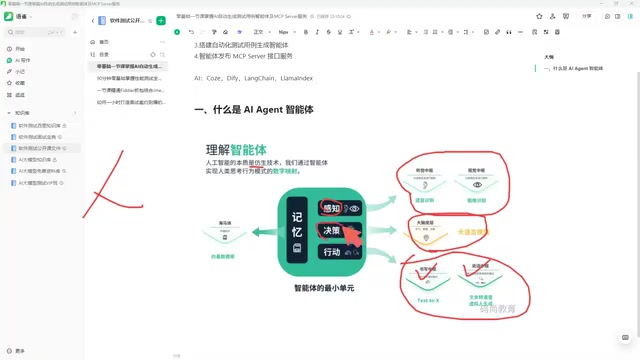
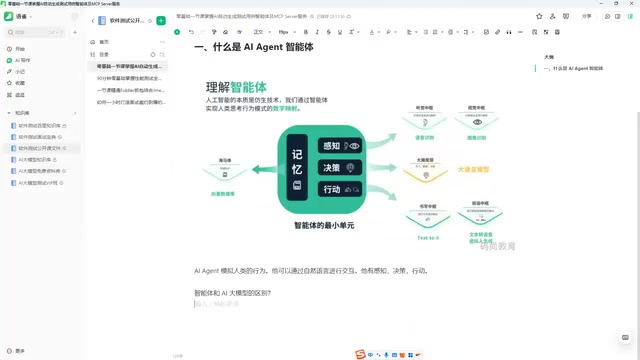
Artificial intelligence is essentially a biomimetic technology—it mimics biological capabilities to achieve digital functions. The most intuitive way to understand AI agents is to start from ourselves.
As humans, we possess four core capabilities:
- Perception: Receiving external information through senses like hearing and vision (speech, images, etc.)
- Decision-making: The brain performs learning, thinking, and judgment
- Action: Executing specific operations such as writing, speaking, and completing tasks
- Memory: Storing and recalling past experiences
AI agents are the digital simulation of these four capabilities. They interact with users through natural language (perception), leverage large models for reasoning (decision-making), invoke external tools to complete specific tasks (action), and use knowledge bases to maintain contextual memory.
The Key Difference Between AI Agents and Large Models
Many people confuse agents with AI large models, but the two are fundamentally different.
AI large models (such as DeepSeek, GPT-4) are technically large-scale pre-trained language models based on the Transformer architecture. Their core capability is learning language patterns from massive text data to complete text generation, understanding, and reasoning tasks. However, large models themselves are stateless—each conversation is an independent input-output exchange, lacking persistent memory and proactive execution capabilities. Essentially, it's a Q&A system: you ask, it answers. If you ask it to place a food delivery order for you, it can't—because it has no ability to execute actions.
AI agents introduce the ReAct (Reasoning + Acting) paradigm on top of large models, enabling the model to dynamically invoke external tools during reasoning, forming a closed loop of "think → act → observe → think again." When you say "order me some food delivery," it can:
- Understand your intent (perception)
- Open the Meituan app (action)
- Search for the product you want (decision + action)
- Complete payment (action)
In short, an AI large model is just one component of an agent. An agent adds workflow orchestration and knowledge base support on top of the large model, forming a complete autonomous execution capability.
Core Architecture of AI Agents: Large Model + Workflow + Knowledge Base
Now that we understand the concept of agents, let's break down their technical architecture. A complete AI agent can be summarized in one formula:
AI Agent = AI Large Model + Workflow + Knowledge Base
AI Large Model: The Agent's "Brain"
The large model handles natural language understanding and reasoning. It's the core engine for agent-user interaction and directly determines how "smart" the agent is. Current mainstream large models include DeepSeek, the GPT series, Qwen, and others.
Workflow: The Agent's "Action Plan"
At the technical level, workflows correspond to DAG (Directed Acyclic Graph) task orchestration, defining the sequence of steps an agent follows to complete a task, corresponding to the human process of "perceive → think → act." Using food delivery as an example:
- Step 1: Open the delivery platform
- Step 2: Search for the target product
- Step 3: Confirm the order
- Step 4: Complete payment
Each step is a node in the workflow, and the agent executes them sequentially according to predefined logic. In the test case auto-generation scenario, the workflow can be designed as: parse requirement documents → extract feature points → generate test cases → output in standard format.
Knowledge Base: The Agent's "Professional Memory"
Large model training data has timeliness limitations and cannot access the latest business information. The knowledge base serves to inject domain expertise into the agent. Its underlying technology relies on RAG (Retrieval-Augmented Generation): private documents are chunked and converted into high-dimensional vectors through Embedding models, then stored in vector databases (such as Chroma, Pinecone, Milvus, etc.). When a user asks a question, the system first retrieves semantically relevant document fragments from the vector store, then injects them as context into the large model's prompt, generating precise answers based on private knowledge.
Here's a healthcare example: Xiangya Hospital has accumulated decades of clinical cases and research findings—data that large models don't know about. By building this data into a knowledge base and "feeding" it to the large model, the agent can reason and make decisions based on real medical data.
In software testing scenarios, the knowledge base can include:
- Project requirement specification documents
- Historical test case libraries
- Defect reports and regression test records
- Business rules and boundary condition documents
Comparison of Mainstream Agent Development Tools: How to Choose Between Dify, Coze, and LangChain
There are currently two main paths for building AI agents: low-code tools and code frameworks.
Low-Code Agent Development Tools
| Tool | Features | Use Cases |
|---|---|---|
| Coze | Built by ByteDance, online platform, currently free | Personal learning, rapid prototype validation |
| Dify | Open-source with private deployment support, extremely high enterprise adoption | Enterprise-level agent development, the preferred choice of ~80% of enterprises |
Coze, as an online platform, is easy to get started with but not well-suited for internal enterprise deployment. Dify, with its open-source and privately deployable advantages, has become the de facto standard tool for enterprises building agents. Architecturally, Dify has built-in support for RAG pipelines, workflow orchestration, model management, and API publishing, enabling enterprises to quickly deploy agent applications without building infrastructure from scratch.
Code-Level Agent Development Frameworks
| Framework | Features | Use Cases |
|---|---|---|
| LangChain | Mature ecosystem, active community, widely used | Agent development requiring high customization |
| LlamaIndex | Frequent recent updates, more powerful features | Data-intensive agents, RAG retrieval-augmented scenarios |
LangChain has been the hottest AI development framework for some time, providing core abstractions like Chain, Agent, and Memory to help developers quickly combine large models with external tools. LlamaIndex is specifically designed for data-intensive scenarios, offering a complete toolchain for document ingestion, index construction, and query engines, with unique advantages in knowledge retrieval augmentation (RAG)—particularly impressive in recent feature updates and capability improvements.
Selection Recommendations: If your team wants to quickly deploy a test case generation agent using a tool-based approach, prioritize Dify. If you need deep customization and code-level control, both LangChain and LlamaIndex are excellent choices.
MCP Server: Taking Agents from "Can Talk" to "Can Do"
MCP (Model Context Protocol) is one of the hottest protocols in the AI field today. The protocol was proposed and open-sourced by Anthropic in late 2024, with the design goal of solving the integration fragmentation problem between AI models and external data sources/tools—before MCP, every AI application needed to develop a separate adapter layer for each tool, resulting in extremely high maintenance costs. MCP adopts a client-server architecture based on the standardized JSON-RPC communication protocol, enabling any MCP-compliant tool to be directly invoked by any MCP-supporting AI client, truly achieving "integrate once, use everywhere."
Simply put, MCP Server provides AI agents with a standardized external tool invocation interface, enabling large models to interact with various external systems.
MCP Server Applications in Automated Test Case Generation
In testing scenarios, MCP Server delivers value in the following areas:
- Connecting test management platforms: Agents can directly write generated test cases into tools like Jira and TestRail
- Accessing code repositories: Automatically reading the latest code changes to generate targeted regression test cases
- Integrating with CI/CD pipelines: Automatically integrating test cases into continuous integration workflows
The emergence of MCP has evolved agents from "eloquent talkers" to "capable doers."
Related articles
 Tutorials
ChatGPT Plus Subscription Guide: Are GPT-5.5, image-2, and Codex Worth the Upgrade?
A detailed look at ChatGPT Plus features — GPT-5.5, image-2, and Codex — with a Plus vs Pro comparison and a complete step-by-step subscription guide for users outside the US.
 Tutorials
Harness AI Engineering in Practice: Using Claude Code to Master Enterprise-Level E-Commerce Development
Deep dive into Harness AI Engineering: master enterprise e-commerce development with Claude Code using the Rules, Skills, Wiki, and Changes framework.
 Tutorials
Cursor + Codex Dual-IDE Collaboration: A Practical Methodology for Open-Source Project Customization
A complete methodology for open-source project customization based on real-world experience, detailing the Cursor+Codex dual-IDE workflow, seven-stage process, MVP validation, and AI source code reading techniques.