AIChat: A Deep Dive into the All-in-One LLM Command-Line Tool Built with Rust

AIChat is a Rust-built all-in-one CLI tool integrating Shell Assistant, RAG, and multi-LLM support.
AIChat is an all-in-one LLM command-line tool written in Rust that combines Shell Assistant, Chat-REPL, RAG, and AI Agent capabilities into a single binary. Supporting major LLM providers including OpenAI, Claude, Gemini, and Ollama, it offers developers a unified, high-performance terminal interface for AI-powered workflows. With nearly 10K GitHub stars, it stands out for its multi-model flexibility and Rust-powered efficiency.
Project Overview
AIChat is an all-in-one LLM command-line tool written in Rust, integrating core features such as Shell Assistant, Chat-REPL, RAG (Retrieval-Augmented Generation), AI Tools, and Agents. The project has earned nearly 10,000 stars (9,948 stars) on GitHub with 694 forks, making it one of the most popular AI CLI tools available today.
Maintained by developer sigoden, the project supports integration with major large language model services including OpenAI, Claude, Gemini, Ollama, Groq, and more, providing developers with a unified command-line interaction interface.
Core Features
Shell Assistant
AIChat's Shell Assistant feature allows users to generate and execute Shell commands directly in the terminal using natural language descriptions. For developers who frequently need to look up command parameters, this feature dramatically improves productivity. Users simply describe the task they want to accomplish, and the AI generates the corresponding command-line instructions.
Chat-REPL Interactive Mode
The REPL (Read-Eval-Print Loop) mode provides an interactive experience similar to the ChatGPT web interface, but running entirely in the terminal. Developers can engage in multi-turn conversations, set system prompts, and switch between different model backends—all within the familiar command-line environment.
RAG (Retrieval-Augmented Generation)
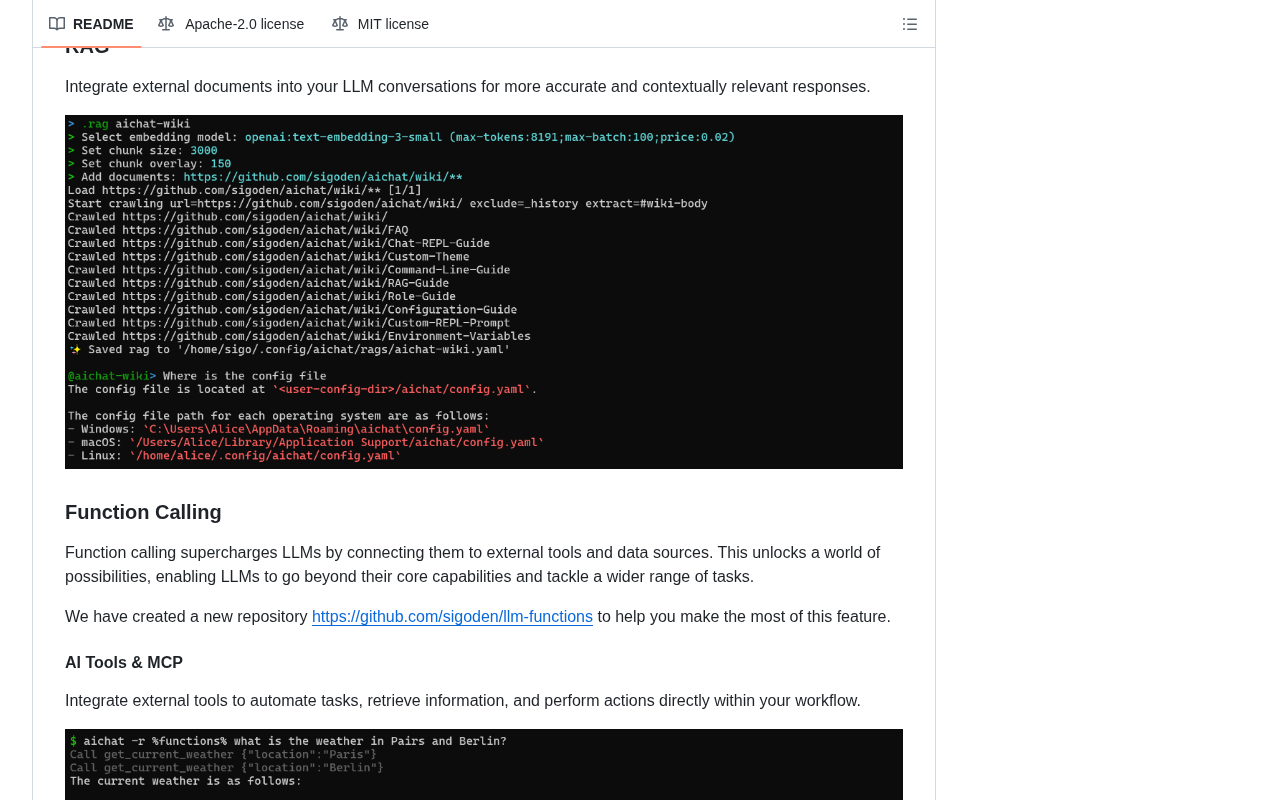
The RAG feature is a major highlight of AIChat. Users can import local documents, codebases, and other knowledge sources into the system. When answering questions, the AI automatically retrieves relevant content as context, delivering more accurate and targeted responses. This is particularly useful for scenarios that require Q&A based on specific documentation.
AI Tools & Agents
Tool calling and intelligent agent capabilities make AIChat more than just a chat tool. By defining custom tools, the AI can perform actual tasks such as file operations, network requests, and data processing—bridging the gap from "conversation" to "action."
Multi-Model Support
One of AIChat's standout advantages is its extensive model compatibility:
- OpenAI: GPT-4, GPT-3.5, and other series models
- Anthropic Claude: Claude 3 series
- Google Gemini: Gemini Pro and others
- Ollama: Locally deployed open-source models
- Groq: High-speed inference service
- And many more services compatible with the OpenAI API format
This multi-model architecture means users can flexibly switch models based on task requirements without installing multiple different tools.
Technical Implementation & Design Philosophy
The project is developed in Rust, which brings several significant advantages:
- High Performance: Rust's zero-cost abstractions and memory safety guarantees ensure efficient tool execution
- Cross-Platform: Compiles to native binaries for all major operating systems
- Low Resource Usage: Compared to similar tools implemented in interpreted languages like Python, memory consumption is much smaller
- Single Binary Distribution: No runtime dependencies required, making deployment extremely straightforward
Use Cases
- Daily Development: Quickly generate code snippets, explain error messages, write documentation
- System Administration: Generate complex Shell commands and scripts through natural language
- Knowledge Management: Build personal knowledge Q&A systems based on local documents
- Automated Workflows: Leverage Agent capabilities to chain multiple task steps together
Comparison with Similar Tools
Compared to other CLI AI tools (such as GitHub Copilot CLI, Shell GPT, etc.), AIChat's advantage lies in its "all-in-one" positioning—consolidating multiple features into a single tool while supporting virtually all major LLM service providers. The Rust implementation also gives it a competitive edge in terms of performance and reliability.
Conclusion
AIChat represents the trend of deep integration between AI tools and traditional command-line workflows. For power terminal users and developers, it provides an efficient, unified, and extensible AI interaction entry point. As the project approaches its 10,000-star milestone, both its community activity and feature completeness continue to grow, making it well worth watching and trying out.
Related articles
 Product Reviews
The Programmer's Desk Setup Guide: Building a Workspace That Feels Like Home
Discover how programmers build productive, comfortable workspaces. From multi-monitor setups to ergonomic design, explore the desk philosophy that drives focus and flow.
 Product Reviews
Qoder vs Cursor Real-World Comparison: Which $20/Month AI IDE Is Better?
Hands-on comparison of Qoder vs Cursor AI IDEs: Agent autonomy, human interaction count, and architecture decisions. Qoder needed only 2 interactions vs Cursor's 8.
 Product Reviews
Cursor Cloud Agent Demo: Eliminating Bottlenecks Across the Entire Software Development Lifecycle
Deep analysis of Cursor's Cloud Agent demo showing how cloud VMs, automated test artifacts, and a full-chain control plane systematically eliminate human bottlenecks across the software development lifecycle.