Can Claude Opus 5 Refactor 25-Year-Old Legacy Code? The Real Capability Boundaries of AI Programming

AI can't yet solo-refactor massive legacy codebases — human-AI collaboration remains the practical path forward.
A Reddit discussion about Claude Opus 5 sparked debate over whether AI can independently refactor a 25-year-old, 50,000-line undocumented legacy codebase. The community consensus: despite impressive advances, AI still lacks the ability to handle large-scale projects autonomously due to context window limits, implicit business logic, and verification challenges. Companies are using AI for targeted, human-guided refactoring rather than wholesale rewrites, and the real costs extend beyond code to team cognition and organizational knowledge.
An Extreme Test for the "Singularity"
Recently, a Reddit discussion about Claude Opus 5 sparked widespread attention. The original poster half-jokingly proposed a highly challenging evaluation standard: rather than looking at standardized benchmarks, he wanted to see how AI would perform when faced with a real "technical nightmare" — a legacy application created by a single developer, spanning 25 years of history, containing 50,000 lines of code, with absolutely no documentation.
The "Technological Singularity" mentioned here is a concept popularized by mathematician Vernor Vinge and futurist Ray Kurzweil, referring to a hypothetical moment when artificial intelligence surpasses human intelligence and triggers explosive technological growth. In the software engineering context, it's often used tongue-in-cheek to describe an idealized state where AI could completely replace human programmers and independently handle all development tasks. The original poster used this concept as his target, designing his own "singularity test."
The author's criteria were rather extreme: if the AI, when faced with this mess, chose either "A. Delete itself" (humorously indicating surrender) or "B. Flawlessly rewrite the entire application," only then would he consider the technological singularity to have truly arrived.
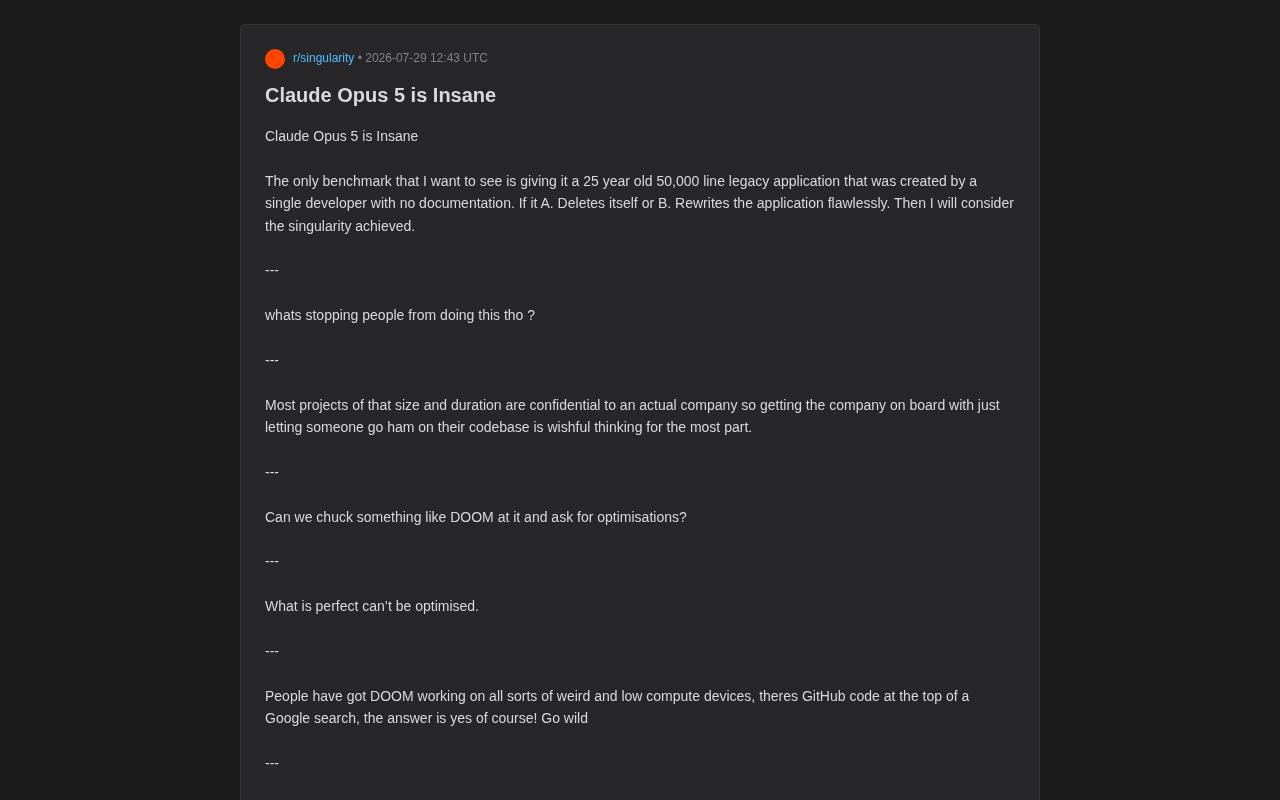
This seemingly playful post actually touches on the core pain point of current large language model (LLM) applications in software engineering: Can AI truly handle large-scale, highly complex, context-poor real engineering projects independently?
Why Doesn't Anyone Actually Use AI to Refactor Large Legacy Codebases?
The most valuable part of the discussion came from the community's deep analysis of why "nobody just tries it." On the surface, testing AI on a legacy codebase seems easy enough, but reality is far more complex than imagination.
Some industry context is needed here: legacy code is extremely common in the software industry. It's estimated that over 80% of code running in enterprises worldwide can be classified as legacy systems. These systems are typically written in outdated programming languages or frameworks, lack unit tests and documentation, yet carry critical business logic. Famous examples include COBOL systems still running in American banking today, as well as many internal enterprise ERP and CRM systems. The difficulty of handling legacy code lies in the fact that it implicitly contains massive amounts of business rules — rules that often exist only in the code itself and in the memories of a few veteran employees.
Obstacle One: Corporate Code Confidentiality
One commenter hit the nail on the head: the vast majority of projects that reach this scale and age belong to real companies as confidential assets. Getting a company to agree to let someone "freely tinker" with their core codebase is essentially "wishful thinking."
However, another commenter pushed back: "All company codebases have version control. You can absolutely pull a local copy and tinker to your heart's content with zero risk — if it doesn't work out, just throw it away." This point is technically valid. Modern software development universally uses distributed version control systems like Git, where developers can create complete local copies (clones) of a codebase and experiment on isolated branches without affecting the production environment. However, whether code can actually run depends on external services, databases, configuration files, environment variables, and numerous other factors — simply having a code copy doesn't equate to having a complete, runnable system. This shifted the discussion from "can it be done" to "why doing it wouldn't help anyway."
Obstacle Two: AI Still Can't Handle Large Projects Independently
This is the crux of the matter. As that rational commenter summarized:
"They don't do it because AI isn't yet capable of handling a project of this size on its own, so it would still be a massive amount of work. We haven't reached the point where you can just hand over control to AI and step away from the developer seat."
This analysis reveals the true boundaries of current AI-assisted programming. 50,000 lines of code is "by no means outrageously large" for modern software engineering (as another user emphasized), but even so, having AI understand, refactor, and guarantee functional equivalence in one go still exceeds the reliable capability range of current models.
From a technical perspective, one of the core bottlenecks is the context window limitation of large language models. Even though models like Claude have expanded their context windows to 200,000 tokens or more, 50,000 lines of code (assuming an average of 10-15 tokens per line) could reach 500,000 to 750,000 tokens — far exceeding single-conversation processing capacity. While techniques like RAG (Retrieval-Augmented Generation) and code chunking can alleviate this issue, models still struggle to maintain the kind of global understanding of entire system architecture that human developers hold in their minds. Implicit dependencies between code, runtime behavior, and side effects are all things that static analysis cannot fully capture.
Furthermore, verifying functional equivalence is itself the most core and difficult goal in code refactoring. It requires the rewritten system to produce output and behavior completely identical to the original system for all possible inputs. For legacy systems lacking documentation and tests, this verification is nearly impossible to accomplish through automated means. A 25-year-old system may contain numerous undocumented edge cases, special handling, and historical instances of "bugs that are actually features" — any wholesale rewrite faces enormous risk of introducing regression defects.
The Real Cost of Large-Scale Refactoring Isn't the Code Itself
The discussion also revealed a deep issue that's often overlooked: The cost of large-scale code refactoring goes far beyond rewriting the code.
Even if AI could perfectly rewrite the application, every developer at the company would have to relearn the entire codebase. This is a massive undertaking that would stall progress until everyone caught up.
Commenters astutely pointed out that this "is equally true for human-led large refactors" — which is precisely why large-scale refactoring rarely happens in practice. This observation is highly relevant to the famous Conway's Law in software engineering, which states: "Organizations which design systems are constrained to produce designs which are copies of the communication structures of these organizations." In other words, code architecture often reflects the organizational structure and communication patterns of the team that created it. When a codebase is completely rewritten, the new code not only needs to implement the same functionality but also needs to be re-internalized by the team — understanding each module's responsibilities, inter-module interactions, and the design decisions and trade-offs implicit in the architecture. A codebase isn't just a technical asset; it carries the team's collective cognition and collaborative tacit knowledge. Starting from scratch means rebuilding this cognitive system — costly and extremely risky.
AI Refactoring in Reality: Targeted Local Optimization, Not Wholesale Rewriting
So how do companies actually use AI for code refactoring? The answer is:
"Companies are absolutely using AI for refactoring, but they're doing it in more targeted, smaller chunks under the guidance of human developers."
This observation precisely describes the current best practices for AI programming tools. AI isn't meant to replace developers in making overall architectural decisions — rather, it serves as a powerful "local executor" — efficiently completing specific refactoring tasks within scope and goals clearly defined by humans. For example, a developer might ask AI to refactor a module from callback-style to async/await patterns, or extract a group of functions into independent microservice interfaces. These tasks have clear scope and verification criteria, falling squarely within the sweet spot of current AI capabilities.
Code Optimization vs. Code Adaptation: Two Different AI Capabilities
The discussion also included an interesting tangent. Someone proposed: "Could you throw DOOM at it and have it optimize?"
DOOM is a first-person shooter released by id Software in 1993, developed under the leadership of legendary programmer John Carmack. Its source code was open-sourced in 1997 and has since been ported to over a hundred platforms — from calculators and ATMs to smart refrigerators — spawning the famous internet meme "Can it run DOOM?" DOOM's code is renowned for its extreme performance optimization and clear architectural design, considered a textbook case in game engine engineering.
This proposal led to a rather insightful exchange. Someone responded "perfection cannot be optimized," only to be corrected: "You're confusing optimization with adaptation."
This seemingly tangential exchange actually highlights two different capability dimensions of AI in code engineering:
- Optimization: Making code run faster and use fewer resources within established goals and constraints. This typically involves algorithmic improvements, memory management optimization, instruction-level parallelism, and other deep technical decisions requiring profound understanding of hardware architecture and runtime behavior.
- Adaptation: Making code continue to work in new environments and under new requirements. This includes platform porting, API migration, framework upgrades, and similar tasks where the core challenge lies in understanding interface contracts and behavior mapping.
DOOM, as a classic case that has been extremely optimized and ported to various low-compute devices, perfectly illustrates the distinction between these two. AI can indeed shine at the "adaptation" level — identifying platform differences, generating compatibility layers, adjusting API calls are all natural extensions of pattern-matching capabilities. But "optimizing" a system that's already near-perfect is an entirely different challenge — it requires precise quantitative understanding of system performance bottlenecks and the ability to make trade-offs within extremely narrow margins for improvement.
Conclusion: The Singularity Is Still Far Away — Human-AI Collaboration Is the Right Path
Returning to the original discussion about Claude Opus 5, we can arrive at a more clear-eyed understanding:
No matter how "insane" a model's capabilities may be, the current value of AI in software engineering still rests on the foundation of human-AI collaboration. It can dramatically improve development efficiency and handle tedious local tasks, but it remains quite far from the singularity scenario of "taking over a 25-year legacy system and independently rewriting it perfectly."
The real bottleneck lies not only in the model's technical capabilities but also in the inherent complexity of software engineering itself — the organizational cognition, collaboration costs, and business context that cannot be measured in lines of code. This reminds us that while embracing AI programming tools, maintaining a rational understanding of their capability boundaries is essential to truly harnessing their value. The most pragmatic path forward isn't waiting for some omnipotent AI model to arrive, but continuously optimizing human-AI collaborative workflows — letting humans handle architectural decisions, requirements understanding, and risk assessment, while letting AI handle code generation, pattern transformation, and repetitive labor. This division of labor both respects the inherent complexity of software engineering and maximizes the current value of AI technology.
Related articles

Qwen-Audio-3.0-TTS Voice Model Released: Tops the TTS Leaderboard
Alibaba's Qwen releases Qwen-Audio-3.0-TTS text-to-speech model, topping the Artificial Analysis TTS Leaderboard. Supports 16 languages, fine-grained emotion control, and natural language style instructions with Flash and Plus versions.

Qwen3.8-Max Preview Continues Iterating with Major Improvements in Frontend Development Capabilities
Alibaba's Qwen3.8-Max-Preview iterates daily with significant frontend development improvements. The team uses an open preview strategy to collect community feedback, promising open-weight release.

QwenGrowthPlan: A New Paradigm for AI Model Iteration Driven by Real-World Tasks
Alibaba Qwen launches QwenGrowthPlan, inviting developers to drive Qwen3.8-Max model iteration through real-task feedback. Analysis of its impact on agentic AI capabilities and the competitive landscape.