Qwen3.8-Max Preview Continues Iterating with Major Improvements in Frontend Development Capabilities

Qwen3.8-Max Preview iterates daily with major frontend coding improvements and promises open-weight release.
Alibaba's Qwen team is rapidly iterating Qwen3.8-Max-Preview with daily improvements, highlighting significant advances in Web frontend development capabilities. The team employs an open preview strategy to collect real-world feedback from the developer community, addressing the benchmark-reality gap. Frontend code generation has become a key AI battleground, and Qwen3.8's improvements target this high-value use case. The team has committed to releasing an open-weight official version, continuing Qwen's tradition of accessible AI models.
Qwen3.8-Max Preview: Getting Stronger Every Day
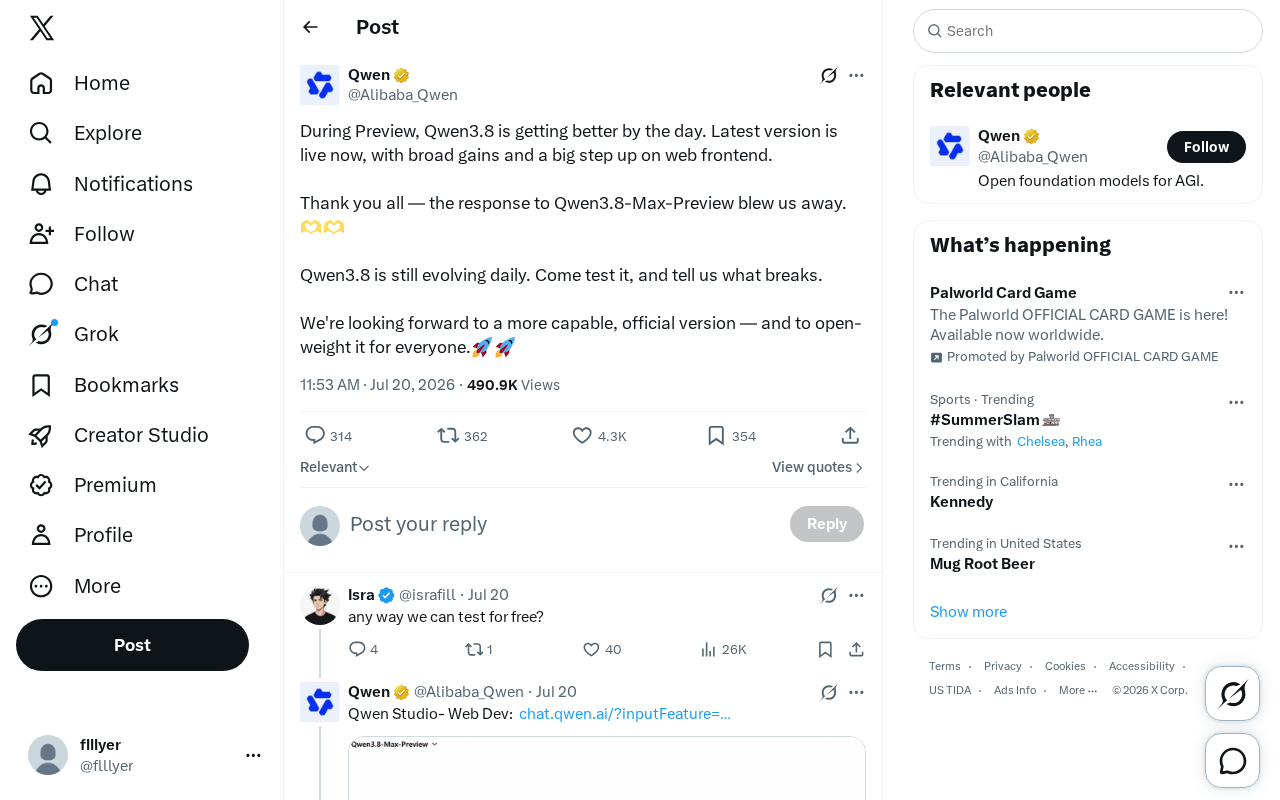
Alibaba's Qwen team recently announced on social media that Qwen3.8-Max-Preview is iterating at a pace of "improving every day." The latest version has achieved broad improvements across multiple dimensions, with a significant leap forward in Web frontend development capabilities.
For the developer community, this sends a clear signal: this is no longer a model that becomes static after release, but rather a "living" product in active development that continuously absorbs feedback and iterates rapidly. The team specifically thanked the community for the enthusiastic response to the preview version, stating that "your feedback has blown us away."
The Product Logic Behind the "Preview" Strategy
Interestingly, the Qwen team has adopted a "preview while polishing" development approach. They explicitly invite users to "come test it, and tell us what breaks." This practice is quite representative in today's intensely competitive LLM landscape — by releasing preview versions, the team can collect massive amounts of edge cases from real-world usage scenarios, thereby accelerating model convergence and optimization.
From a technical perspective, this strategy combines what software engineering calls Continuous Delivery with user-feedback-driven development. For large language models, this approach is particularly important because there's often a significant gap between a model's benchmark performance in lab settings and its performance in real user scenarios — a phenomenon known in the industry as the "benchmark-reality gap." No matter how comprehensive standard evaluation sets are, they struggle to cover the long-tail use cases users encounter in actual work: a peculiar CSS layout requirement, code that needs backward compatibility with older browsers, or a complex project involving version conflicts across multiple third-party libraries. By releasing a preview version, the team can collect real-world scenario data that's difficult to reproduce in the lab at minimal cost, allowing them to specifically patch the model's blind spots.
Compared to the traditional "closed-door development → official release" path, this continuous iteration strategy offers several advantages:
- It exposes the model's shortcomings in practical tasks more quickly
- It leverages the community's diverse needs to validate the model's generalization capabilities
- It psychologically creates a sense of participation and anticipation among users, building reputation for the eventual official release
Frontend Capabilities: The Core Highlight of This Qwen3.8 Update
Among the multiple improvements mentioned in this update, the significant enhancement in Web frontend development capabilities was singled out for emphasis — and this is no accident. The competitive focus of AI coding assistants is gradually shifting from "can it write runnable code" to "can it generate complete frontend applications with reasonable structure, beautiful styling, and polished interactions."
Frontend development places highly comprehensive demands on a model: it needs to understand the syntactic details of HTML, CSS, JavaScript, and various frameworks, possess a certain level of design aesthetics and UX judgment, and handle complex component state management and layout logic. Modern frontend frameworks like React, Vue, and Svelte introduce component-based architecture, reactive state management, virtual DOM, and other abstraction layers. The model must not only generate correct syntax but also understand component lifecycles (such as useEffect dependency array logic), data flow directions (one-way data flow vs. two-way binding), and the spatial reasoning logic of CSS layout models (Flexbox and Grid).
What's even more challenging is that the "correctness" of frontend code is difficult to measure with a single metric — a piece of code might be syntactically perfect but visually broken, functionally correct but with serious accessibility defects, or running perfectly on desktop but completely crashing on mobile. This means a model that excels at frontend tasks typically needs solid foundations in long-context understanding, structured output, and multimodal alignment (understanding the correspondence between visual expectations and code implementations).
Why AI Frontend Code Generation Has Become a New Battleground
From an industry trend perspective, "generating complete frontend pages from natural language" has become an important benchmark for measuring the practical value of code-focused LLMs. Whether it's Claude's Artifacts or various AI website builders (such as v0.dev, Bolt.new, etc.), everyone is competing for this high-frequency, high-value application scenario. Qwen3.8's focused investment in this dimension is clearly targeting the aspect of developers' daily workflows where productivity gains are most apparent.
The technical capability of AI frontend generation has evolved from simple HTML template filling to generating complex single-page applications (SPAs) with animations, responsive layouts, dark mode switching, and API interactions. This leap depends on several key technical advances: first, the expansion of long context windows — the complete codebase of modern frontend applications typically ranges from thousands to tens of thousands of tokens, and the model needs to maintain architectural consistency throughout the generation process; second, improved instruction-following capabilities, as users' UI requirements are often vague natural language descriptions (e.g., "make a modern-looking data dashboard"), requiring the model to have a reasoning chain from abstract descriptions to specific pixel-level implementations; finally, code consistency maintenance across multi-turn conversations, as users often need to iterate and modify the same project multiple times, and the model must accurately remember previous architectural decisions and design choices to avoid introducing structural regressions with each modification.
For small-to-medium developers and startup teams, a model that can quickly generate usable frontend interfaces means dramatically compressed time costs from idea to prototype — an extremely attractive value proposition.
Open-Source Commitment: Qwen3.8's Open Path for Everyone
Another noteworthy statement in the announcement is that the team "looks forward to releasing a more powerful official version and making it open-weight for everyone."
It's worth noting that the term used here is "open-weight" rather than "open-source." These two concepts have an important distinction in the LLM field: open-weight means publicly releasing the model's parameter files for users to download, deploy, and use for inference, but doesn't necessarily mean disclosing training data, data preprocessing pipelines, training code, and complete reproduction workflows. Truly fully open-source (as pursued by standards like Allen AI's OLMo project) requires disclosing all details including training datasets, cleaning rules, training hyperparameters, and evaluation methods. Nevertheless, for the vast majority of developers and enterprises, open weights already provide sufficient practical value — they can run the model on local GPUs, perform domain-specific fine-tuning, build RAG (Retrieval-Augmented Generation) systems, and even embed the model in edge devices.
This continues the consistent open-source strategy of the Qwen series. Previous Qwen series models have already built widespread influence in the open-source community. From Qwen2 to Qwen3, their open-weight approach (mostly using permissive licenses like Apache 2.0 that allow commercial use and derivative development) has enabled developers worldwide to deploy locally, fine-tune, and build upon them. The explicit promise that Qwen3.8's official version will also be open-sourced will undoubtedly further solidify its position in the open-source LLM ecosystem.
The Competitive Landscape of Open-Source LLMs
In the current LLM landscape, the debate between open-source and closed-source approaches continues. The open-source/open-weight camp, represented by Qwen, DeepSeekAd, and Llama, is rapidly narrowing the gap with top closed-source models like GPT-4o and Claude through a combination of "high performance + open weights," and holds significant advantages in cost-sensitive application scenarios. Particularly in the Chinese market, enterprises' strong demands for data security and local deployment give open-weight models a natural competitive moat.
For enterprises and research institutions, open-source weights mean greater controllability, data security, and customization freedom. Model inference doesn't require sending sensitive data to third-party APIs, fine-tuning can be completed entirely on enterprise internal infrastructure, and inference costs continue to decrease as quantization techniques (such as GPTQ, AWQ, GGUF formats) mature. If Qwen3.8 can deliver on its open-source promise while maintaining performance leadership, it will provide the entire open-source community with another high-quality foundation model choice, further driving the prosperity of the open-source ecosystem.
Summary and Outlook
From this brief announcement, we can read several layers of information: Qwen3.8-Max-Preview is in a high-frequency iteration phase, frontend capabilities are the focus of this upgrade round, and the open-sourcing of the official version is on the roadmap.
For readers following AI programming and the LLM ecosystem, it's worth continuously tracking Qwen3.8's subsequent performance — especially its real capabilities in frontend generation, code completion, and other practical development tasks. When a model chooses to evolve publicly with a posture of "improving every day" and commits to eventual open-sourcing, it signals not just technical progress but an open attitude toward participatory development.
Whether the final version can deliver on its promise of being "more powerful," and how big a wave it can create in the community after open-sourcing, are both worth looking forward to.
Related articles

Chain of Thought Isn't Just for AI: How Humans Can Use CoT to Improve Thinking Quality
Chain of Thought isn't just a prompt trick for large models. Starting from a Hacker News discussion, this article analyzes why CoT works for human thinking too, breaks down actionable ways to transfer it, and highlights the key differences between human CoT and machine CoT.
Cloudflare Teams Up with OpenAI: Closi…
Cloudflare Teams Up with OpenAI: Closing the Loop from Vulnerability Discovery to Defense with AI
Cloudflare uses OpenAI Daybreak to investigate security vulnerabilities and generate reviewable remediation plans, while developers use Codex to boost coding efficiency and quality.

Orca Multi-Agent Orchestration in Practice: A Guide to Parallel Collaboration with Claude and Codex
Orca is Stable AI's free open-source agent workbench supporting 34 agents like Claude Code and Codex in parallel. Learn its Git worktree isolation, multi-model orchestration, and mobile management.