ccNexus: Intelligent API Gateway for Claude Code/Codex CLI with Multi-Endpoint Rotation and Usage Monitoring

ccNexus is a Go-based intelligent API gateway designed to manage multi-tool AI API calls efficiently.
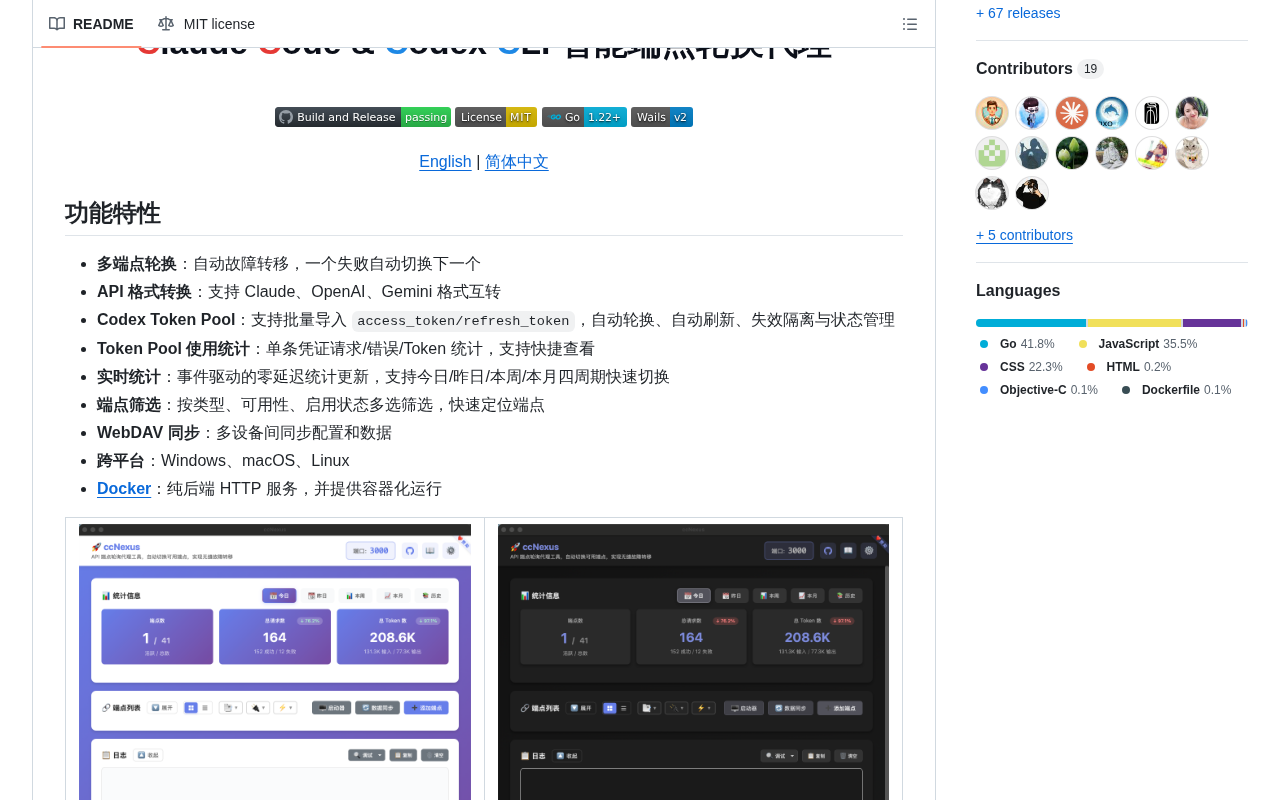
ccNexus is an open-source project on GitHub with 841 Stars, built as an intelligent API gateway in Go specifically for AI coding tools like Claude Code and Codex CLI. It offers three core features: API endpoint rotation (bypassing rate limits and improving availability), seamless multi-AI platform integration (OpenAI, Gemini, etc.), and API usage monitoring (tracking token consumption and costs), helping developers and teams unify AI API management and control expenses.
Project Overview
With the explosive growth of AI programming assistants, developers increasingly use multiple AI coding tools simultaneously, such as Claude Code and Codex CLI. Claude Code is Anthropic's command-line AI programming tool that can understand codebase context directly in the terminal and execute complex coding tasks; Codex CLI is a similar tool from OpenAI, powered by its robust code generation models. These tools share a common characteristic: they call backend large language models via APIs to accomplish code generation, refactoring, and debugging tasks, with each interaction incurring API calls and token consumption.
However, managing multiple API endpoints, monitoring usage, and controlling costs has become an increasingly significant pain point. As AI tool adoption in developers' daily workflows continues to rise, API call volumes are growing exponentially — a single developer's monthly API costs can skyrocket from tens to hundreds of dollars. An open-source project on GitHub called ccNexus is addressing this problem — it's an intelligent API gateway written in Go, designed specifically for AI coding tools.
An API Gateway is a core design pattern in microservice architecture that serves as a unified entry point for all client requests, handling request routing, load balancing, authentication, rate limiting, and circuit breaking. In the traditional cloud-native space, Kong, Envoy, and Nginx are well-known API gateway implementations. ccNexus brings this mature architectural pattern into the AI coding tool domain, with customized design for the special requirements of AI API calls (such as token metering, model routing, and multi-vendor management) — essentially a specialized gateway for a vertical domain.
Since its launch, the project has earned 841 Stars and 114 Forks, attracting widespread attention in the developer community.
Core Features of ccNexus
API Endpoint Rotation
One of ccNexus's most critical capabilities is API endpoint rotation. In practice, developers may have multiple API keys or accounts across multiple service providers. Through the endpoint rotation mechanism, ccNexus can automatically switch requests between multiple endpoints:
- Bypass rate limits on a single API key: Automatically switch to the next available endpoint when a key reaches its call limit
- Improve service availability: Automatically route requests to backup endpoints when a provider experiences outages
- Balance cost distribution: Spread call volume across multiple accounts to avoid excessive charges on a single account
Rate limiting is a universal constraint in the AI API space. Nearly all AI API providers implement strict rate limiting policies — taking OpenAI as an example, its API sets limits on requests per minute (RPM) and tokens per minute (TPM) based on different usage tiers. Free tier limits are particularly strict, with Tier 1 users limited to only 500 requests per minute for the GPT-4o model. Anthropic's Claude API has similar limiting mechanisms. When developers use AI coding tools for intensive code generation or extended pair programming sessions, they can easily hit these limits, resulting in rejected requests (HTTP 429 errors). The endpoint rotation strategy effectively multiplies available rate quotas by automatically switching between multiple API keys.
Seamless Multi-AI Platform Integration
ccNexus isn't limited to a single AI platform — it supports seamless integration with multiple mainstream AI platforms including OpenAI, Gemini, and more. Developers can call model capabilities from different platforms simultaneously through a single unified gateway entry point. For scenarios requiring switching between different models for testing, this greatly simplifies configuration and management complexity.
The value of this feature is particularly prominent given the industry trend toward multi-model evaluation. As AI model competition intensifies, performance differences across models on coding tasks are significant and constantly shifting. For example, Claude 3.5 Sonnet has long led on code benchmarks like SWE-bench, but GPT-4o may perform better on certain specific languages and frameworks, while Google's Gemini 2.5 Pro demonstrates unique advantages in long-context code understanding. Developers and teams need to select the most suitable model based on specific task types (such as frontend development, backend architecture, data processing, etc.). This multi-model strategy has become an industry best practice, but frequently switching between different platform API configurations is a tedious process — ccNexus's unified gateway entry significantly reduces this switching cost.
API Usage Monitoring
With AI API call costs growing increasingly significant, usage monitoring is especially important. ccNexus provides real-time monitoring capabilities to help developers:
- Track call frequency and token consumption for each endpoint
- Understand API usage distribution across different projects or tools
- Detect anomalous calls promptly to prevent unexpected high bills
Understanding token consumption is crucial for cost control. Tokens are the basic units that large language models use to process text — for English text, one token corresponds to approximately 4 characters or 0.75 words; in Chinese text, one character is typically encoded as 1-2 tokens. Token consumption for AI coding tools is particularly staggering: when a tool needs to understand an entire codebase's context, input tokens can reach tens or even hundreds of thousands. Taking Claude 3.5 Sonnet as an example, input tokens are priced at $3 per million tokens, and output tokens at $15. A single complex code refactoring session might consume hundreds of thousands of tokens, costing several dollars. ccNexus's usage monitoring feature precisely tracks token consumption for each call by parsing the usage field in API responses, helping developers build clear cost awareness.
Technical Architecture and Go's Design Advantages
ccNexus chose Go as its development language, a highly appropriate choice for API gateway scenarios:
- High concurrency handling: Go's goroutine model is ideal for processing large volumes of concurrent API requests
- Low resource footprint: Compiles to a single binary, simple to deploy, with minimal memory usage
- Mature networking ecosystem: The standard library provides excellent support for HTTP proxying and reverse proxy scenarios
Looking deeper, Go's goroutines are user-space lightweight threads with an initial stack space of only about 2-8KB. Compared to the MB-level stack space of OS threads, you can easily create hundreds of thousands of concurrent goroutines. Go's runtime includes a built-in M:N scheduler (GMP model) that efficiently maps large numbers of goroutines onto a small number of OS threads. In an API gateway scenario, each incoming HTTP request can be handled by an independent goroutine, while forwarded requests to backend AI services may involve significant wait times (LLM inference latency typically ranges from hundreds of milliseconds to several seconds). The non-blocking nature of goroutines allows the gateway to efficiently handle other requests while waiting for responses. Additionally, Go's net/http standard library includes httputil.ReverseProxy, providing out-of-the-box support for building reverse proxies.
Architecturally, ccNexus acts as a middleware layer between AI coding tools and backend AI services. Requests from Claude Code and Codex CLI first reach ccNexus, and the gateway decides which specific API endpoint to route the request to based on preset strategies.
Use Cases
Cost-Saving Tool for Individual Developers
If you hold API keys for multiple AI platforms or switch between different free tiers, ccNexus can automate this process and maximize utilization of each platform's free quota.
Unified API Management for Teams
For development teams, ccNexus can serve as a unified API management entry point, centrally managing all members' AI tool calls for easier cost accounting and usage auditing.
Multi-Model Comparison and Evaluation
When conducting comparative tests of different AI models' coding capabilities, ccNexus's multi-platform integration makes switching between models much more convenient.
Summary and Outlook
ccNexus fills the gap in the API management layer within the AI coding tool ecosystem. As tools like Claude Code and Codex CLI become more widespread, and AI API pricing models diversify, demand for intelligent gateway tools like this will only continue to grow.
The project is still in a rapid development phase, and its growth momentum to 841 Stars indicates community endorsement of this direction. For developers who heavily use AI coding tools, ccNexus is worth following and trying out.
Project repository: github.com/lich0821/ccNexus
Related articles
 Product Reviews
The Programmer's Desk Setup Guide: Building a Workspace That Feels Like Home
Discover how programmers build productive, comfortable workspaces. From multi-monitor setups to ergonomic design, explore the desk philosophy that drives focus and flow.
 Product Reviews
Qoder vs Cursor Real-World Comparison: Which $20/Month AI IDE Is Better?
Hands-on comparison of Qoder vs Cursor AI IDEs: Agent autonomy, human interaction count, and architecture decisions. Qoder needed only 2 interactions vs Cursor's 8.
 Product Reviews
Cursor Cloud Agent Demo: Eliminating Bottlenecks Across the Entire Software Development Lifecycle
Deep analysis of Cursor's Cloud Agent demo showing how cloud VMs, automated test artifacts, and a full-chain control plane systematically eliminate human bottlenecks across the software development lifecycle.