Complete Guide to Canceling Perplexity Subscriptions: Practical Solutions to Bypass Phone Verification

How to cancel your Perplexity subscription when phone verification blocks your account settings.
When Perplexity requires phone verification to access account settings, users can bypass this by canceling through their original payment channel—App Store, Google Play, or PayPal—rather than struggling within the app. This guide covers practical cancellation methods, explains why subscription products create cancellation friction, and discusses the broader implications for consumer rights and privacy.
A Seemingly Simple Question
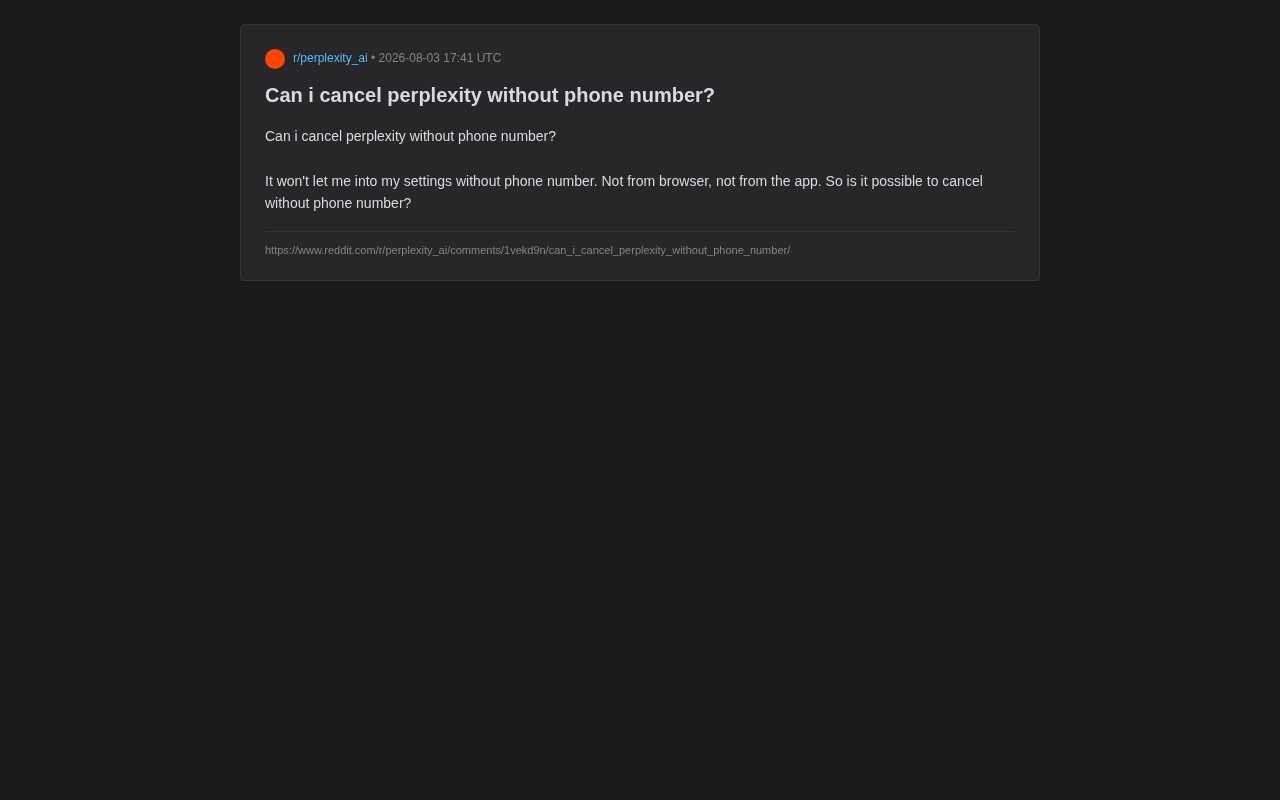
Recently, a Reddit user posted a highly representative question in the community: "Can I cancel my Perplexity subscription without a phone number?"
According to the user, the core issue is this: whether through a browser or the mobile app, the system requires phone number verification to access the settings page, which becomes a roadblock on the path to canceling the subscription.
"It won't let me into my settings without phone number. Not from browser, not from the app."
This seemingly trivial user experience issue actually reflects a contradiction common to AI subscription products today: the enormous gap between the ease of signing up and the complexity of canceling.
Why Does Perplexity Have a "Cancellation Problem"?
The Natural Tendency of Subscription Business Models
Perplexity, an AI product focused on "conversational search," uses a typical SaaS (Software as a Service) subscription model for its Pro plan. In this type of model, the product's revenue is highly dependent on users' continued renewals, so when designing product flows, teams often — intentionally or not — make the "cancel" path more convoluted than the "subscribe" path.
Understanding the SaaS subscription model requires knowing a few core metrics: MRR (Monthly Recurring Revenue) measures the stable subscription income coming in each month; Churn Rate represents the proportion of users who cancel their subscription relative to total subscribers each month. For investors and product teams, even reducing churn by 0.5 percentage points has enormous cumulative long-term effects. It's precisely this metric pressure that drives many products to introduce friction into the cancellation process.
This isn't unique to Perplexity. From streaming services to software, the "one-click subscribe, labyrinthine unsubscribe" design pattern is pervasive across the subscription economy. This approach, known in the industry as a "Dark Pattern," may boost retention metrics in the short term but seriously damages user trust over time. The term Dark Pattern was formally coined by UX designer Harry Brignull in 2010, referring to interface design techniques that deliberately exploit users' psychological weaknesses to induce them into making unintended decisions. Common types include "Roach Motel" (easy to get in, hard to get out), "Misdirection," and "Hidden Costs." The Perplexity case in question fits the classic characteristics of the "Roach Motel" pattern.
Phone Verification as a New Barrier to Cancellation
What makes this case special is that the obstacle isn't a deeply hidden cancel button, but rather account settings themselves being blocked by phone verification. This could stem from several situations:
- The user originally signed in through a third-party account (such as Google or Apple) without binding a phone number
- The account triggered some security verification mechanism that forces phone number completion
- The product added a mandatory phone verification process in certain regions or versions
Understanding this issue from a technical perspective requires knowledge of how OAuth (Open Authorization Protocol) works. When a user selects "Sign in with Google," Perplexity actually uses the OAuth 2.0 protocol to obtain basic identity information (such as an email address) from Google, without requiring the user to create a separate password or provide a phone number on Perplexity. This means the user's account may never have had a phone number bound to it. When the product later adds phone verification as a prerequisite for accessing the settings page — perhaps for MFA (Multi-Factor Authentication) security considerations — a paradox emerges: users must provide information they never provided in the first place just to manage their own account.
Regardless of the reason, when "accessing your own account settings" requires providing additional personal information, this crosses the boundary of reasonable security and constitutes a restriction on user autonomy.
Practical Solutions for Canceling Your Perplexity Subscription
Bypass Phone Verification Through Your Payment Channel
For users facing a similar predicament, a key insight is: subscription cancellation doesn't necessarily have to happen within the product itself. Depending on how you originally paid, you can try the following methods:
Cancel Perplexity subscription through App Store (iOS):
- Open iPhone "Settings" → Tap your Apple ID at the top → "Subscriptions"
- Find Perplexity and tap "Cancel Subscription"
- This path completely bypasses the Perplexity app itself, requiring no phone verification
Cancel Perplexity subscription through Google Play (Android):
- Open Google Play Store → Profile icon → "Payments and subscriptions" → "Subscriptions"
- Select Perplexity and cancel
These two methods work because Apple and Google explicitly state in their app store developer agreements that all in-app purchases (IAP) completed through the App Store or Google Play have subscription management rights belonging to the platform, not the developer. In other words, when you pay through the App Store, Apple is the actual payment recipient, which then shares revenue with the developer (typically at a 70/30 or 85/15 split). Therefore, canceling a subscription is essentially a contract modification between you and Apple/Google, which the app developer has no right or ability to prevent. This mechanism is a cornerstone of consumer protection in the platform ecosystem.
For users who subscribed directly via credit card/PayPal on the website:
- If paid via PayPal, you can directly cancel the authorization in PayPal's "Automatic Payments" settings
- If via credit card, the last resort is to contact your card issuer and explain the situation
Note that canceling through your credit card issuer (i.e., initiating a "dispute" or "stop payment") should be a last resort. Frequent credit card disputes may affect your credit history, and merchants may consider this a breach of contract. A safer approach is to try resolving through official customer support first.
Contact Perplexity Official Support Directly
If none of the above channels apply, the most direct approach is to email Perplexity's official support (support@perplexity.ai), explain the situation of being unable to access settings, and request manual assistance to cancel the subscription. Keep your subscription receipts and communication records for potential future disputes.
Lessons from This Case
Consumers: Leverage the Platform's "Higher-Level Control"
The most important practical takeaway from this case is to remind consumers: when you subscribe through the App Store or Google Play, the platform always holds ultimate control over cancellation. This is a mechanism mandated by Apple and Google to protect consumers, and no app can prevent you from canceling a subscription in system settings. Therefore, when facing "cancellation difficulties," your first instinct shouldn't be to struggle within the app, but to go back to the payment source.
A worthwhile extended recommendation: when choosing AI product subscriptions, prioritize paying through the App Store or Google Play (even if the price may be slightly higher than subscribing directly on the website), because this essentially purchases an extra layer of platform protection. In case of disputes, Apple's and Google's customer service systems and refund policies are typically more standardized and efficient than those of individual developers.
Product Teams: Easy Cancellation Is the Long-Term Play
For AI products like Perplexity that are in a rapid growth phase, user reputation is crucial. A user who becomes resentful due to "cancellation difficulties" is very likely to spread negative experiences through social media — this very case is proof of that.
A truly healthy subscription product should follow the principle of "canceling should be as simple as subscribing." The "Click-to-Cancel" rule promoted by the U.S. Federal Trade Commission (FTC) is a regulatory response to this industry-wide problem. Officially passed in October 2024, the rule requires all merchants offering subscription services to allow consumers to cancel with the same ease as they signed up. Specifically, if a user subscribed through an online click, cancellation must also be achievable through an online click, without forcing users to make phone calls or send emails. Companies violating this rule may face FTC enforcement actions and fines. On the EU side, GDPR (General Data Protection Regulation) Article 17 grants users the "Right to Erasure," requiring businesses to delete personal data upon user request; the Digital Services Act (DSA) also imposes higher requirements on platform transparency and user rights protection.
For AI companies, rather than using friction to retain users, it's better to retain them through product value itself. Netflix founder Reed Hastings once shared a famous philosophy: make cancellation extremely easy, so that when users come back, they're truly returning because of product value. Data confirms this — companies that simplify their cancellation process often enjoy higher win-back rates.
Privacy Concerns
It's worth noting that mandatory phone verification also raises privacy issues. Being forced to provide more personal information just to cancel a service is an unreasonable exchange in itself. In an era of growing data privacy awareness, product teams should carefully design such mandatory verification processes to avoid penny-wise, pound-foolish outcomes.
The privacy risks of phone numbers as personal identifiers are often underestimated. Unlike email addresses, phone numbers are highly unique and persistent — they can be used to track user behavior across platforms, correlate social media accounts, and even become targets of SIM swapping attacks. SIM swapping is when attackers use social engineering to convince carriers to transfer a victim's phone number to a SIM card controlled by the attacker, thereby hijacking all SMS-based two-factor authentication. In recent years, such attacks have led to numerous cryptocurrency account thefts and personal data breach incidents. Therefore, users being cautious about providing phone numbers in non-essential scenarios is a perfectly reasonable security-conscious behavior.
Conclusion
A simple question — "Can I cancel Perplexity without a phone number?" — reveals the broader tug-of-war between consumers and service providers in the subscription economy era. For ordinary users, mastering the key technique of "canceling through the payment channel" can address the vast majority of cancellation difficulties. For AI product teams, getting the "last mile" of user experience right — the exit experience — may earn more lasting trust than any growth hacking tactic.
Key Takeaways
Related articles

Apple Accuses Former Employees of Taking Confidential Data to OpenAI: The AI Talent War Escalates
Apple accuses former employees of taking trade secrets to OpenAI, spotlighting the escalating AI talent war and intellectual property challenges in the tech industry.

Dashi Metrics: A Real-Time Visualization Tool That Maps Revenue Data onto a 3D Globe
Dashi Metrics maps revenue and visitor data onto an interactive 3D globe in real-time, giving SaaS teams and indie founders intuitive geographic visualization of their global business.

Adform Hacked: Why You Should Be Using an Ad Blocker Right Now
Ad tech giant Adform was hacked, exposing security risks in online advertising. Learn why ad platforms are targets, how ad blockers protect against malvertising, and get practical tips on uBlock Origin and Pi-hole.