CostPerPrompt: A Deep Dive into Real-Time AI API Cost Estimation and Pricing Comparison

CostPerPrompt offers real-time AI API pricing comparison and workload-based cost estimation for developers.
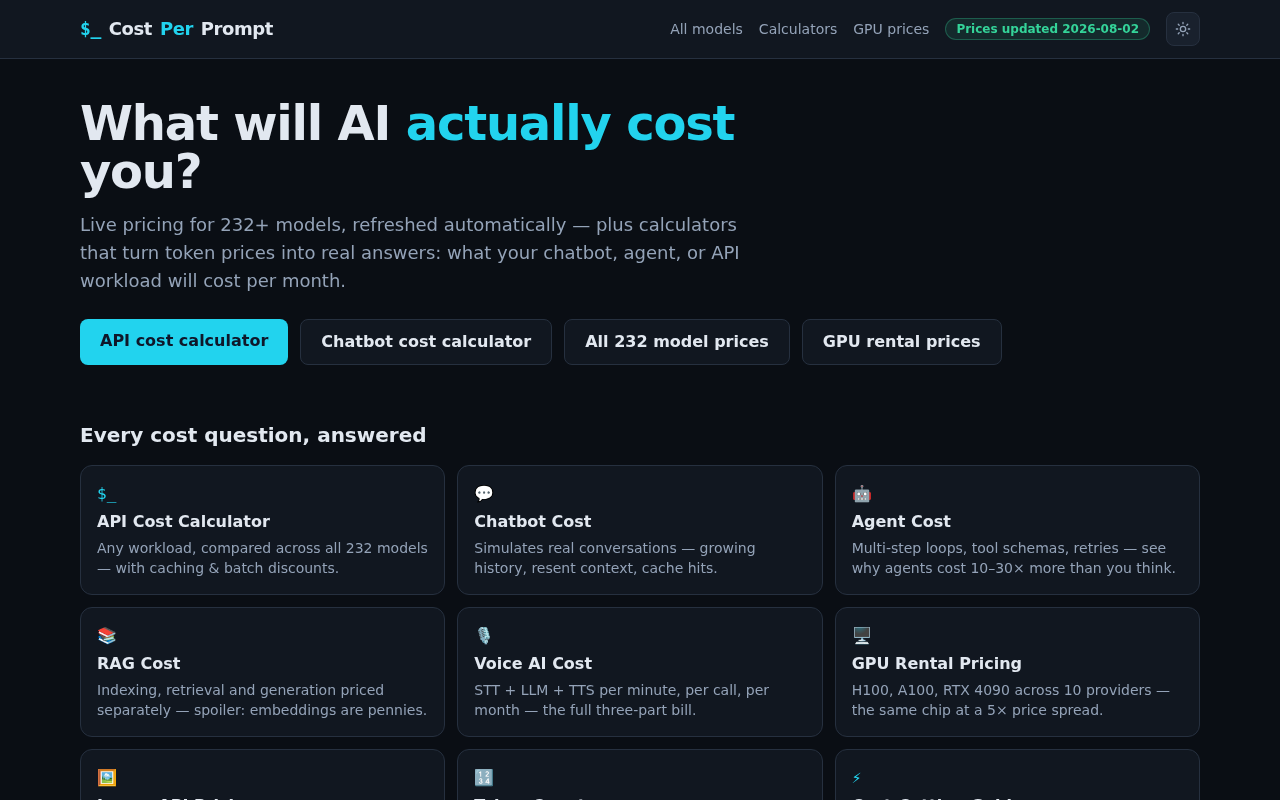
CostPerPrompt is a newly launched tool that provides real-time pricing comparisons across major AI API providers like OpenAI, Anthropic, and Google, while enabling developers to estimate actual monthly costs based on real workload parameters. It addresses the growing need for cost observability as AI applications move from prototypes to production, helping teams make informed model selection decisions by quantifying the true economic impact of token consumption at scale.
When AI API Costs Become an Expense You Can't Ignore
As LLM APIs are integrated at scale into all kinds of applications, "token cost" is evolving from a technical detail into a critical variable that affects product profitability. For any team relying on APIs from OpenAI, Anthropic, Google, and other providers, a seemingly simple question is often surprisingly hard to answer: How much will this feature actually cost per month once it goes live?
Here it's important to understand the technical background of token-based billing: A token is the basic unit by which large language models process text, and it doesn't simply equate to a single word or character. Taking the BPE (Byte Pair Encoding) tokenizer used by OpenAI as an example, one token in English corresponds to roughly 0.75 words on average, while in Chinese, due to encoding characteristics, a single character typically consumes 1.5–2 tokens. This means Chinese-language applications inherently face higher token costs for the same semantic content. Moreover, different providers implement their tokenizers differently, meaning the same text may produce different token counts across different APIs — further complicating cost comparisons.
Recently, CostPerPrompt debuted on Hacker News as a "Show HN" post, targeting precisely this pain point. It's a tool that provides real-time AI API pricing comparisons and real-workload cost estimation. While the project is still in its early stages in terms of community traction, the problem it solves is both widespread and highly practical.
What AI API Cost Pain Points Does CostPerPrompt Address?
Pricing Information Is Fragmented and Constantly Changing
The pricing pages of major LLM providers are all siloed, with significant differences in billing units, context windows, and per-token prices for input vs. output. What makes it worse is that these prices change frequently — a single model iteration or price cut can invalidate your existing cost estimates.
It's worth noting that mainstream API providers universally implement differential pricing for input tokens (prompt tokens) and output tokens (completion tokens), with output tokens typically costing 2–4x more than input tokens. This is because generating output requires autoregressive decoding token by token, which is far more computationally expensive than processing input in parallel. For example, OpenAI's GPT-4o charges $2.50 per million input tokens but $10 per million output tokens. Understanding this mechanism is crucial for cost optimization — streamlining system prompts can reduce input costs, while controlling the max_tokens parameter or using stop sequences can constrain output costs.
One of CostPerPrompt's core selling points is "Live pricing" — real-time synchronization of the latest pricing from each provider. This means developers no longer need to manually comb through multiple vendors' documentation to compare the cost-effectiveness of different models side by side in a single interface.
From "Unit Price" to "Real Workload Cost"
The tool's real value lies in its "real-workload cost calculators." Simply knowing the price per million tokens has limited utility, because actual costs in production depend on specific usage patterns:
- Average input/output token length
- Daily/monthly request volume
- Whether optimization techniques like caching or batching are used
- Scenarios involving mixed calls to multiple models
Regarding caching and batching optimizations, the industry has developed several mature strategies. Prompt caching (such as Anthropic's Prompt Caching and OpenAI's Cached Input) allows repeated system prompt portions to be charged only on the first processing, with subsequent calls receiving 50%–90% discounts. Batch APIs trade real-time response for price discounts, typically offering 50% cost savings — suitable for latency-insensitive scenarios like offline analysis and data labeling. Additionally, semantic caching identifies semantically similar queries and reuses historical responses, significantly reducing costs from repeated calls.
CostPerPrompt incorporates these variables into its calculations, helping developers extrapolate from abstract unit prices to monthly bill estimates that closely reflect production environments. This transformation from "theoretical pricing" to "real-world cost" is exactly the decision-making input that many teams need most during the architecture selection phase.
Why AI API Cost Estimation Tools Are Arriving at the Right Time
AI Applications Have Entered the "Cost-Sensitive" Phase
Over the past year or two, many teams were in an exploratory "get it working first" phase where cost wasn't the primary concern. But as AI features move from demos to scaled deployments, token expenses begin directly impacting gross margins. This is especially true for high-frequency, long-context applications (such as RAG retrieval, Agent multi-turn reasoning, and code generation), where costs can grow exponentially.
Take RAG (Retrieval-Augmented Generation) as an example — it's one of the most popular architecture patterns in enterprise AI applications today, retrieving relevant document fragments from external knowledge bases and injecting them as context into prompts so the model can generate answers based on the latest or proprietary data. However, RAG architectures are inherently token-intensive: each query requires concatenating multiple retrieved document chunks into the input, easily consuming thousands or even tens of thousands of input tokens. When the number of retrieved chunks, chunk size, and request frequency are multiplied together, cost growth far outpaces simple Q&A scenarios.
The cost amplification effect of Agent multi-turn reasoning is even more dramatic. In AI Agent architectures, the model needs to perform multiple rounds of autonomous reasoning and tool calls to complete a single user task. In a typical ReAct framework, an Agent might go through 5–15 "think-act-observe" cycles, each being a complete API call. Because conversation history accumulates, the input token count for subsequent rounds increases linearly. A seemingly simple Agent task might ultimately consume 20–50x the tokens of a single-turn conversation. This is why Agent applications are considered one of the most urgent scenarios for cost optimization.
In this context, the value of a tool that can quickly answer "how much would we save by switching models" or "what happens to costs if we scale this feature 10x" is obvious. It shifts cost from a problem discovered after the fact to a core consideration during architecture design and technology selection.
Side-by-Side Comparison Drives Rational Selection
Price differences between models often span several times or even orders of magnitude. Flagship GPT-4-class models and lightweight models differ enormously in unit price, yet for many tasks, lighter models are already "good enough." Tools like CostPerPrompt enable developers to move beyond "performance-only" or "brand-only" thinking through quantified comparisons, making more economical choices based on actual task requirements.
Objective Assessment: CostPerPrompt's Opportunities and Challenges
As an early-stage project that just debuted on Hacker News, CostPerPrompt's concept hits the mark, but it still faces several challenges before becoming a staple tool in developers' workflows:
Accuracy and timeliness of pricing data: Provider pricing changes frequently. Ensuring "Live pricing" remains consistently accurate is the lifeline of such a tool. Once data lags, estimation results will mislead decisions.
Fit of the estimation model: Real workloads vary enormously. Designing input parameters that are flexible enough without being overly complex directly determines the credibility of estimates.
Competitive differentiation: There are already some similar token calculators and pricing comparison pages on the market. CostPerPrompt needs to build its moat through breadth of data coverage, depth of scenario-specific calculations, or superior user experience.
Conclusion: AI Cost Observability Will Become a Required Course for Engineering Teams
CostPerPrompt represents an increasingly important direction in the AI infrastructure toolchain: cost observability. As large models transition from novelty toys to core components of production systems, keeping track of the economics behind every prompt will become a required course for engineering teams.
Cost Observability borrows from the three pillars of observability in software engineering — logs, metrics, and traces — applying them to the monitoring and analysis of AI API expenses. In practice, this means teams need to log the model, token consumption, and cost of each API call at the code level; build dashboards at the system level to track cost distribution and trends across functional modules; and set up budget alerts and cost anomaly detection at the process level. Tools like LangSmith, Helicone, and Portkey are already positioning themselves in this space, while CostPerPrompt focuses more on the pre-deployment planning and selection phase, forming a complement to runtime monitoring tools.
For developers who are evaluating or already using AI APIs, it's worth incorporating cost estimation tools like this into your technical evaluation process. Even spending just a few minutes doing a cost simulation during the selection phase could save a significant amount of money once you scale up.
Related articles

White House Invites OpenAI and Other Giants to Preview Voluntary AI Framework: Open-Source Language Becomes Key Battleground
Trump administration invites OpenAI, Anthropic, and Google to preview a voluntary AI framework, with open-source language emerging as the core lobbying battleground that could reshape industry competition.

AI Art Prompt Structure Breakdown: Creating a Desert Crystal Pyramid Scene
Breaking down a popular Reddit AI artwork to reveal the five core elements of structured prompts: subject, material, lighting, environment, and atmosphere for AI art scene creation.

$100 Million Deal: AI Gives 50,000 Ukrainian Kamikaze Drones Autonomous Target Lock
A U.S. company struck a $100M deal with Ukraine to deploy AI visual lock-on capabilities on 50,000 cheap kamikaze drones, enabling terminal autonomous guidance to defeat electronic warfare jamming.