White House Invites OpenAI and Other Giants to Preview Voluntary AI Framework: Open-Source Language Becomes Key Battleground

White House previews voluntary AI framework with OpenAI, Anthropic, and Google; open-source wording becomes key lobbying focus.
The Trump administration invited OpenAI, Anthropic, and Google to the White House to preview a new voluntary AI framework stemming from a June executive order. Companies have been lobbying over specific language, particularly around open-source definitions that could determine compliance obligations for model releases. Meta's notable absence from the meeting raises questions about open-source representation. The framework signals a light-regulation approach contrasting with the EU's mandatory AI Act.
Closed-Door Meeting Between the White House and AI Giants
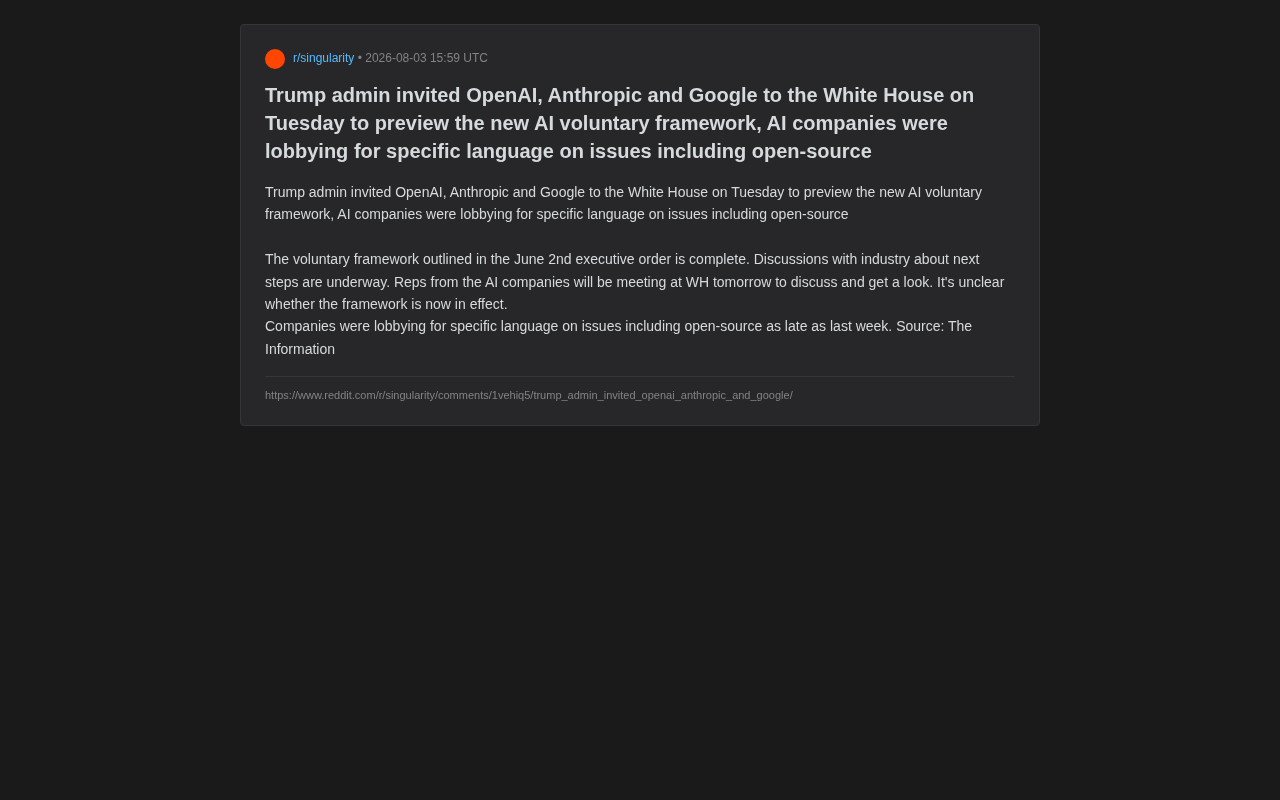
According to tech media outlet The Information, the Trump administration invited three leading American AI companies—OpenAI, Anthropic, and Google—to the White House on Tuesday to preview a new AI "voluntary framework." This framework originated from an executive order signed on June 2nd of this year, and has now been drafted, with the White House engaging in discussions with industry stakeholders about next steps for implementation.
A notable detail: this framework adopts a "voluntary" rather than mandatory regulatory approach—a stark contrast to the Biden administration's preference for executive order-style constraints. In fact, voluntary frameworks are nothing new in American tech governance history. In July 2023, the Biden administration convened seven AI companies including OpenAI, Google, Meta, and Anthropic to sign voluntary commitments covering safety testing, watermarking, and information sharing, though these commitments were dismissed by critics as "paper exercises" due to their lack of enforcement mechanisms. The Trump administration's renewed use of the voluntary approach comes in a very different context—AI capabilities have experienced exponential leaps over the past year, GPT-4-level models have become the industry baseline, and the emergence of multimodal and Agent capabilities has made the risk landscape far more complex. This move is widely interpreted as reflecting the Trump administration's preference for a "light regulation, pro-innovation" stance on AI governance, attempting to maintain America's AI leadership while avoiding excessive compliance burdens on companies.
Notably, after taking office in January 2025, Trump swiftly revoked Biden-era Executive Order 14110 on AI safety—which had required developers to report safety testing results for large models to the government. In its place came a series of new policies focused on promoting innovation and maintaining American competitiveness. The June 2nd executive order is a continuation of this policy trajectory, with the core logic being to treat AI as a strategic national competitiveness asset rather than a risk source requiring strict control.
Framework Content and Uncertainty Over Its Status
Based on currently available information, the specific provisions of this voluntary framework have not been fully disclosed. While the framework outline sketched in the executive order has been "completed," whether it has officially taken effect remains unclear. Representatives from the three AI companies will see the full framework for the first time at the meeting and consult with the government on implementation details.
This "draft first, negotiate later" approach is itself noteworthy. On one hand, it demonstrates the government's desire to quickly establish the basic direction of AI governance; on the other hand, inviting corporate representatives to preview and discuss it also signals that the framework's final form remains open to adjustment. For AI companies, this represents both a window to express their demands and a contest over rule-making authority.
Open-Source Issues Become the Lobbying Focus
The most intriguing detail in the report: as recently as last week, AI companies were still lobbying over specific language in the framework, with one core issue being "open-source."
Why Open-Source Is So Critical
The open-source vs. closed-source debate is one of the most profound philosophical divides in the current AI industry. The open-source camp, represented by Meta's Llama series, advocates for public model weights and community collaboration, arguing this accelerates innovation, lowers barriers, and prevents technological monopoly. Companies leaning more toward closed-source or limited openness, such as OpenAI and Anthropic, emphasize the safety risks and potential for misuse of frontier models, advocating for cautious release.
However, the concept of "open-source" in AI is far more complex than in traditional software. Traditional open-source software (like Linux) follows mature licensing systems such as GPL and MIT, where publishing source code means reproducibility. But AI model "open-source" exists on multiple levels: releasing only model weights, releasing training code, releasing training datasets, and releasing complete training procedures and hyperparameters. While Meta's Llama series releases model weights, its license includes commercial use restrictions and usage limitation clauses, which strictly speaking do not comply with the Open Source Initiative's (OSI) "Open Source AI Definition" published in 2024. Therefore, how the framework defines the boundaries of "open-source"—whether releasing weights alone qualifies, or whether stricter standards must be met—will directly determine which companies and models fall into which compliance categories.
The framework's language on open-source could directly affect: whether open-source models must bear additional safety evaluation obligations, whether model weight releases face restrictions, and compliance costs for companies under different business models. If the framework requires open-source models to undergo safety evaluations before release (such as red-teaming or dangerous capability assessments), this would have profound implications for the entire open-source ecosystem. Currently, the release process for open-source models is relatively straightforward—developers can directly publish weight files on platforms like Hugging Face after training. Introducing evaluation obligations, even voluntary ones, would create de facto industry standards and public expectations, raising the publication threshold for small developers and academic institutions. This also touches on a fundamental technical debate: once model weights are public, anyone can remove safety alignment layers and fine-tune the model, so how effective is it really to impose safety obligations on the publisher? Even a few words' difference could reshape the entire industry's competitive landscape—which explains why companies continue lobbying over "specific language."
Undercurrents of Corporate Interest
The three participating companies do not hold entirely aligned positions on open-source, and their business models and technical approaches differ significantly. OpenAI has transitioned from a nonprofit to a for-profit entity with a valuation exceeding $300 billion, with core revenue dependent on API access and ChatGPT subscriptions, favoring closed-source commercialization. Anthropic, founded by former core OpenAI members, is known for "Constitutional AI" and safety research, with Amazon holding a significant position in its funding structure, seeking balance between safety and commercialization. Google simultaneously operates the closed-source Gemini series and the open-source Gemma series, and its identity as a cloud services giant gives it multiple competing interests in framework discussions.
Notably absent from the attendee list is Meta—currently the largest open-source AI model provider. This absence itself is a telling signal, potentially indicating that the strongest advocate for the open-source camp did not participate in core discussions at the earliest stage of the drafting process.
This means the White House's framework drafting process is effectively seeking balance among multiple interests. Whoever gains the upper hand in the language gains a first-mover advantage in future market competition and the policy environment. The stakes of this battle playing out in White House meeting rooms may extend far beyond a single document.
Deeper Reading of Policy Direction
From a broader perspective, this meeting marks a new phase in U.S. AI governance. The Trump administration's choice of a "voluntary framework" over hard regulations is essentially a value judgment between "innovation freedom" and "risk management."
The advantages of a voluntary framework lie in its flexibility, speed, and business-friendliness, maintaining adaptability amid rapid technological iteration. But its obvious weakness is limited binding force—when a framework relies solely on corporate self-discipline, its actual effectiveness depends heavily on companies' willingness and execution.
For observers in China and other regions globally, this development holds reference value. Every choice America makes in AI regulation produces spillover effects through technical standards, supply chains, and international rules. From the perspective of international AI governance, the EU officially passed the AI Act in 2024, establishing a mandatory regulatory framework based on risk classification that sets transparency and safety obligations for General-Purpose AI (GPAI) models. China has implemented full-process regulation including algorithm filing and safety assessments through regulations such as the "Interim Measures for the Management of Generative AI Services." The UK has chosen a "pro-innovation" route, relying on existing regulators for distributed governance. If the U.S. ultimately establishes a voluntary framework path, it will form a second pole globally that is diametrically different from the EU's hard regulation, potentially attracting more AI companies and capital to concentrate in America, but also potentially creating friction with the EU on cross-border data flows and model exports. The strictness of open-source policy will particularly affect which frontier capabilities global developers can access.
Conclusion
Currently, the complete content of this voluntary framework, its effective date, and the final language regarding open-source all await further official disclosure. What is certain is that AI governance rule-making has moved from abstract discussion to substantive negotiation, and standing at the negotiating table are precisely the key companies determining AI's future direction. The formal publication of the framework text will be a critical moment for assessing the true direction of U.S. AI policy, and deserves continued attention.
Key Takeaways
Related articles

WorkBuddy Step-by-Step Tutorial: Get an Automated Workflow Running in Half an Hour
A step-by-step breakdown of the WorkBuddy automated workflow: why most people only use it as a chat app, how the 27-anchor course and 12 templates help beginners get up and running in half an hour, plus notes on usage boundaries.

The Truth About Free Claude Code: Three Legitimate Paths and One Scam
Is free Claude Code possible? We break down the real cost of Pro and Max (with exchange rates and taxes), how community free methods work and their privacy trade-offs, plus fake installers and phishing traps—and three legitimate free paths.
Codex Cloud Mode Explained: Environment Setup and Use Cases
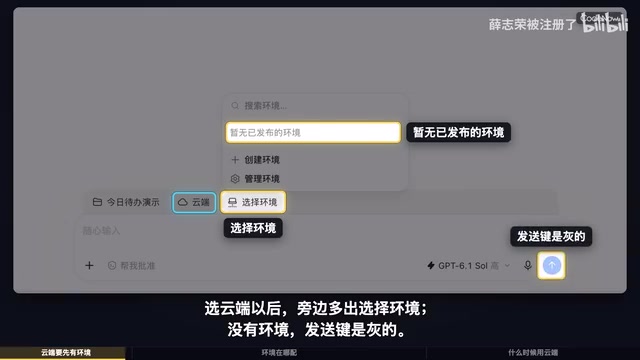
This article explains how Codex cloud mode works, environment setup steps, and use cases, including how to create environments, connect GitHub repositories, set scheduled tasks, and compare cloud vs. local mode.