Cursor Start India Plan at ₹649/Month: Decoding the Regional Pricing Strategy for AI Coding Tools

Cursor launches India-exclusive Start plan at ₹649/month with Grok 4.5 and Composer Agent capabilities.
Cursor has introduced a regional Start plan for Indian developers at ₹649/month (~$7.70), roughly one-third the cost of its US Pro subscription. The plan includes full access to Grok 4.5 and Composer Agent for AI-driven development workflows. This PPP pricing strategy targets India's 17M+ developer community, signaling intensifying competition in AI coding tools and the beginning of global democratization of AI programming capabilities.
Cursor Start: A Tailored AI Coding Plan for Indian Developers
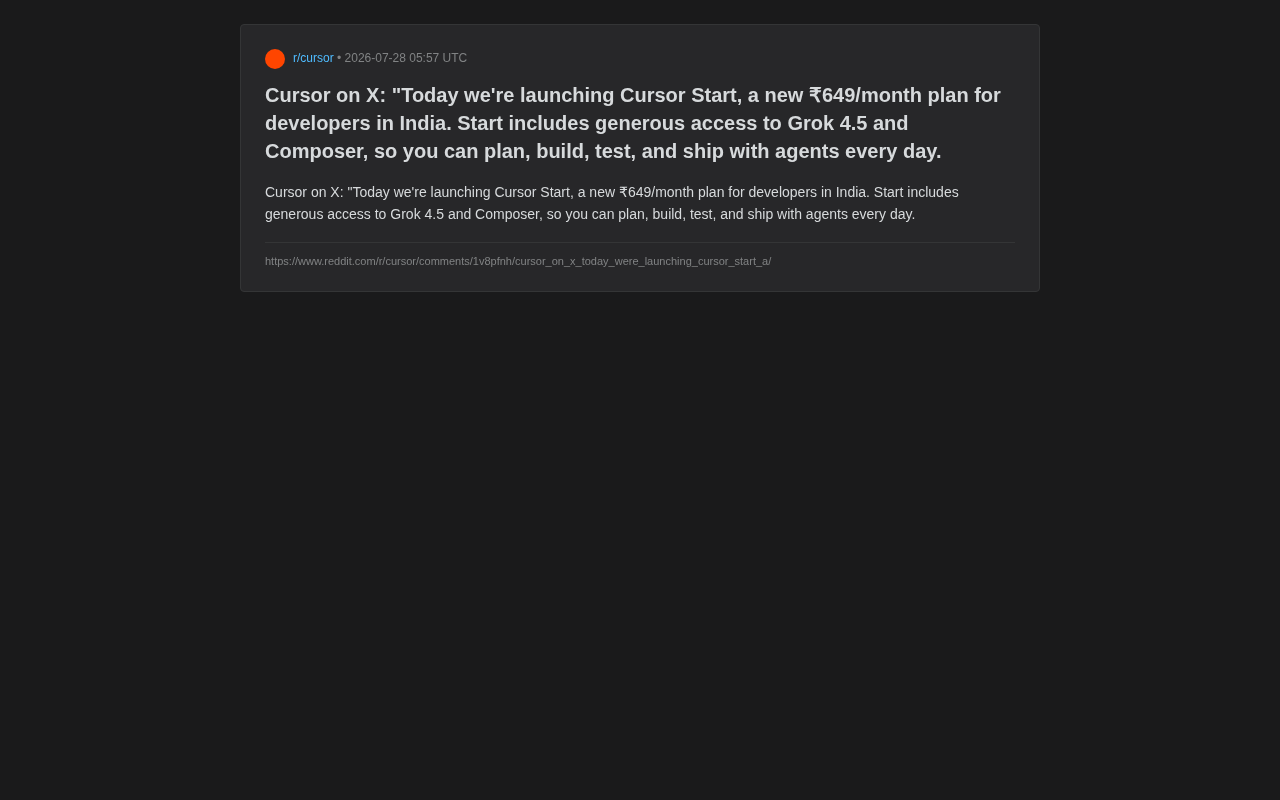
Competition in the AI coding tools space is shifting from feature wars to market wars. Recently, the popular AI code editor Cursor announced a brand-new Cursor Start plan priced at ₹649/month (approximately $7.70 USD), specifically targeting the Indian developer community.
According to Cursor's official announcement on X, this plan is not a stripped-down version but provides full access to Grok 4.5 and Composer — two core capabilities that enable developers to plan, build, test, and ship with AI Agent assistance every day.
This pricing strategy is highly targeted. Compared to Cursor's Pro subscription starting at $20/month in Western markets, the ₹649 price point is roughly one-third of that, clearly designed to align with India's local cost of living and developer income structure.
The Strategic Thinking Behind Regional Pricing
India: The World's Largest Untapped Developer Market
India is home to one of the world's largest software developer communities. According to multiple industry estimates, India's developer population has approached or even surpassed that of the United States, making it the fastest-growing source of GitHub users. According to GitHub's 2024 Octoverse report, India has overtaken the US as the country with the most developers on GitHub, with over 17 million active developers. This massive community has deep historical roots: since the IT outsourcing wave of the 1990s, India has built a global IT services supply chain represented by companies like Infosys, TCS, and Wipro, graduating over 1.5 million engineering students annually. Cities like Bangalore, Hyderabad, and Pune have formed dense technology industry clusters.
Notably, the composition of India's developer community is far more complex than surface numbers suggest. Beyond the large base of Java/.NET developers trained by traditional IT services companies, India's startup ecosystem has been growing rapidly in recent years. Bangalore, known as the "Silicon Valley of Asia," houses the headquarters or R&D centers of over 400 unicorn companies. India's developer education system is also transforming — beyond the IIT (Indian Institutes of Technology) system, numerous online coding bootcamps (such as Scaler and Masai School) are training a new generation of full-stack and AI engineers. This means Cursor is targeting not just existing enterprise developers, but also a rapidly growing population of independent developers and startup technical teams.
However, the dollar-denominated pricing of overseas SaaS tools has long been a barrier for Indian developers. Adjusted for purchasing power parity, a $20 monthly fee is quite expensive for local developers. Indian developer incomes show extreme stratification: senior engineers at top tech companies can earn ₹30-50 lakh annually (approximately $36,000-60,000 USD), but many junior developers and freelancers may earn only ₹20,000-40,000 per month (approximately $240-480 USD). In this income context, a $20/month SaaS subscription represents a significant financial burden.
Cursor's ₹649 local currency pricing is essentially a Purchasing Power Parity (PPP) Pricing strategy. Purchasing power parity is a theoretical framework in economics for measuring the real purchasing power of different currencies across countries, originally proposed by Swedish economist Gustav Cassel in the early 20th century. The core idea is that the same goods priced in different currencies should converge to the same price after exchange rate conversion. However, in reality, due to vast differences in income levels, cost of living, and consumption structures across countries, uniform pricing at nominal exchange rates often excludes users in lower-income nations. PPP pricing addresses this reality by adjusting prices based on the target market's actual purchasing power.
This approach has precedents in Spotify, Netflix, and even some developer tools — Spotify's Premium subscription in India costs only ₹119/month (approximately $1.40 USD), far below the $11.99/month in the US; JetBrains and other developer tools have long offered PPP-based regional discounts. The core logic is: rather than losing vast numbers of potential users due to high prices, it's better to trade lower unit prices for greater market penetration. The key tradeoff is that while per-user revenue decreases, it can significantly expand the user base and achieve total revenue growth in digital products with extremely low marginal costs.
That said, while PPP pricing is theoretically sound, it faces arbitrage risks in practice. Users might obtain low-price regional subscriptions via VPNs or fake addresses — a problem every SaaS company implementing regional pricing must address. Common countermeasures include: requiring local payment methods (such as UPI or local bank cards), IP address verification, and restricting cross-regional account usage. Cursor's choice to price in Indian rupees and likely require Indian payment methods reflects exactly this type of anti-arbitrage mechanism.
The User Acquisition Race in AI Coding Tools
The AI coding tools market is currently in an intense user acquisition phase. GitHub Copilot, Cursor, Windsurf, Cline, and other products are all competing for developer mindshare and usage habits.
Specifically, this competitive landscape can be understood across multiple dimensions. GitHub Copilot, as the first mover backed by Microsoft and OpenAI's resources, holds the largest market share with over 2 million paid users by the end of 2024, priced at $10/month for individuals. Cursor enters the market as a standalone code editor, built on VS Code's open-source core (Electron + Monaco Editor), but with substantial innovation in AI integration depth — particularly its multi-model support and Agent capabilities that have won over technically sophisticated developers. Windsurf (launched by Codeium) also adopts the standalone editor strategy, positioning itself as an "AI-native IDE." Cline takes the open-source route, running as a VS Code plugin that supports users bringing their own API keys for various models. Additionally, players like Augment Code, Sourcegraph Cody, and Amazon Q Developer each occupy their niches.
At the technical architecture level, Cursor's differentiation deserves deeper examination. Cursor is built on VS Code's open-source version (Code OSS), but its core differentiation lies in deeply rewriting the editor's AI interaction layer. It implements a "Shadow Workspace" technology that allows AI to make code modifications and run tests in the background without disrupting the developer's current workflow. Additionally, Cursor's code indexing system builds semantic indexes across entire codebases, enabling more accurate AI understanding of project context. These foundational technical investments give Cursor a structural advantage over plugin-based competitors in Agent-based task execution.
The essence of this competition is that switching costs for AI coding tools are relatively low (unlike traditional IDEs with deep plugin ecosystem lock-in), making user acquisition exceptionally fierce. Price, model quality, interaction experience, and ecosystem integration are all critical variables. Whoever first establishes a user base in high-growth markets will hold the advantage in future paid conversion and ecosystem lock-in.
Cursor's choice of India as the breakthrough point for regional pricing targets precisely this massive, high-growth incremental market. By lowering barriers to help more developers build the daily habit of coding with an Agent, Cursor is essentially paving the way for future monetization.
Cursor Start Plan Details: Grok 4.5 and Composer
The Addition of Grok 4.5
The Cursor Start plan explicitly includes access to Grok 4.5, which is noteworthy. Grok is a large language model series developed by xAI, the company founded by Elon Musk. xAI was established in July 2023, motivated by Musk's dissatisfaction with OpenAI's direction and his concerns about AI safety and openness. The Grok series derives its name from Robert Heinlein's science fiction, meaning "to understand profoundly and intuitively."
As a significant iteration in the series, Grok 4.5 shows notable improvements in code understanding and generation capabilities. Compared to contemporaries like GPT-4o and Claude 3.5 Sonnet, Grok 4.5 demonstrates competitive performance on programming benchmarks, particularly excelling in code comprehension and debugging tasks. Notably, xAI possesses unique computational resource advantages — its "Colossus" supercomputing cluster in Memphis is equipped with a massive GPU cluster, providing powerful compute support for model training and inference.
From a business strategy perspective, xAI's aggressive integration of Grok into third-party platforms (like Cursor) reflects a distribution strategy distinct from OpenAI and Anthropic. OpenAI and Anthropic tend to reach users directly through their own platforms (ChatGPT, Claude.ai) while also providing API services. xAI, beyond its own product (Grok's integration in X), more actively seeks third-party channel partnerships to rapidly expand model usage and market awareness. This strategy aligns with xAI's fundraising cadence — the company completed a $6 billion Series B in 2024 and needs to justify its valuation through rapid scaling.
Including Grok in an entry-level plan enriches Cursor's model selection and reflects the trend of AI coding tools moving toward "multi-model integration" — no longer relying on a single model but matching the most suitable model for different tasks. Cursor's choice to include Grok 4.5 in an entry-level plan may also reflect xAI's aggressive pricing in model distribution, willing to trade lower API call costs for market share.
Composer: The Core Component for Agent-Based Development
Composer in the plan is Cursor's key component for enabling Agent-based development. To understand Composer's value, one must appreciate the paradigm shift occurring in AI coding tools — from "assistance" to "agency" (Agent). The first generation of AI coding tools centered on code completion, like GitHub Copilot's original Tab completion feature, which was essentially context-based code prediction. The second generation introduced conversational interaction, allowing developers to discuss code issues with AI through chat windows. The third generation — the current Agent phase — sees AI gaining the ability to autonomously execute complex, multi-step tasks.
The technical foundations of this Agent-based development mode include: large language models' long context windows (supporting simultaneous understanding of multiple files), tool use capabilities (allowing models to invoke external tools like terminals, browsers, etc.), and reasoning frameworks like ReAct (Reasoning + Acting). The ReAct framework was proposed by a Google research team in 2022, with the core idea of having language models alternate between "thinking" (Reasoning) and "acting" (Acting) during the reasoning process, using observations from actions to guide the next step of reasoning, forming a thought-action loop similar to human problem-solving. Composer is a product of this evolution, allowing developers to describe requirements in natural language while AI automatically completes cross-file code modifications, test execution, and bug fixes. It integrates file editing, terminal operations, and test verification into a single automated workflow, shifting developers from "line-by-line coding" to "requirements-driven automated development."
However, it's important to objectively assess the current technical maturity of Agent-based development. On standardized benchmarks like SWE-bench, the success rate of state-of-the-art coding Agents in resolving real GitHub issues has improved from under 20% in early 2024 to approximately 50-60% by mid-2025 — significant progress but far from perfect. Agents perform best on clearly defined, small-to-medium-scale tasks, while tasks involving complex system architecture decisions or ambiguous requirements still require close developer supervision and intervention. Cursor Start users should maintain a cautious attitude toward Composer's output, especially for production environment code modifications.
The official description of "plan, build, test, and ship" is precisely the complete workflow built around Composer. This means that even entry-level paid users can experience relatively complete AI Agent programming capabilities, rather than just basic features like code completion.
Implications for the AI Tools Industry
Localized Pricing Is a Mandatory Course for SaaS Going Global
Cursor's move provides a reference case for other AI tool vendors. In global competition, a single dollar-denominated price is increasingly insufficient to cover diverse market needs. Currency localization plus PPP pricing may become the standard playbook for AI tools reaching emerging markets.
For Chinese AI coding tools, this also carries lessons — how to design differentiated products and pricing for different regional markets will directly impact their international expansion success. Domestic tools like Tongyi Lingma, Doubao MarsCode, and CodeGeeX currently serve mainly the Chinese market, but as technical maturity improves and overseas strategies advance, regional pricing will become an unavoidable challenge.
Early Signals of an AI Coding Tools Price War
By offering a complete plan with cutting-edge models and Agent capabilities at approximately $7.70/month, Cursor is sending a clear signal: price competition in AI coding tools is intensifying. The economic viability of this pricing strategy largely depends on the dramatic decline in model inference costs over the past two years. In early 2023, API call costs for GPT-4-level models were approximately $30-60 per million tokens (input); by mid-2025, inference costs for models of equivalent capability have dropped over 90%.
This decline is driven by multiple factors: model architecture optimizations, such as Mixture of Experts (MoE) architectures that activate only a subset of parameters during inference, dramatically reducing computational requirements — for example, DeepSeek-V3's MoE architecture has hundreds of billions of total parameters but activates only approximately 37 billion per inference, greatly improving inference efficiency; engineering optimizations in inference frameworks, including continuous improvements to inference engines like vLLM and TensorRT-LLM, as well as techniques like Speculative Decoding and KV Cache optimization; hardware-level advances, with NVIDIA H200, B200, and other next-generation GPUs providing higher inference throughput; and market competition itself — the emergence of efficient models like DeepSeek and the rapid catch-up of open-source models forcing all model providers to cut prices competitively.
The continued decline in inference costs means that tool vendors like Cursor can dramatically lower end-user prices while maintaining reasonable profit margins. As competition intensifies, more vendors may launch regional low-cost plans in the future, with developers ultimately being the beneficiaries.
Conclusion: The Beginning of AI Coding Tools' Globalization and Democratization
The launch of the Cursor Start plan appears on the surface to be a simple regional pricing adjustment, but it actually reflects the reality that AI coding tool market competition has entered deep waters. As technical capabilities increasingly converge, market coverage, user habits, and business model competition will become the deciding factors.
For developers in India and broader emerging markets, this is undoubtedly good news — accessing cutting-edge AI development tools with Grok 4.5 and Composer at a lower cost. For the industry as a whole, this may be just the beginning of the globalization and democratization wave for AI coding tools. In the future, we may see more tools launching similar regional plans targeting Southeast Asia, Latin America, Africa, and other emerging markets, with the democratization of AI coding capabilities reshaping the landscape of global software development.
Related articles

StoryVoice: Automatically Generate Customer Case Studies from 5-Minute Voice Interviews
StoryVoice is an AI case study generator that lets customers record 5-minute voice interviews via a link, automatically producing case studies with real quotes and metrics for B2B marketing teams.

Cloudflare Uses AI to Standardize Engineering Practices: From Standards Drift to Automated Enforcement
Deep dive into how Cloudflare uses LLMs to auto-enforce engineering standards, solving standards drift in large teams. Explores AI code review in CI/CD pipelines, challenges, and implications.

50 Decision Engines: Reshaping Creator Economy Operations with Quantitative Tools
Deep dive into the Sovereign Creator Calculator Suite: 50 Notion-based interactive decision engines covering pricing, churn, ad ROI, and MRR modeling for data-driven creator growth.