StoryVoice: Automatically Generate Customer Case Studies from 5-Minute Voice Interviews

StoryVoice uses AI to turn 5-minute customer voice recordings into publish-ready B2B case studies.
StoryVoice is a new AI-powered tool that streamlines B2B case study production by letting customers record 5-minute voice interviews via an async link. The system transcribes the audio, extracts key quotes and metrics, and generates structured case studies—eliminating weeks of scheduling, writing, and revision cycles. Designed for marketing teams and startup founders who need social proof at scale.
From "Writing Cases" to "Speaking Cases": How AI Is Reshaping the Customer Case Study Workflow
For B2B marketing teams, customer case studies have always been one of the most persuasive yet hardest-to-produce content formats. According to a Content Marketing Institute survey, 73% of B2B marketers consider case studies one of the most effective content types. Their core value lies in providing "third-party validation"—potential customers are more inclined to trust real experiences from peers than vendor self-promotion. A high-quality case study typically covers problem background, solution, implementation process, and quantified results, serving multiple stages of the buyer's decision journey from awareness to evaluation.
However, the traditional process often involves several rounds of email coordination, scheduling meetings, drafting initial versions, back-and-forth revisions, and client approvals… The entire chain can drag on for weeks, consuming significant bandwidth from professional writers and marketing teams.
A recently launched Product Hunt newcomer, StoryVoice, aims to reshape this workflow with AI. Its core proposition is straightforward: send a link to your customer, have them talk for 5 minutes, and AI automatically generates a publish-ready case study—complete with real quotes and quantified metrics, no dedicated writer needed, and no endless follow-ups.
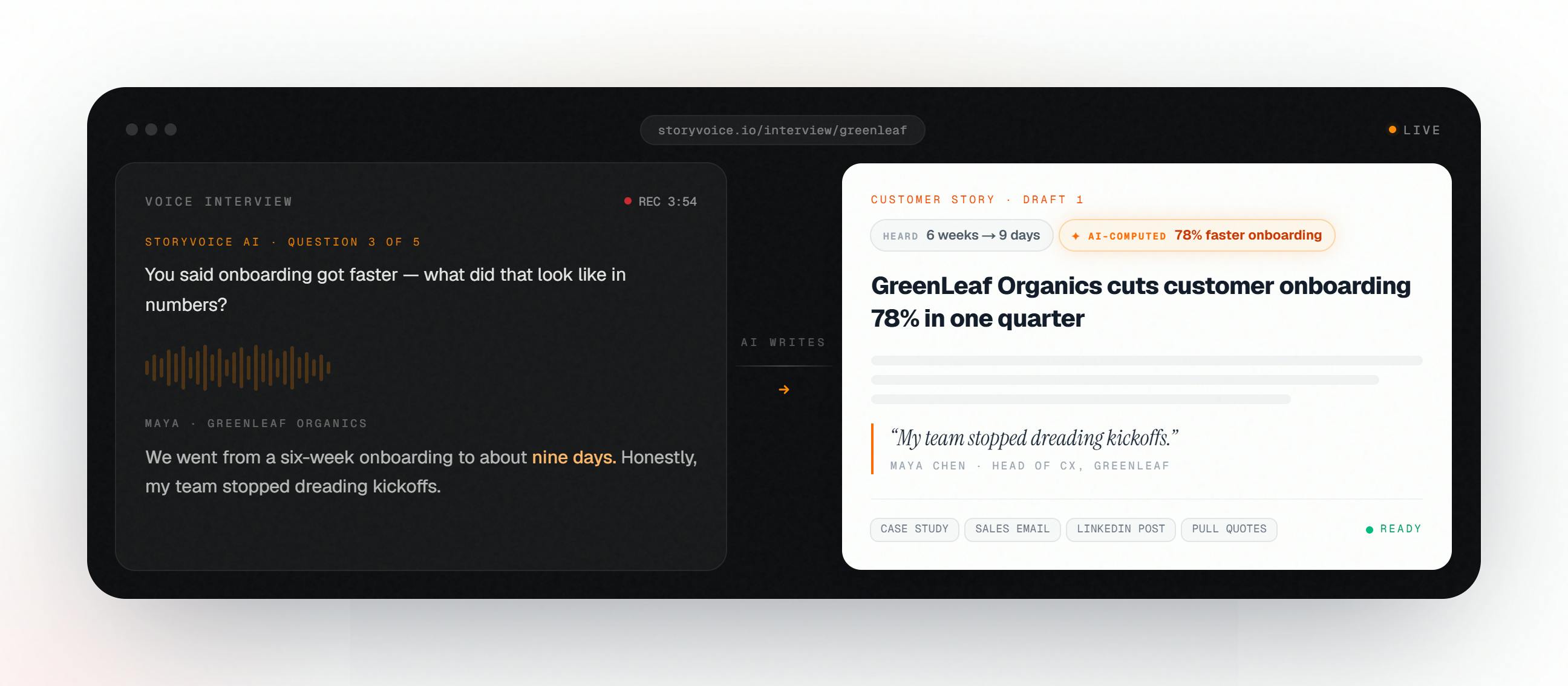
StoryVoice Product Logic: Turning Voice Interviews into Structured Case Content
StoryVoice's workflow can be broken down into three stages:
Step 1: Initiate the interview. Marketers generate a unique link and send it to the target customer—no need to coordinate schedules. This asynchronous link model borrows from the collaboration paradigm validated by async video tools like Loom and Vidyard. In B2B scenarios, customer-side decision-makers and users are often distributed across time zones with packed schedules. Traditional synchronous interviews require both parties to be online simultaneously, while async mode allows customers to complete recordings at any convenient time. According to McKinsey, remote collaboration tool adoption grew approximately 3x between 2020-2023, making asynchronous communication one of the mainstream forms of inter-company collaboration.
Step 2: Voice recording. Customers spend about 5 minutes naturally describing their experience using the product, the problems they encountered, and the results they achieved.
Step 3: AI content generation. The system transcribes the audio, extracts key insights, and assembles them into a fully structured case study. From a technical perspective, this process involves a multi-layered NLP stack: first, Automatic Speech Recognition (ASR) converts audio to text; then Named Entity Recognition (NER) extracts key data points such as company names and numerical metrics; finally, a Large Language Model (LLM) performs topic segmentation, key argument extraction, and narrative restructuring. Advances in modern LLMs' "constrained generation" capabilities—outputting content according to preset templates and structures—make it possible to produce marketing content that meets specific format requirements.
The key design decision here is "voice-first." Compared to having customers fill out lengthy questionnaires or write text feedback, speaking is a much lower barrier and more likely to capture authentic, vivid expressions. This design choice is backed by cognitive psychology research: studies show that human speech rate averages 125-150 words per minute, while typing speed is typically only 40-60 words. More importantly, people tend to use more natural, narrative expressions when speaking, including more emotional color and specific details. This reduction in "cognitive load" means customers don't need to carefully craft every word as they would in written feedback, potentially providing richer raw material.
The product specifically emphasizes preserving "real quotes" and "metrics"—precisely the two most critical assets of a persuasive case study.
Why This Angle Deserves Marketing Teams' Attention
The fundamental reason case studies are hard to produce is a coordination cost problem. They require customer time, marketing team organization, and writer output—all three must align. StoryVoice eliminates scheduling hassles with an async link, lowers customer participation costs with voice, and offloads writing work to AI. All three bottlenecks are weakened simultaneously, theoretically compressing what used to take weeks into days or less.
Target Scenarios: Who Benefits Most from StoryVoice
Based on its Product Hunt categorization, StoryVoice falls under Marketing, Artificial Intelligence, and Audio—a clear positioning that serves marketing teams needing continuous customer testimonial content, startup founders, and SaaS product operations.
For early-stage startups, the value of such tools is especially apparent. Founding teams often lack dedicated content roles yet urgently need social proof to address potential customers' concerns. The concept of social proof originates from psychologist Robert Cialdini's influence theory, referring to people's tendency to reference others' behavior when making decisions under uncertainty. In the SaaS industry, social proof manifests as customer logo walls, testimonials, case studies, and review platform ratings. According to Edelman Trust Barometer data, 63% of B2B buyers say peer recommendations are their primary reference when evaluating new vendors. This explains why even very small teams need to accumulate customer testimonial content early on.
StoryVoice transforms "collecting case studies" from a task requiring dedicated project management into a lightweight, batch-executable action.
Potential Limitations and Usage Recommendations
Any content tool marketed as "fully automated" must face scrutiny on quality and authenticity. A case study's credibility is built on accurate details and genuine customer statements. How AI handles over-embellishment during transcription and polishing, and how it deals with customer misspoken words or vague statements, directly impacts the usability of the final output. Particularly noteworthy is the LLM "hallucination" problem—where AI may fabricate non-existent information—which is especially risky in scenarios requiring precise customer quotes and specific data. Whether 5 minutes of audio can support an in-depth case study also depends on the quality of interview question design.
Additionally, the customer review step remains indispensable—even when AI generates a first draft, quotes and data intended for external publication typically still need client sign-off. Therefore, the "No follow-ups" promise may be better understood in practice as "dramatically fewer back-and-forth communications" rather than completely eliminating the confirmation process.
In terms of traction, StoryVoice currently has 12 upvotes and 11 comments on Product Hunt, ranking 18th—clearly an early-stage product. It validates a real pain point, but whether it can establish a foothold in the competitive marketing tools space depends on its content generation quality and actual customer feedback. It's worth noting that the customer testimonial and case study tool space already includes players like Testimonial.to (collecting video/text recommendations), Case Study Buddy (case study writing services), and UserEvidence (customer evidence platform). More broadly, general AI writing tools like Jasper and Copy.ai also offer case study templates. StoryVoice's differentiation lies in integrating "voice collection" and "case generation" into an end-to-end workflow, rather than just providing writing assistance—a vertical integration strategy increasingly common in the AI tools space, building competitive moats by deeply serving a single workflow rather than pursuing feature breadth.
Summary: Can Voice + AI Become the New Standard for Case Study Production?
StoryVoice represents a pragmatic attempt at AI content generation in a vertical marketing scenario. Rather than pursuing a "big and comprehensive" approach, it precisely targets the high-value, high-cost specific step of "customer case study production," lowering the barrier to content creation with its voice + AI combination. For B2B marketing teams struggling with case study bottlenecks, this "have customers talk for 5 minutes" approach offers at least one new path worth trying.
With speech transcription accuracy already exceeding 95% and LLMs' structured output capabilities maturing rapidly, the "from speaking to writing" content production paradigm is being validated in more and more vertical scenarios. Whether StoryVoice will become the standard tool in the case study space remains to be seen, but the direction it represents—reducing human coordination costs in content production and letting AI handle the transformation from unstructured input to structured output—is undoubtedly a significant trend in B2B marketing tool evolution.
Related articles

Gaussian Process Bandit Optimization: Exploration Strategies and Inference Regret Guarantees
Cumulative regret guarantees in Bayesian optimization fail to reflect final recommendation quality. This article examines a new study that provides inference regret guarantees for Gaussian process bandit optimization through exploration query strategies and fill distance analysis, validated on hyperparameter optimization and control tasks.

The Most Detailed Codex Guide on Bilibili: From Installation to Real-World Practice
The most detailed Codex guide on Bilibili: from app store installation to daily work mode configuration, with a real coffee shop project demonstrating file organization, data extraction, dashboard creation, and other practical tasks. Learn to use Plan Mode and desktop pets to leverage Codex efficiently.

Appearance Compensation in Volume Rendering: Why RGB Accuracy Cannot Guarantee Density Correctness
Volume rendering research reveals that volumetric data perfectly reproducing external RGB views may still contain density errors: appearance compensation can double central density and keep external rays unchanged even when L2 error exceeds 14.52%. Density recovery depends on appearance capacity, spatial resolution, and measurement design.