DeepSeek-Reasonix: A Terminal AI Coding Agent Optimized with Prefix Cache Stability

DeepSeek-Reasonix is a terminal AI coding agent optimized for DeepSeek models via prefix cache stability.
DeepSeek-Reasonix is a terminal AI coding agent written in TypeScript, natively designed for DeepSeek models. Its core innovation lies in deep architectural optimization around "prefix cache stability" — by maintaining a persistent running state to reuse KV Cache computation results, it achieves lower latency, reduced API costs, and more coherent code comprehension. Compared to general-purpose AI coding tools, it differentiates through model focus, performance-first design, and a fully open-source approach, making it ideal for long coding sessions and cost-conscious developers.
DeepSeek-Reasonix Project Overview
DeepSeek-Reasonix is an AI coding agent tool natively designed for DeepSeek models, running directly in the terminal environment. Written in TypeScript, the project has already garnered 857 stars and 53 forks on GitHub, reflecting the developer community's sustained interest in specialized AI coding tools.
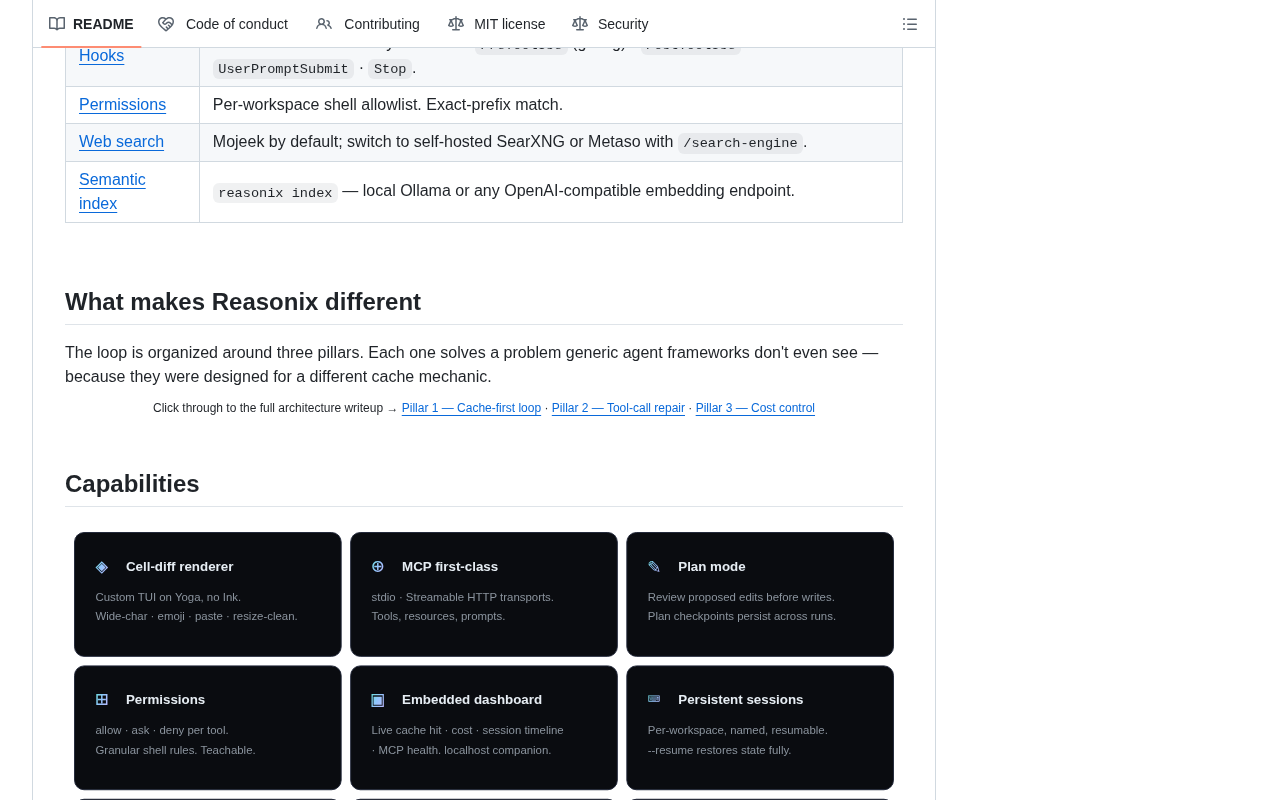
The tool's core design philosophy revolves around "prefix-cache stability," with the official usage recommendation being to "keep it running" — a design philosophy that sets it distinctly apart from the crowd of AI coding agents.
Core Feature: Prefix Cache Stability Mechanism
How Prefix Caching Works
In the inference process of large language models, Prefix Cache is a critical performance optimization technique. When users engage in multi-turn conversations with AI, the context generated from previous exchanges is cached, allowing subsequent requests to directly reuse these computed results. This avoids redundant KV Cache computation, significantly reducing response latency and API call costs.
To understand the value of prefix caching, it's essential to first understand the underlying KV Cache mechanism. In Transformer-based large language models, every time a new token is generated, the Key and Value matrices in the attention mechanism must be computed. KV Cache technology stores previously computed Key-Value pairs to avoid redundant computation during autoregressive generation. Prefix caching takes this a step further — when multiple requests share the same prefix (such as system prompts or prior conversation history), the server can directly reuse the cached KV state, skipping the forward pass computation for that portion. DeepSeek's API service natively supports this mechanism at the architecture level, charging significantly lower fees for cache-hit input tokens (typically one-tenth of the normal price). This creates a powerful economic incentive for engineering optimizations around cache stability.
Why Reasonix Emphasizes "Keep It Running"
DeepSeek-Reasonix has undergone deep architectural optimization around the prefix caching mechanism. Traditional AI coding assistants need to rebuild context from scratch each time they start, whereas Reasonix maintains a persistent running state to ensure cache stability. This design delivers three core advantages:
- Lower response latency: When the cache hits, the model doesn't need to reprocess the full context history, dramatically improving inference speed
- Lower API costs: DeepSeek applies lower billing rates for cache-hit tokens, enabling significant cost savings during long-running sessions
- More coherent code comprehension: Continuous operation ensures the AI's understanding of project structure and code logic isn't lost due to session interruptions
Technical Positioning and Ecosystem Fit
DeepSeek-Native Optimization Design
Unlike general-purpose AI coding tools such as Aider and Cursor, Reasonix explicitly positions itself as a "DeepSeek-native" tool. This means it's specifically optimized for DeepSeek models' reasoning capabilities, context window management strategies, and API interface characteristics. This specialized approach often delivers a superior practical experience in specific scenarios compared to general-purpose solutions.
DeepSeek is a series of large language models developed by DeepSeek (the company). DeepSeek-V3 is renowned for its MoE (Mixture of Experts) architecture, featuring 671B total parameters but activating only about 37B per inference, dramatically reducing computational costs while maintaining high performance. DeepSeek-R1 is the reasoning-enhanced version, trained through reinforcement learning to achieve Chain-of-Thought capabilities similar to OpenAI o1, performing particularly well on mathematical reasoning and code generation tasks. DeepSeek API's pricing strategy is extremely competitive in the industry, and its discount mechanism for cache-hit tokens provides a unique optimization space for tools like Reasonix — by carefully managing context prefix consistency, actual usage costs can be compressed to extremely low levels.
General-purpose AI coding tools, in order to be compatible with multiple model providers (OpenAI, Anthropic, Google, etc.), typically need to adopt a lowest-common-denominator design approach across prompt engineering, context management, and output parsing, making it impossible to fully leverage the unique capabilities of a specific model. A tool focused on a single model ecosystem can perform deep tuning for that model's specific characteristics: for example, optimizing context compression strategies for DeepSeek's tokenization approach, leveraging its proprietary API parameters (such as prefix cache controls) for more granular performance management, and designing more effective prompt templates based on the model's specific behavior patterns in code tasks. This strategy has analogous precedents in the database domain — specialized databases (like the time-series database InfluxDB or the graph database Neo4j) often outperform general-purpose databases in specific scenarios.
Terminal-First Interaction Design
The project chose the terminal as its primary interaction interface, aligning with the daily work habits of a large number of developers. Compared to IDE plugins or web interfaces, terminal tools are lighter and more flexible, seamlessly integrating into existing command-line workflows like Git, Docker, and SSH, reducing the cognitive burden of context switching.
The terminal-first design philosophy is rooted in the Unix philosophy — each tool does one thing well, achieving complex functionality through pipes and composition. In modern development workflows, the terminal remains the central hub connecting various tools: Git version control, Docker container management, SSH remote development, package managers, CI/CD pipelines, and other critical operations all use the command line as their primary interaction method. Choosing the terminal as the vehicle for an AI coding agent means the tool can directly access the file system, execute shell commands, read environment variables, and seamlessly collaborate with developers' existing dotfiles configurations and shell scripts. Compared to IDE plugins that need to adapt to different platform APIs like VS Code and JetBrains, terminal tools inherently offer stronger cross-platform compatibility with lower deployment and maintenance costs.
Market Competitive Landscape Analysis
The AI coding agent space is currently in the heat of fierce competition, from GitHub Copilot to Cursor, from Aider to Claude Code, with each product having its own focus.
AI coding agents have undergone rapid evolution from simple code completion to autonomous coding agents. Early GitHub Copilot primarily performed line-level or block-level code completion based on the Fill-in-the-Middle (FIM) pattern. Cursor introduced deeper IDE integration, supporting multi-file editing and conversational interaction. Aider, as a pioneer among open-source terminal tools, was the first to implement Git-based code change management. Claude Code represents Anthropic's exploration in the agentic coding direction, supporting autonomous execution of terminal commands and file operations. The common trend across these tools is a shift from passive code suggestions to proactive task execution — from the Copilot model to the Agent model — where AI not only generates code but also understands project structure, runs tests, debugs errors, and even autonomously plans multi-step development tasks.
DeepSeek-Reasonix has chosen three differentiation entry points in this competitive landscape:
- Model-focused strategy: Deep investment in the DeepSeek ecosystem rather than pursuing multi-model compatibility
- Performance-first philosophy: Prefix cache stability as the core competitive advantage, emphasizing efficiency gains in long-running session scenarios
- Fully open-source approach: Completely open code, supporting community contributions and enterprise custom deployments
For developers and teams already using the DeepSeek API, Reasonix offers a more cost-effective coding assistance solution.
Typical Use Cases
- Full-stack developers who need continuous AI assistance during long coding sessions
- Startup teams and independent developers looking to effectively control DeepSeek API call costs
- Backend engineers and DevOps professionals who prefer terminal workflows and are comfortable with command-line operations
- AI application projects with deep usage needs for DeepSeek reasoning models (such as DeepSeek-R1)
Summary and Outlook
DeepSeek-Reasonix represents a noteworthy direction in AI coding tool development: rather than pursuing comprehensive feature coverage, it focuses on deep optimization around the underlying technical characteristics of a specific model. The prefix cache stability design philosophy reflects the team's deep understanding of LLM inference mechanisms and delivers tangible performance improvements and cost savings for users.
As DeepSeek model capabilities continue to iterate and improve, and as developers become increasingly sensitive to API costs, the practical value of such natively optimized tools will become even more prominent. For developers looking for cost-effective AI coding solutions, DeepSeek-Reasonix is well worth including in their toolchain evaluation.
Related articles
 Product Reviews
The Programmer's Desk Setup Guide: Building a Workspace That Feels Like Home
Discover how programmers build productive, comfortable workspaces. From multi-monitor setups to ergonomic design, explore the desk philosophy that drives focus and flow.
 Product Reviews
Qoder vs Cursor Real-World Comparison: Which $20/Month AI IDE Is Better?
Hands-on comparison of Qoder vs Cursor AI IDEs: Agent autonomy, human interaction count, and architecture decisions. Qoder needed only 2 interactions vs Cursor's 8.
 Product Reviews
Cursor Cloud Agent Demo: Eliminating Bottlenecks Across the Entire Software Development Lifecycle
Deep analysis of Cursor's Cloud Agent demo showing how cloud VMs, automated test artifacts, and a full-chain control plane systematically eliminate human bottlenecks across the software development lifecycle.