Fay Open-Source Agent Framework: The Connection Layer Between Digital Humans and Business Systems

Fay is an open-source Agent framework connecting digital humans/LLMs with enterprise business systems.
Fay is an open-source Agent framework with 12,700+ Stars on GitHub. Its core positioning is not the digital human itself, but rather serving as a middleware layer — connecting various digital human frontends (2.5D/3D/multi-terminal) on one side, linking to LLMs like DeepSeek through OpenAI-compatible interfaces, and integrating with enterprise business systems on the other. Built with Python, it's suitable for intelligent customer service, virtual streaming, enterprise assistants, and more, helping enterprises quickly achieve AI application business loops.
Project Overview
Fay is an open-source Agent framework focused on solving the connectivity problem between digital humans, large language models, and business systems. The project has earned over 12,700 Stars on GitHub with 2,274 Forks, making it one of the most popular open-source projects in China's digital human space.
In the current wave of AI application deployment, a core pain point is how to make large models and digital humans actually "do work" — that is, integrate with existing enterprise business systems. Fay was built specifically to address this challenge.
Fay's Core Positioning: An Agent Framework, Not a Digital Human Itself
More Than a Digital Human Driver
At first glance, many might simply categorize Fay as a digital human project, but its core value lies in "connectivity." Fay is fundamentally an Agent framework that serves as a middleware layer — connecting various digital human frontends or large language models on one side, and enterprise business systems on the other.
Here it's important to understand the concept of an Agent framework. Unlike simple API calls, Agents have the capability for autonomous decision-making, tool invocation, and task orchestration. They can independently determine which tools to call, which data sources to access based on user input, and chain multiple steps together to complete complex tasks. Current mainstream Agent frameworks include LangChain, AutoGPT, MetaGPT, and others, each focusing on different application scenarios. Fay's unique distinction is that it's specifically optimized for digital human interaction scenarios, tightly coupling the Agent's decision-making capabilities with multimodal output (voice, expressions, gestures), forming a differentiated technical positioning.
This architectural design means that regardless of whether your digital human is 2.5D, 3D, or running on mobile, desktop, or web, Fay can serve as a unified backend framework to support it.
Multimodal Frontend Support
Fay covers mainstream digital human formats in terms of frontend adaptation:
- 2.5D Digital Humans: Suitable for lightweight scenarios such as customer service windows, information display screens, etc.
- 3D Digital Humans: Suitable for immersive interaction scenarios such as virtual streamers, exhibition hall guides, etc.
- Multi-terminal Coverage: Supports deployment on mobile, desktop, and web, meeting the reach requirements of different business scenarios
From a technical implementation perspective, digital human technology can be divided into different forms by rendering dimension. 2.5D digital humans are typically driven by images or videos, achieving lip sync and facial expression changes through facial keypoint detection and deformation techniques, with relatively low computational resource consumption, making them suitable for large-scale deployment. 3D digital humans are based on complete three-dimensional models, using skeletal animation and physics engines to achieve more natural body movements, but with higher GPU requirements. In recent years, with the development of technologies like NeRF (Neural Radiance Fields) and 3D Gaussian Splatting, both the realism and rendering efficiency of digital humans have significantly improved. Fay shields these frontend technology differences through a unified backend interface, allowing developers to flexibly choose the digital human format best suited for their business scenario.
LLM Compatibility: Supporting DeepSeek and OpenAI-Compatible Interfaces
In terms of large language model integration, Fay adopts a pragmatic compatibility strategy. It supports OpenAI-compatible interfaces, meaning that the vast majority of LLM services following the OpenAI API specification can be directly connected, including but not limited to:
- DeepSeek: Explicitly marked as supported in the project, representing domestic Chinese LLMs
- OpenAI-compatible services: Including various locally deployed open-source models (exposed via OpenAI-compatible interfaces through tools like vLLM and Ollama)
The OpenAI API specification has become the de facto standard for LLM services. This specification defines the request and response formats for core interfaces such as Chat Completions, Embeddings, and Function Calling. Due to its broad ecosystem influence, virtually all major LLM service providers (such as Anthropic's Claude, Google's Gemini, and Chinese providers like Zhipu, Baichuan, and Moonshot) offer compatibility layers. Local deployment tools like vLLM (a high-performance inference engine supporting memory optimization techniques like PagedAttention, capable of multiplying inference throughput several times) and Ollama (a lightweight model serving tool for individual developers that can start model services with a single command) also expose OpenAI-compatible interfaces by default, allowing application-layer code to switch underlying models without modification.
This design reduces the cost of model switching. Enterprises can flexibly choose their underlying LLM based on their needs without worrying about framework-level adaptation issues. For example, enterprises can use locally deployed open-source models during development to reduce costs, then switch to commercial APIs in production for better performance and stability — the entire process only requires configuration changes without modifying business code.
Technical Architecture Analysis
Rapid Development in the Python Ecosystem
Fay uses Python as its primary development language, a natural choice in the AI application development field. Python's rich AI/ML ecosystem libraries, active community support, and relatively low barrier to entry enable developers to quickly perform secondary development and customization.
Core Capabilities of the Agent Framework
As an Agent framework, Fay needs to handle core problems including:
- Intent Recognition and Routing: Understanding users' natural language input and mapping it to corresponding business operations
- Business System Integration: Interacting with existing enterprise systems through APIs, databases, etc.
- Multimodal Output: Converting processing results into voice, expressions, gestures, and other multimodal outputs to drive natural interactive feedback from digital humans
- Session Management: Maintaining context state and supporting multi-turn conversations
Among these, intent recognition and routing is a core component of the Agent framework, determining which business processing module should handle user input. Traditional intent recognition relies on NLU (Natural Language Understanding) models for classification, requiring predefined intent categories and extensive labeled training data, with long development cycles and high maintenance costs. In the era of large models, the Function Calling mechanism provides a more flexible solution — developers only need to describe available tools and functions in natural language (including function names, parameter descriptions, and usage scenarios), and the large model can autonomously determine when to call which function and extract corresponding parameters from user input. This significantly reduces the development cost of business integration and is the technical foundation enabling Fay to quickly connect with various business systems. Adding a new business integration point may only require writing a function and adding its description, without needing to retrain models.
Typical Application Scenarios
Fay's architectural design makes it naturally suited for multiple enterprise-level application scenarios:
- Intelligent Customer Service: Digital human appearance + LLM comprehension + business system data queries, building a complete intelligent customer service solution
- Virtual Streamers/Live Commerce: Digital human frontend + product system integration for automated live streaming
- Enterprise Internal Assistants: Connecting to OA, ERP, and other internal systems, completing business operations through natural language interaction
- Exhibition Hall/Store Guides: 3D digital human + product knowledge base, providing immersive product introduction experiences
Community Activity and Project Maturity
The 12,700+ Stars and 2,274 Forks indicate that Fay has considerable influence and user base in the open-source community. The high number of Forks suggests that many developers are conducting secondary development based on Fay, indirectly validating the framework's extensibility and practicality.
For developers and enterprises looking to quickly build digital human applications or bridge LLM capabilities with business systems, Fay offers an open-source option worth serious evaluation. Compared to building from scratch, developing on top of Fay can significantly shorten project timelines, allowing teams to focus their efforts on customizing business logic.
Summary
Fay's core competitive advantage lies in its clear positioning — it doesn't try to be the best digital human rendering engine, nor does it try to be the most powerful LLM. Instead, it focuses on doing "connectivity" well.
In enterprise AI application architecture, this middleware layer takes on critical responsibilities including protocol conversion, process orchestration, state management, and security control. Large models themselves only provide inference capabilities, while enterprise business systems (such as CRM, ERP, OA) each have independent data formats and interface protocols. The value of a middleware framework lies in shielding this heterogeneity and providing a unified development paradigm. Analogous to how the Spring framework or Express framework shields HTTP protocol details for web developers, an Agent middleware lets developers focus on business logic rather than low-level integration details. This is why the importance of middleware frameworks is increasingly apparent as AI applications move from demos to production environments — it is precisely the key link that determines whether a project can truly close the business loop.
Related articles
 Product Reviews
The Programmer's Desk Setup Guide: Building a Workspace That Feels Like Home
Discover how programmers build productive, comfortable workspaces. From multi-monitor setups to ergonomic design, explore the desk philosophy that drives focus and flow.
 Product Reviews
Qoder vs Cursor Real-World Comparison: Which $20/Month AI IDE Is Better?
Hands-on comparison of Qoder vs Cursor AI IDEs: Agent autonomy, human interaction count, and architecture decisions. Qoder needed only 2 interactions vs Cursor's 8.
 Product Reviews
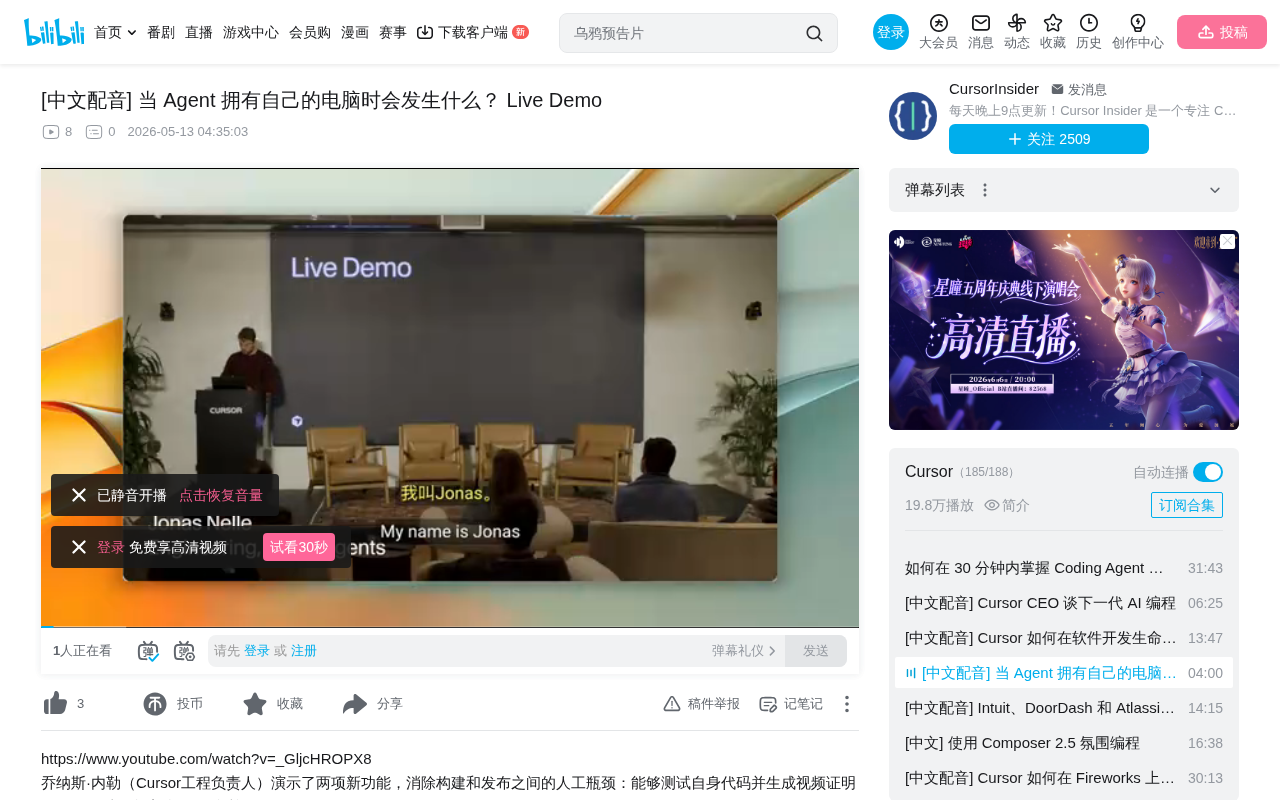
Cursor Cloud Agent Demo: Eliminating Bottlenecks Across the Entire Software Development Lifecycle
Deep analysis of Cursor's Cloud Agent demo showing how cloud VMs, automated test artifacts, and a full-chain control plane systematically eliminate human bottlenecks across the software development lifecycle.