Ferrari Teams Up with IBM: How AI Is Turning F1 Viewers into Superfans

Ferrari and IBM use AI to transform casual F1 viewers into deeply engaged superfans.
Scuderia Ferrari has partnered with IBM to leverage AI for real-time processing of the massive data generated during F1 races, translating complex telemetry into personalized content accessible to fans at every level. The collaboration aims to cultivate casual viewers into high-value "superfans" while balancing technical efficiency with emotional warmth, offering a clear blueprint for AI-driven fan engagement across the sports industry.
Overview
The latest collaboration between Scuderia Ferrari HP and IBM is using artificial intelligence to reshape the Formula 1 fan experience. This isn't just a technology upgrade — it's a fundamental shift in how the sports entertainment industry approaches fan engagement, moving from one-way content consumption to two-way intelligent interaction.
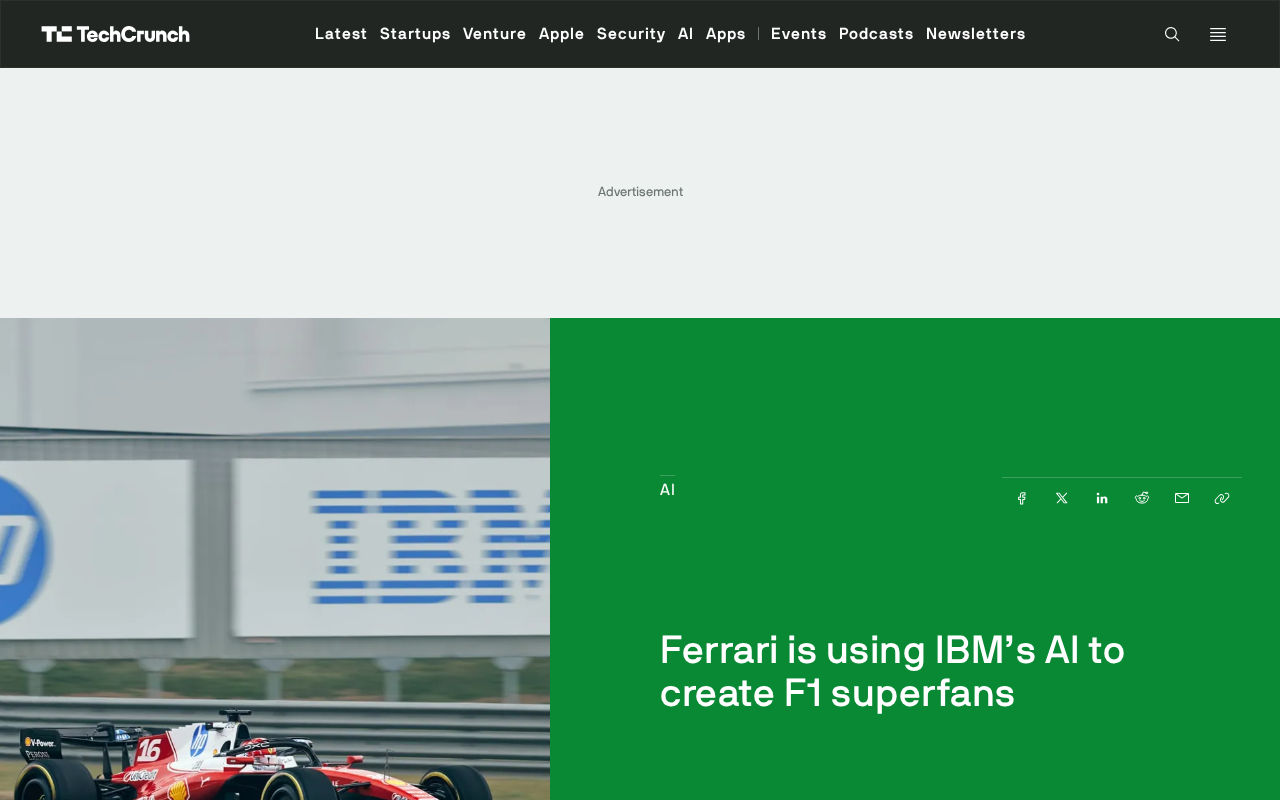
How IBM AI Is Empowering the F1 Fan Experience
Real-Time Transformation of Massive Race Data
Each F1 race generates billions of data points spanning car telemetry, tire degradation, pit stop strategy, weather changes, and many other dimensions. IBM's AI system processes this complex data in real time and transforms it into visualized content that casual viewers can understand and actually want to engage with.
To appreciate the technical sophistication behind this capability, it helps to understand the scale and complexity of F1 data. A modern F1 car is one of the most data-dense pieces of sporting equipment in the world. Each car is equipped with over 300 sensors, generating approximately 1,500 data points per second. A single race can produce tens of terabytes of raw data, covering hundreds of dimensions including engine RPM, brake pressure, fuel consumption, tire temperature and wear gradients, suspension travel, and aerodynamic downforce. Traditionally, this data served the real-time decision-making of team engineers — ordinary viewers had virtually no access to it. What IBM's AI system does is complete data aggregation, pattern recognition, and natural language generation within millisecond-level latency, translating engineer-grade technical information into narratives that the general public can understand. Technically, this requires simultaneously solving three hard problems: stream computing, multimodal data fusion, and personalized content generation.
For seasoned fans, the AI provides deeper strategic analysis. For newcomers just getting into F1, it explains what's happening in the race in accessible, easy-to-understand terms. This layered approach to information presentation effectively lowers the barrier to enjoying F1.
From Passive Viewing to Active Participation
The core objective of this partnership is to convert casual viewers into "Superfans" — not just people who watch races, but deeply engaged, continuously interactive, emotionally connected loyal supporters.
"Superfan" isn't a marketing buzzword — it's a user segmentation concept with clear quantitative definitions in sports economics. According to research from McKinsey, Deloitte, and other institutions, roughly 15%-20% of fans in top sports leagues contribute over 80% of commercial value, including streaming subscriptions, event tickets, licensed merchandise, and brand sponsorship exposure. F1 faces unique challenges in this area: compared to the NFL or the English Premier League, F1's global audience is more dispersed, time zone differences lead to lower live viewing rates, and the complexity of race rules results in noticeably higher churn among new viewers. Since Netflix's Drive to Survive series debuted in 2019, the proportion of female viewers among new F1 fans in North America and Asia-Pacific has risen from 14% to 40%. This wave of new fans is precisely the target audience that AI-powered personalized experiences need to serve most — they're emotionally invested in the sport but lack the technical background, requiring a content guidance path different from that of traditional racing enthusiasts.
IBM's AI technology drives this transformation across three dimensions:
- Real-time strategic insights: AI-driven pit stop predictions and strategy analysis delivered during live races
- Personalized content delivery: Tailored information feeds based on each fan's interests and preferences
- Immersive deep engagement: Creating a sense of participation that goes beyond the traditional broadcast feed
The Accelerating Trend of AI in Sports
Why F1 Is Leading the Charge
As a technology-intensive sport, F1 has a natural DNA for digitization and intelligent systems. Netflix's Drive to Survive documentary series has already proven the enormous power of content innovation to expand F1's audience. AI technology now solves an even harder problem: how to deliver personalized experiences at the scale of millions of users.
The Ferrari-IBM partnership is far from an isolated case. From the NBA's player tracking systems to the Premier League's VAR-assisted officiating, AI is permeating every aspect of the sports industry. But F1's application of AI at the fan experience level is ahead of the entire field. It's worth noting that IBM has been in the sports data intelligence space for over 30 years. Its most well-known case is a long-running partnership with Wimbledon — IBM's AI system generates thousands of personalized match highlights for Wimbledon each year and uses sentiment analysis to predict "highlight moments." The Ferrari collaboration is built on IBM's watsonx platform — IBM's enterprise-grade AI and data platform launched in 2023, which integrates large language models, machine learning pipelines, and data governance tools. It delivers customizable, explainable AI capabilities to the team while ensuring data security and compliance, rather than black-box outputs from generic models.
The Business Logic Behind Superfans
From a business perspective, a single superfan is worth far more than ten casual viewers. They have higher willingness to pay, stronger brand loyalty, and greater influence on social media.
IBM's AI helps Scuderia Ferrari achieve three things:
- Precisely identify high-potential fan segments
- Systematically nurture the conversion path from casual interest to deep engagement
- Continuously maintain the activity and loyalty of superfans
This framework delivers direct commercial returns across the team's sponsorship value, merchandise sales, and membership program operations.
Balancing Technical Efficiency with Emotional Warmth
The biggest risk of introducing AI into the fan experience is making interactions feel cold and mechanical. Over-reliance on algorithmic recommendations can erode the inherent uncertainty and emotional tension that make sports compelling.
This concern has deep roots in both academic research and product design. One of the core appeals of sports is its "unpredictability" — it's precisely this uncertainty that creates emotional peaks. Overly precise personalized recommendations carry the risk of "filter bubbles": when AI only serves users content aligned with their known preferences, it may actually undermine the social function of sports events as "shared experiences." Take football as an example — part of the value of a World Cup final comes from hundreds of millions of people worldwide experiencing the same moment simultaneously. IBM's "AI stays in the background" strategy for the Ferrari fan experience corresponds technically to "context-aware recommendation" rather than "preference reinforcement" — meaning the AI dynamically adjusts content priorities based on the real-time state of the race, rather than relying purely on collaborative filtering based on user history. This approach preserves, to a meaningful degree, the narrative authority of the event itself.
Ferrari has nearly 80 years of racing history, and the brand carries passion, glory, and legend. Whether AI can serve as a tool for enhancing emotional connection rather than replacing emotion itself is the key test for the long-term success of this partnership. Based on the current direction, this restrained design philosophy may well represent the optimal balance between technology and brand warmth.
Looking Ahead: The Dawn of the Superfan Era
The Ferrari-IBM partnership provides a clear blueprint for AI applications in the sports industry. As generative AI capabilities continue to evolve, the fan experience of the future will be more immersive, more personalized, and more real-time.
This isn't just about the future of one sport. It signals the direction of the entire sports entertainment industry — using intelligent technology to close the distance between brands and fans, gradually cultivating every passing viewer into a deeply engaged superfan.
Key Takeaways
- Scuderia Ferrari and IBM are partnering to use AI to transform casual F1 viewers into deeply engaged superfans
- IBM's AI processes massive volumes of race data in real time, delivering personalized viewing experiences for fans at every level
- The partnership reflects the broader trend of AI adoption in sports, aiming to lower barriers to entry and strengthen emotional connections through technology
- Superfans deliver far greater commercial value than casual viewers, and AI helps teams precisely identify and cultivate high-value user segments
Related articles
 Industry Insights
The IRS Mobile App Debate: A Trust Crisis in Government Digital Transformation
The IRS's proposed mobile app has sparked heated debate. This article analyzes the core arguments, exploring data security, privacy, and the trust crisis in government digital transformation.
 Industry Insights
IRS Fully Embraces Claude AI, Accelerating Federal Government's AI Adoption
The IRS is recruiting staff with 24/7 Claude AI access, marking Anthropic's breakthrough into the federal government. Explore the strategic implications and tax use cases.
 Industry Insights
Nadella Introduces the Loopcraft Framework: Building AI Ecosystems Through Feedback Loops
Microsoft CEO Satya Nadella's Loopcraft framework explains how to build frontier AI ecosystems through nested feedback loops across technology, business, and ecosystem dimensions.