The IRS Mobile App Debate: A Trust Crisis in Government Digital Transformation

The proposed IRS mobile app exposes deep tensions between government digital convenience and public trust.
A proposed IRS mobile app has ignited fierce debate over government digital transformation. Supporters cite efficiency gains and global precedents, while opponents raise concerns about data security (recalling the 2015 OPM breach), mobile attack surfaces, and the digital divide. The article examines COBOL legacy debt, zero trust architecture, FedRAMP compliance, and contrasts U.S., Chinese, and EU data governance models.
Introduction: The Deep Power Struggle Behind a Simple Question
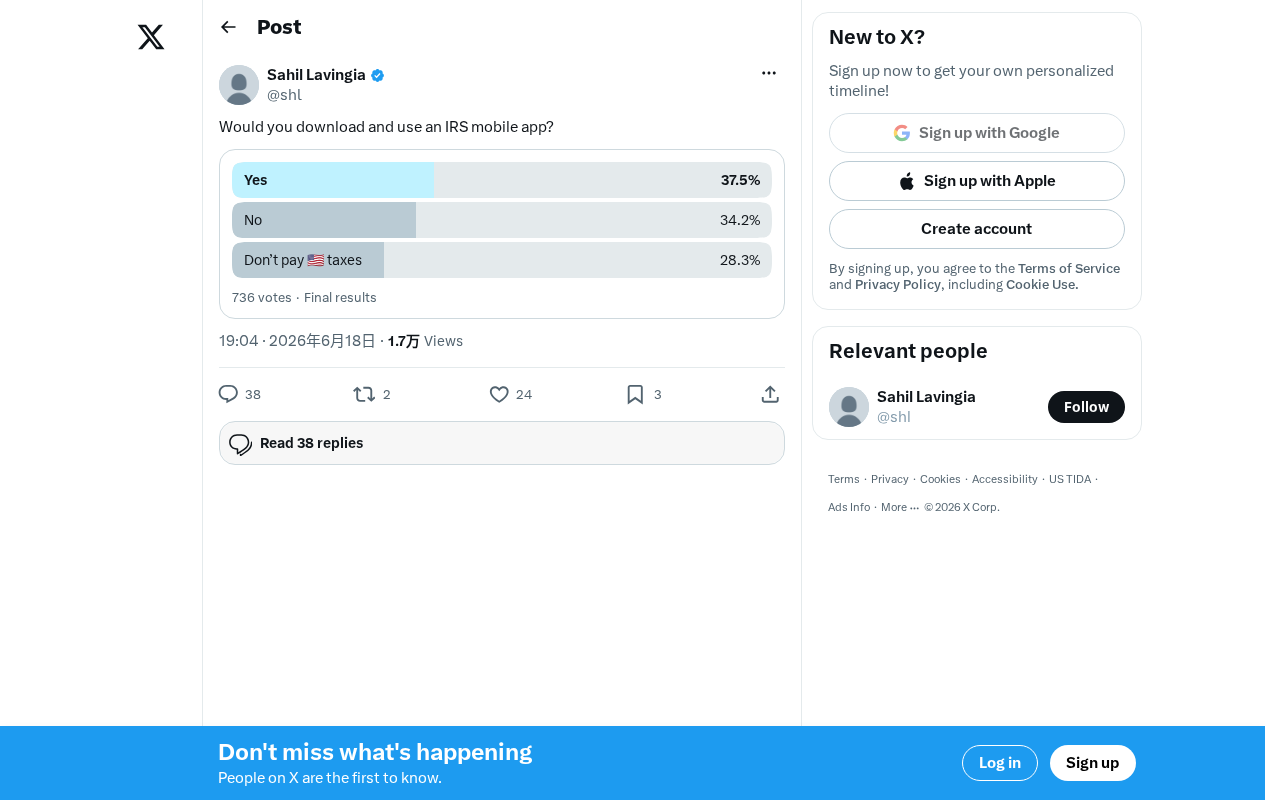
Recently, a seemingly simple poll on social media sparked widespread discussion: "Would you download and use an IRS (Internal Revenue Service) mobile app?" This question touches the most sensitive nerve in government digital transformation — the balance between public trust, data security, and convenience.
The Background of IRS Digital Transformation
A Long Road to Modernization: The Technical Debt of COBOL Legacy Systems
The IRS has long been criticized for its technological backwardness. Parts of its core systems still run on COBOL code from the 1960s, and system crashes during every tax season have almost become a "tradition."
COBOL (Common Business-Oriented Language) is a programming language developed in 1959, designed specifically for business data processing. The IRS's core tax processing system, the Individual Master File (IMF), has been running on COBOL code since the 1960s and still processes hundreds of millions of tax records today. An estimated 220 billion lines of COBOL code exist worldwide, with a significant portion running on mainframes in financial and government institutions. Modernizing these systems is extremely complex: the original developers have long since retired, documentation is incomplete, and the systems are deeply coupled with decades of accumulated business logic. Any hasty migration could lead to catastrophic data errors. This explains why the IRS would rather maintain a "patch-upon-patch" status quo than risk a complete rebuild — the cost of repaying technical debt sometimes far exceeds the original debt itself.
It's worth noting that "technical debt" here is not merely a metaphor. The concept was introduced by software engineer Ward Cunningham in 1992 to describe the long-term maintenance costs accumulated by prioritizing short-term speed. The IRS's COBOL debt has evolved into "compound technical debt" — every new feature layered on top of the legacy system makes future migration more complex, creating a self-reinforcing lock-in effect. The deeper predicament is that this debt has transcended the purely technical realm, becoming a form of organizational inertia: the staffing arrangements, procurement contracts, and operational processes built around legacy systems constitute a vast network of vested interests, making fundamental change difficult to push through even when funding is ample.
COBOL system modernization is not just a technical problem — it's also a talent crisis. Statistics show that the average age of developers proficient in COBOL exceeds 55 globally, and a vast amount of specialized knowledge faces the risk of being lost as the older generation of programmers retires. Some banks and government agencies have had to rehire retired engineers at premium salaries, or commission "COBOL modernization" services from mainframe vendors like IBM — semi-automatically translating legacy code into Java or cloud-native architectures. However, the accuracy of these translation tools is far from 100%, and subtle deviations in business logic may not surface for years, appearing as difficult-to-trace calculation errors. For an institution like the IRS that processes hundreds of billions of dollars in tax revenue annually, this level of uncertainty represents an unbearable risk.
In recent years, the IRS has received billions of dollars in modernization funding, and the mobile app discussion is an extension of this transformation effort. Currently, the IRS already offers digital tools such as IRS Online Account and Direct File, but a full-featured mobile app has not yet been officially launched. The convenience of a mobile platform is particularly attractive to younger taxpayers — features like checking refund status, downloading tax documents, and receiving notifications would undoubtedly greatly improve the user experience if they could be completed with a single tap on a phone.
Why the IRS Mobile App Is Controversial
Judging from social media reactions, public attitudes toward an IRS mobile app are sharply divided. Supporters see it as an inevitable trend in government service modernization, while opponents express deep concerns about data security and privacy protection.
The deeper context of this controversy also involves fundamental flaws in America's digital identity infrastructure. The root cause of America's digital identity dilemma lies in its federalist architecture and the historical political resistance to a national ID card — the Immigration Reform Act of 1996 attempted to establish a unified federal driver's license standard but was met with opposition from both liberals (privacy concerns) and conservatives (federal power expansion). This cross-spectrum resistance means the U.S. still has no federal digital identity standard comparable to the EU's eIDAS framework. NIST (National Institute of Standards and Technology) published the SP 800-63 series of standards defining Identity Assurance Levels (IAL) and Authentication Assurance Levels (AAL), providing a technical specification framework for identity verification in government services. However, unlike Estonia's national eID system or China's resident ID card real-name system, the U.S. lacks a unified federal digital identity infrastructure, forcing agencies like the IRS to rely on third-party identity verification services, thereby introducing new break points in the chain of trust. The IRS previously adopted the third-party identity verification service ID.me, but faced fierce backlash from Congress and civil liberties organizations due to its mandatory facial recognition requirement, ultimately being forced to offer alternative verification methods. This episode profoundly illustrates the unique dilemma the U.S. faces in advancing government digitization: every step of a technical solution must find an extremely narrow balance point between efficiency, privacy, and political acceptability.
Core Arguments in Favor of an IRS Mobile App
Convenience and Efficiency Gains: Lessons from Tax Mobile Apps Around the World
For hundreds of millions of American taxpayers, virtually every interaction with the IRS is accompanied by anxiety. A well-designed mobile app could:
- Check tax status in real time: No more repeatedly calling perpetually busy customer service lines
- Receive notifications securely: Replacing paper letters that are easily lost or ignored
- Simplify document management: Access W-2s, 1099s, and other tax documents anytime
- Speed up the refund process: Reduce delays caused by missing information
Multiple countries worldwide have accumulated rich experience with tax service mobilization, providing the IRS with useful reference models. Australia's myGov platform integrates multiple government services including tax, healthcare, and social security, with its ATO (Australian Taxation Office) App supporting facial recognition login and real-time refund tracking, maintaining consistently high user satisfaction. The UK's HMRC App uses a strict Government Gateway identity verification system and undergoes regular independent audits by the National Cyber Security Centre (NCSC). Estonia, as a "digital government" benchmark nation, has built its e-Tax system on a national digital identity card (eID) system, achieving highly secure end-to-end tax digitization. The common lesson from these cases is that successful government tax apps are not standalone products but are built on robust national digital identity infrastructure, requiring ongoing transparency efforts to maintain public trust.
Estonia's digital government practice deserves particularly close examination. This small Baltic nation of only 1.3 million people began systematically building national digital infrastructure in the late 1990s. At its core is the X-Road data exchange layer — a distributed architecture that allows different government databases to securely interconnect. Every data query is recorded in a blockchain-style audit log, and citizens can check at any time which government agencies have accessed their data. This "transparency as trust" design philosophy is key to the high public acceptance of Estonia's digital government. However, the replicability of the Estonian model faces fundamental limitations: its success largely depends on the governance flexibility of a small state, a relatively homogeneous social structure, and the historical opportunity to build digital infrastructure from scratch — conditions that are nearly impossible to replicate for the United States, with its 330 million people and dozens of independent federal and state-level systems.
The Nordic "pre-filled tax return" model is also worth noting. The reason tax apps in countries like Norway and Sweden can achieve a "one-click confirm and finish" minimalist experience is fundamentally because their backends have established standardized direct data connections between employers, financial institutions, and tax authorities — the tax authority has already automatically collected the vast majority of taxpayers' income information from third parties before the filing season begins. Because taxpayer data in the U.S. is scattered across thousands of employers and financial institutions, and there is no unified data reporting standard interface, the technical complexity of achieving similar functionality is orders of magnitude higher. This means that even if the IRS successfully launches a mobile app, its user experience will likely fall considerably short of the Nordic model.
Core Concerns Against an IRS Mobile App
Data Security and Privacy Risks: The Shadow of the OPM Breach
Tax data is among the most sensitive personal information, containing core privacy elements such as income, bank accounts, and Social Security numbers. Opponents' concerns primarily center on:
- Poor government cybersecurity track record: U.S. federal agencies have experienced multiple large-scale data breaches historically, with the 2015 OPM breach being particularly emblematic
- Larger mobile attack surface: Phone loss, malware, insecure Wi-Fi, and other factors can all become attack vectors
- Surveillance concerns: Some of the public worry the app could be used for data collection beyond the scope of taxation
- Political trust crisis: In the current politically polarized environment, some groups hold fundamental distrust toward federal agencies
The 2015 Office of Personnel Management (OPM) data breach was one of the most severe cybersecurity incidents in U.S. government history. Hackers (later attributed to Chinese state-sponsored actors) stole highly sensitive information of approximately 21.5 million federal employees and their dependents, including Social Security numbers, fingerprint data, security clearance records, and even mental health files. The devastating nature of this breach lay in the irrevocability of the data — unlike credit card numbers, which can be replaced, fingerprints and personal background information are permanently exposed once leaked. The OPM incident profoundly reshaped American public confidence in federal agencies' digital security capabilities and set an extremely high trust threshold for any subsequent government digitization project. The strong pushback against an IRS mobile app cannot be understood without recognizing the shadow cast by the OPM breach.
The OPM incident exposed not just technical vulnerabilities but a systemic failure in federal agency cybersecurity governance. Post-incident investigations revealed that the attackers had lurked within OPM's network for over a year, continuously conducting lateral movement and data exfiltration while OPM's security team remained completely unaware. The success of this APT (Advanced Persistent Threat) pattern was rooted in OPM's lack of basic network segmentation, anomalous traffic monitoring, and privileged account management mechanisms. Even more ironic is that OPM had received multiple security warnings from the Government Accountability Office (GAO) before the incident but failed to implement corrective measures due to budget and priority issues. This pattern is not unique to OPM and reflects the structural problem of "insufficient security investment and absent accountability mechanisms" that has long existed in U.S. government IT governance.
The technical implications of the mobile attack surface deserve deeper understanding. In cybersecurity, the "attack surface" refers to the sum of all entry points in a system that could potentially be exploited by malicious actors. Mobile applications inherently have a larger attack surface compared to desktop web services: first, the physical security risk of the device itself is higher — a lost or stolen phone directly exposes locally stored data; second, the fragmentation of mobile operating systems (especially the Android ecosystem) results in uneven security patch coverage; third, users are accustomed to using phones on public Wi-Fi, significantly increasing the risk of man-in-the-middle (MITM) attacks; fourth, app stores contain numerous malicious apps that impersonate official applications, making it difficult for ordinary users to distinguish them. Additionally, mobile apps typically need to request system permissions such as camera, location, and contacts access — if permissions are poorly managed, they provide technical conditions for excessive data collection. These factors combined make sensitive tax-level data face far more complex security challenges on mobile platforms than on PCs.
One modern approach to addressing the mobile attack surface is Zero Trust Architecture (ZTA). Its core principle is "never trust, always verify" — instead of assuming any network environment or device is safe, it strictly verifies identity, checks device health, and enforces least-privilege authorization for every data access request. In 2021, the Biden administration signed an executive order requiring federal agencies to complete migration to zero trust architecture by 2024, after which CISA (Cybersecurity and Infrastructure Security Agency) released a specific federal zero trust strategy, requiring comprehensive progress across five pillars: identity, devices, networks, applications, and data. However, public-facing mobile apps present a unique dilemma: federal agencies typically control government-issued devices through MDM (Mobile Device Management) systems, but apps designed for ordinary taxpayers cannot enforce device compliance — a contradiction for which no perfect solution currently exists. In the mobile app context, zero trust means that even after a user has completed login, every sensitive operation (such as viewing a full Social Security number or modifying bank account information) still requires re-verification of identity, and the system continuously assesses the device's security state — whether the latest patches are installed, whether jailbreak or root behavior is detected, and whether the device is in an abnormal geographic location. While this "continuous verification" model adds friction to the user experience, it is a necessary trade-off when handling tax-level sensitive data on mobile devices.
The Digital Divide Problem
Not all taxpayers own smartphones or have the ability to use complex apps. If the IRS over-relies on mobile channels, it could further marginalize the elderly, low-income groups, and rural residents.
The digital divide has special fairness implications in the tax context. According to Pew Research Center data, smartphone ownership among Americans aged 65 and older is approximately 61%, far lower than the 96% among the 18-49 age group; about one-quarter of households earning less than $30,000 annually lack home broadband connections. For these groups, a mobile app is not a convenience tool but a new barrier to access. The deeper issue is that the legal obligation of tax compliance is not waived based on differences in digital capability — if the government shifts service channels toward mobile, it effectively transfers compliance costs to the groups with the weakest digital capabilities.
This issue in the U.S. is further compounded by significant racial and geographic dimensions. Broadband coverage in rural areas has consistently lagged behind urban areas, and digital device ownership rates in some minority communities are below the national average. FCC (Federal Communications Commission) broadband map data shows that millions of American households remain in "digital deserts." Therefore, any responsible government digitization strategy must treat "digital inclusion" as a design principle equally important as security, ensuring that a mobile app serves as a supplement to, not a replacement for existing service channels, while simultaneously advancing broadband infrastructure development and digital literacy training programs.
Technical Perspective: How to Build a Trustworthy Government App
If the IRS does proceed with a mobile app plan, the following technical practices will be key to establishing public trust:
- End-to-end encryption: Ensuring security of data transmission and storage
- Multi-factor authentication: Combining biometrics with hardware keys
- Open-source auditing: Allowing independent security researchers to review code
- Data minimization principle: The app should request only the minimum permissions necessary to function
- Offline functionality: Reducing data exposure on the network
- Zero trust architecture: Continuously verifying identity and device security state for every sensitive operation
- FedRAMP compliance: Ensuring all cloud service backends pass federal security authorization certification
Among these, open-source auditing deserves special attention. Open-source auditing refers to the practice of making software source code public, allowing independent security researchers, academic institutions, and the public to review it. In the realm of government software, this practice carries special political and technical significance. On the technical level, the "many eyes" effect (Linus's Law: given enough eyeballs, all bugs are shallow) helps discover hidden security flaws; on the political level, code auditability is a powerful response to concerns about "government backdoors." European countries like Germany and France have already promoted government software open-sourcing as a policy requirement. However, open source is no silver bullet — making code public also means attackers can more systematically search for vulnerabilities, so it must be paired with rapid vulnerability response mechanisms. For an institution like the IRS, a compromise approach is a "Responsible Disclosure" program, inviting security researchers to conduct vulnerability discovery under controlled conditions rather than fully open-sourcing the code. The Department of Defense's "Hack the Pentagon" bug bounty program has already proven the feasibility of this model, providing a replicable template for government agencies.
The role of the FedRAMP (Federal Risk and Authorization Management Program) framework is also worth noting. Any vendor providing cloud services to federal agencies must achieve FedRAMP certification. This framework, based on the NIST SP 800-53 security control standards, requires vendors to undergo independent audits by accredited Third-Party Assessment Organizations (3PAOs) and continuous security state monitoring. If the IRS mobile app adopts a cloud backend architecture — almost a certainty in modern app development — all cloud services it depends on must comply with FedRAMP requirements. This mechanism serves as both a security safeguard and an explanation for why government digitization projects progress far more slowly than commercial products: a single FedRAMP authorization process typically takes 12-18 months and involves documentation and verification of hundreds of security controls. This institutional friction, while safeguarding security, also constitutes a structural barrier to government digital innovation. Notably, FedRAMP has recently introduced transitional statuses like "FedRAMP Ready" and "FedRAMP In Process," attempting to accelerate the certification process without lowering security standards, but critics argue these improvements are still far from sufficient to match the iteration speed of commercial technology.
Implications for Chinese Readers: A Comparison of U.S. and Chinese Government Digitization
China's "Individual Income Tax" App has been operating for several years, covering core functions such as annual tax reconciliation and special additional deduction declarations, with a user base numbering in the hundreds of millions. The app, led by the State Taxation Administration, has become one of the world's largest tax mobile applications since its official launch in 2019, with over 200 million registered users. It leverages China's relatively mature digital identity infrastructure — resident ID numbers and mobile phone real-name registration — to achieve a highly integrated identity verification system, with direct connections to banking systems enabling rapid tax refunds.
From a technical architecture perspective, the success of China's Individual Income Tax App benefits from a "direct data connection" architecture: through the national unified tax information network established by the Golden Tax Project, the app's backend can retrieve employer-reported income data in real time, eliminating the need for users to manually enter large amounts of information. This pre-filled model dramatically lowers the barrier to user operation and fundamentally reduces tax disputes caused by manual input errors. By contrast, because taxpayer data in the U.S. is scattered across thousands of employers and financial institutions and lacks a unified data reporting standard interface, even if a mobile app were launched, achieving a similarly seamless data integration experience would be extremely difficult.
In comparison, the U.S. has notably lagged in digitizing government services. This contrast reveals not just differences in technical paths but how two models of social contract manifest in the digital age: efficiency-first versus privacy-first, centralized governance versus checks and balances. China's model was able to advance rapidly due to overall societal acceptance of government digital services, a relatively centralized data governance architecture, and privacy concepts that differ from those in the West.
From the perspective of data governance architecture, this difference has institutional roots. China's Personal Information Protection Law (PIPL) and Data Security Law retain considerable latitude for government data access, whereas the American privacy protection system, though fragmented, has multiple layers of legal constraints on government data collection including the Privacy Act of 1974 and the Electronic Communications Privacy Act (ECPA), plus independent state-level privacy legislation under the federalist system (such as California's CCPA), forming multiple institutional checks on government digitization. The EU's GDPR represents a third path: centering on strict data subject rights and independent regulatory bodies, it seeks a European-style balance between efficiency and privacy. The coexistence and competition of these three models constitute the fundamental tension in the current global digital governance landscape.
Each of these three models carries its own costs in practice: the Chinese model sacrifices a degree of data autonomy for extremely high service efficiency; the American model trades institutional friction for checks on government power; and the EU model exchanges compliance costs for systematic protection of data subject rights. No single model is universally optimal — each model's legitimacy is rooted in its society's historical traditions, political culture, and the foundation of citizens' trust in government.
These fundamental value choices ultimately determine the pace and public acceptance of government apps, reflecting deep differences across societies in privacy concepts, government trust levels, and technology governance models.
Conclusion
"Would you download the IRS app?" The answer to this question ultimately depends on a more fundamental proposition: In the digital age, can the government earn sufficient technical trust from its citizens? Convenience and security are not irreconcilable contradictions, but bridging the divide requires transparent governance, rigorous technical standards, and ongoing public dialogue.
From the technical debt of COBOL legacy systems to the trust scars left by the OPM breach; from the modern security paradigm of zero trust architecture to the institutional friction of FedRAMP certification; from the lessons of Estonia's digital government to the fundamental divergences in U.S., Chinese, and European data governance models — the IRS mobile app, a seemingly simple product decision, is in fact a microcosm of the convergence of technology, institutions, politics, and social values. Understanding these deeper dynamics is a necessary prerequisite for evaluating any government digitization project.
Key Takeaways
- The discussion around an IRS mobile app has sparked public debate over trust in government digital services
- The IRS core systems still run on 1960s COBOL code; technical debt compounded by a talent crisis is the biggest obstacle to modernization; the "compound effect" of technical debt means every patch deepens the difficulty of future migration
- The U.S. lacks unified digital identity infrastructure, rooted in its federalist architecture and historical political resistance to a national ID; the ID.me facial recognition controversy reflects the institutional dilemma of government digitization
- Supporters value convenience and efficiency gains, with successful precedents in Australia, the UK, Estonia, and other countries; however, the Nordic pre-filled model depends on direct data connection infrastructure that the U.S. cannot replicate in the short term
- Opponents worry about data security (with the OPM breach as a cautionary tale), the expanded mobile attack surface, and digital divide issues; the digital divide also overlaps with racial and geographic dimensions of inequality
- On the technical level, building trust requires zero trust architecture, end-to-end encryption, FedRAMP compliance, and responsible disclosure programs; zero trust faces a unique device management dilemma in public-facing apps
- Three data governance models coexist across the U.S., China, and the EU, each with its own institutional costs, reflecting different societal value choices between efficiency-first, privacy-first, and checks-and-balances approaches
Related articles
 Industry Insights
IRS Fully Embraces Claude AI, Accelerating Federal Government's AI Adoption
The IRS is recruiting staff with 24/7 Claude AI access, marking Anthropic's breakthrough into the federal government. Explore the strategic implications and tax use cases.
 Industry Insights
Nadella Introduces the Loopcraft Framework: Building AI Ecosystems Through Feedback Loops
Microsoft CEO Satya Nadella's Loopcraft framework explains how to build frontier AI ecosystems through nested feedback loops across technology, business, and ecosystem dimensions.
 Industry Insights
OpenAI's Internal Codex Usage Surges 56x — AI Coding Is Eating Everything
OpenAI reveals internal Codex usage data: Research up 56x, Customer Support 32x, Engineering 27x, Legal 13x since Nov 2025. AI coding tools are penetrating every department faster than expected.