GitHub Daily · August 6: Giving AI Agents a Real Computer

Cloudflare/computer tops GitHub Trending as AI Agent competition shifts from model power to execution environments.
Cloudflare/computer exploded with ~900 new stars, providing AI Agents with secure virtual computing sandboxes on edge infrastructure. This signals the Agent competition shifting from model capabilities to execution environments. Meanwhile, authentik offers mature self-hosted identity authentication, Guava remains Java's evergreen utility library, AutoGPT holds its position as the Agent pioneer, and ChinaTextbook demonstrates open source serving public education needs with 76K+ stars.
GitHub Daily · August 6: Giving AI Agents a Real Computer
Today's GitHub Trending list presents a fascinating combination: there's Cloudflare's freshly launched Agent infrastructure newcomer that racked up nearly 900 stars in a single day, established veterans like AutoGPT and Guava still holding strong positions, and even a Chinese textbook repository serving everyday "public welfare" needs. This list reads like a cross-section of the open-source world — on one end, the cutting-edge AI Agent infrastructure race; on the other, engineering cornerstones that have withstood over a decade of testing; and sandwiched in between, tools solving real problems for ordinary people.
If I had to distill today's keyword, it would be "Agent runtime environments." As large model reasoning capabilities mature, industry attention is shifting from "the model itself" to "how to make the model actually get things done." Cloudflare/computer topping the charts is the latest footnote to this trend. Let's dive into each project.
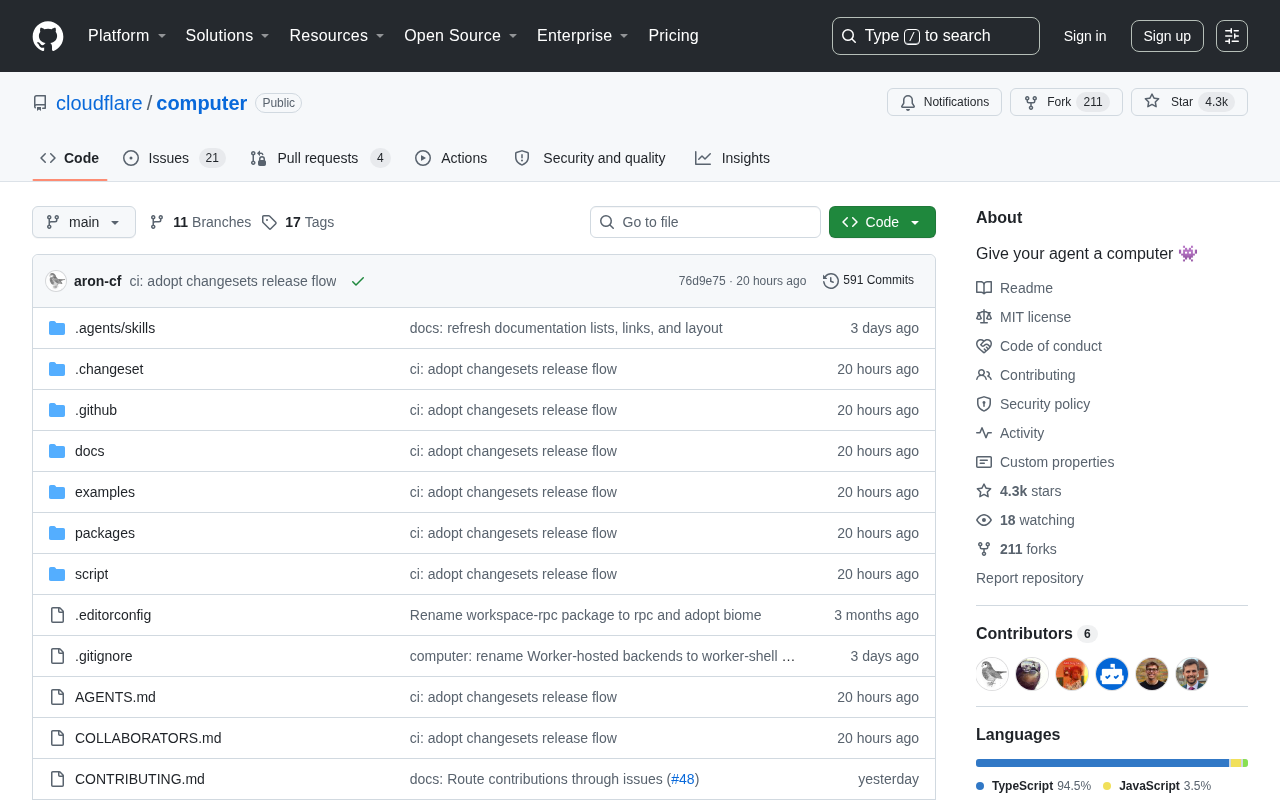
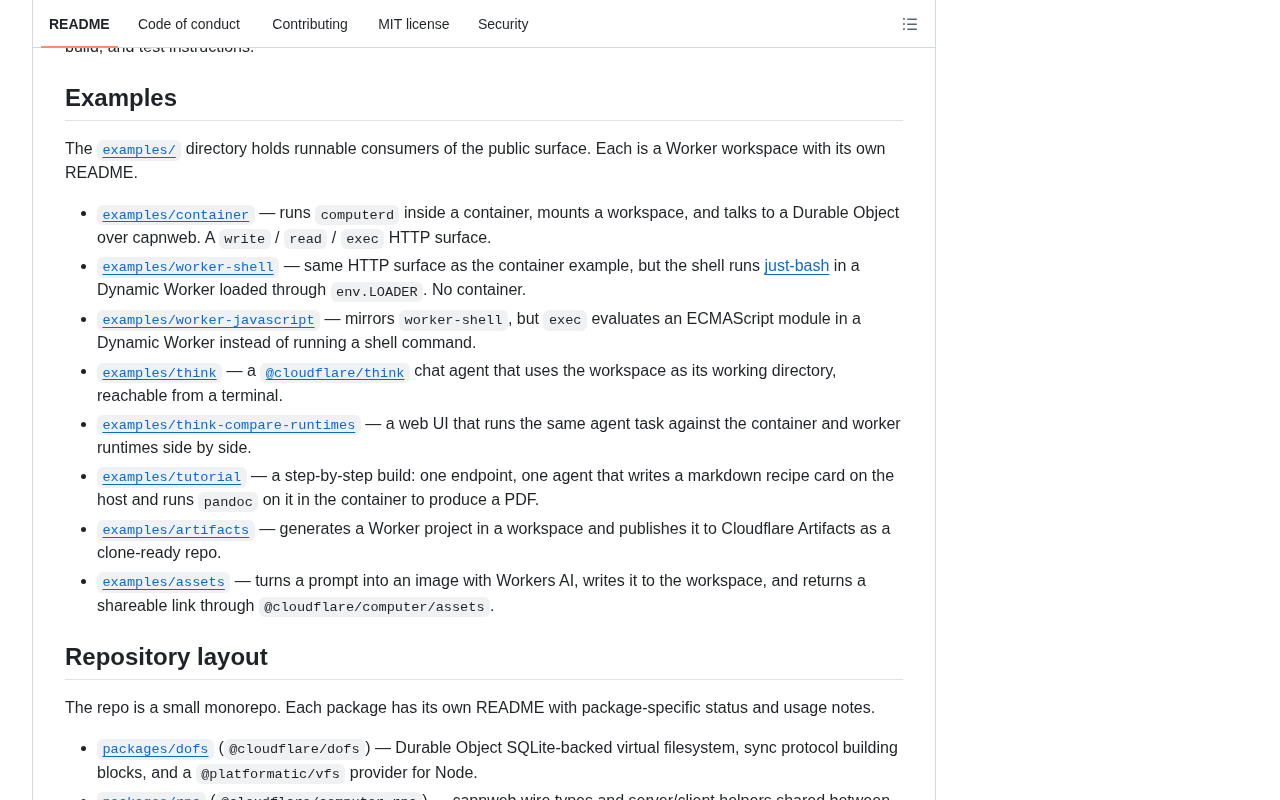
Cloudflare/computer: Giving Your Agent a Computer
Project positioning: This is Cloudflare's infrastructure suite that gives AI Agents a "computer environment," enabling intelligent agents to truly operate a virtual machine to execute tasks.
Problem solved: Over the past year, the capability bottleneck for Agents hasn't been "can it think" but rather "can it act." Models like GPT-5 and Claude Fable 5 already possess complex reasoning and planning abilities, but having them actually browse web pages, run code, manipulate files, and click UI elements requires a secure, isolated, programmable execution sandbox. Building such an environment yourself is both complex and fraught with security risks — you certainly can't let an Agent click around freely on a production server. cloudflare/computer fills exactly that gap between "Agent and real computing environment."
Core features: Built on Cloudflare's powerful edge computing network, it provides out-of-the-box computing sandboxes for Agents. Developers can let Agents execute OS-level tasks in isolated environments without worrying about polluting the host system. Leveraging Cloudflare's globally distributed infrastructure, it naturally offers low latency and high availability.
Use cases: Imagine an automated QA Agent that needs to run test cases in a real browser, or a data analysis Agent that needs to download files, run scripts, and generate charts. These scenarios all require a clean, disposable computing environment. For teams building Devin-like AI software engineers or automation ops Agents, this is a critical puzzle piece.
Tech stack: Written in TypeScript, consistent with the Cloudflare Workers ecosystem style and extremely friendly to web developers. It demonstrates how to combine edge computing with AI Agents — an architectural approach worth studying in its own right.
Stars/Forks analysis: 4,313 stars, with 891 added today alone — a staggering growth rate where single-day additions account for over 20% of the total. This is a classic "new project explosion" curve. The relatively low Fork count of 210 suggests most people are currently watching and experimenting rather than doing secondary development, which is typical for a recently launched infrastructure project. Cloudflare's brand endorsement has undoubtedly accelerated its spread.
goauthentik/authentik: The Authentication Glue You Need
Project positioning: An open-source identity authentication and authorization platform that serves as the "authentication glue" between various applications.
Problem solved: Any system of significant scale faces identity management pain points — single sign-on (SSO), multi-factor authentication, user directory synchronization, and OAuth/SAML/LDAP protocol integration. Commercial solutions like Okta and Auth0 are expensive, while self-building means dealing with countless security details. authentik provides a self-hosted, fully-featured alternative.
Core features: Supports mainstream protocols including OAuth2, SAML, LDAP, and SCIM. It offers flexible authentication flow orchestration (Flows), allowing you to customize login, registration, and password recovery processes like building blocks. It also includes a built-in application proxy that can wrap legacy apps lacking modern authentication support with an SSO layer.
Use cases: An ideal choice for SMBs and self-hosting enthusiasts. When you have a bunch of internal services (Grafana, GitLab, various web apps) and want a unified login portal with enforced MFA, authentik is that hub. It's also commonly seen in teams sensitive about data sovereignty who don't want to hand identity data over to third-party SaaS providers.
Tech stack: Python backend with a modern web technology frontend. For developers wanting to learn the implementation details of authentication protocols, this is an excellent hands-on reference.
Stars/Forks analysis: 22,792 stars with 123 added today — steady, healthy growth. The 1,757 Forks indicate solid developer engagement. The value of infrastructure projects like this lies in long-term accumulation, and the stable growth curve shows it has entered maturity — a choice you can confidently deploy to production.
google/guava: The Evergreen Cornerstone of the Java World
Project positioning: Google's core Java utility library, providing a wealth of practical foundational components for Java development.
Problem solved: While Java's standard library is powerful, it still has many inconveniences in areas like collection operations, caching, string handling, and concurrency utilities. Guava has filled these gaps for over a decade, offering immutable collections, a powerful caching framework, convenient I/O tools, and more — becoming an invisible dependency in countless Java projects.
Core features: Immutable Collections, elegant caching API (CacheBuilder), functional-style collection processing, EventBus, and numerous defensive programming tools (like Preconditions). These designs have greatly influenced the evolution direction of Java's standard library.
Use cases: Virtually any medium-to-large Java project can benefit from Guava. It's a common underlying dependency for backend services and big data frameworks (such as the Hadoop ecosystem).
Tech stack: Pure Java. Guava's source code itself is a treasure trove for learning excellent API design and engineering practices.
Stars/Forks analysis: 51,547 stars with only 9 added today, and a high Fork count of 11,155. Though growth is slow, the fact that it appears on Trending speaks to its "long-tail influence" — a project that has existed since around 2010 and is still being continuously watched and referenced. That's what a true engineering classic looks like.
TapXWorld/ChinaTextbook: An Open-Source Collection of All Chinese Textbooks
Project positioning: An open-source resource repository collecting PDF textbooks for Chinese elementary, middle, high school, and university levels.
Problem solved: The barrier to accessing quality educational resources. For students, parents, teachers, and even overseas Chinese families, systematically finding standardized, complete textbooks isn't easy. This project centralizes and structures scattered textbook resources, dramatically reducing access costs.
Core features: PDF textbooks covering all educational stages, organized by grade and subject for easy searching and downloading. Its value lies not in technology but in "aggregation" itself — organizing public educational resources in an open manner.
Use cases: Students preparing for exams, parents tutoring their children, teachers needing teaching materials, and even developers training education-focused AI models can all benefit.
Tech stack: The repository is labeled as Roff (actually related to document typesetting); it's essentially a content repository rather than a code project.
Stars/Forks analysis: A massive 76,903 stars and 17,382 Forks, with 157 stars added today. Such a high Fork count for a non-code project is quite rare, reflecting users' strong motivation to "bookmark against disappearance" — everyone worries that resource repositories like this could vanish at any time, so they Fork to back it up. Behind these numbers lies genuine, widespread public demand.
Significant-Gravitas/AutoGPT: The Pioneer Making AI Accessible
Project positioning: AutoGPT is dedicated to making AI accessible and buildable for everyone, providing a complete suite of Agent development tools.
Problem solved: When the Agent concept first emerged, AutoGPT was the first to demonstrate the possibility of "letting GPT autonomously decompose tasks and execute in loops." It has since evolved into a more complete platform, enabling non-technical users to build and run their own AI agents.
Core features: Visual Agent building capabilities, automatic task decomposition, tool calling, and continuous execution loop mechanisms. As the earliest "viral" project in the Agent space, it established design paradigms that countless subsequent frameworks have followed.
Use cases: From automated content generation and market research to personal task assistants, AutoGPT suits users who want to quickly experience Agent capabilities without writing code from scratch.
Tech stack: Primarily Python, the mainstream language choice for AI application development.
Stars/Forks analysis: 185,847 stars and 46,048 Forks — the largest project on today's list by volume. Only 28 stars added today, with growth leveling off — consistent with a "phenomenal project" entering its mature, stable phase. While the hype no longer matches its initial explosion, the nearly 46,000 Forks prove its profound influence as the "Agent starter project."
Trend Watch: Agents Moving from "Can Think" to "Can Do"
Connecting today's list together, a clear theme emerges: The competitive focus of AI Agents is shifting from model capabilities to execution environments.
The top-ranked cloudflare/computer solves "how Agents can have an operable computer," while the largest project AutoGPT represents "how Agents can autonomously plan tasks." One new, one established — they precisely constitute two stages of Agent evolution: from "can think autonomously" to "can execute safely." When models like GPT-5 and Claude Fable 5 have already pushed reasoning capabilities to very high levels, the real moat has shifted to the infrastructure layer — whoever can provide secure, isolated, low-latency execution environments holds the key to Agent deployment.
Meanwhile, authentik and Guava remind us that no matter how hot AI gets, identity authentication and foundational engineering libraries — those "unglamorous but essential" cornerstones — remain the skeleton of the software world. And ChinaTextbook's high popularity shows that the power of open source has never served only programmers — it can equally satisfy the most basic public needs.
Today's Must-See TOP 3
#1: cloudflare/computer — If you're doing Agent-related development, this is today's most research-worthy project. It represents the latest direction in Agent infrastructure, backed by Cloudflare's edge network, with enormous potential.
#2: goauthentik/authentik — For any team needing unified identity authentication, this is a mature, reliable self-hosted solution that can save you steep commercial licensing fees.
#3: Significant-Gravitas/AutoGPT — For developers wanting to understand the Agent evolution trajectory, AutoGPT remains an unavoidable classic. Reading its code helps build a holistic understanding of Agent architecture.
Looking ahead: With the rise of execution environment projects, we'll most likely see more new projects emerging around "Agent sandboxes," "tool-calling protocols," and "multi-Agent collaboration." The second half of the Agent era will be a competition of engineering maturity and infrastructure capability. Let's keep watching.
Related articles

How to Interview Engineers in the AI Era: Practical Insights on Restructuring the Interview Process
When AI coding tools render traditional algorithm interviews ineffective, how should teams restructure? Insights from a year of practice on evaluating systems thinking, problem decomposition, and human-AI collaboration.

AI Agent Observability: A New Paradigm for Production Debugging and Hallucination Governance
Deep dive into AI Agent observability tools for production debugging and hallucination governance, covering full-chain tracing, semantic evaluation, and continuous improvement strategies.

How Theoretical Physicists Can Efficiently Get Started with Machine Learning: Optimal Paths and Resource Guide
A systematic guide for theoretical physicists transitioning to ML, covering math advantages, a three-stage learning path, classic textbooks, and physics-ML cross-disciplinary research directions.