GLM-4.7 In-Depth Review: Coding Capabilities on Par with Claude Sonnet 4.5

Zhipu AI's open-source GLM-4.7 demonstrates coding abilities approaching top closed-source models in real-world tests.
Zhipu AI released GLM-4.7, a 358B-parameter MOE open-source model under the MIT license for free commercial use. Official benchmarks show it surpassing DeepSeek V3.2 and Claude Sonnet 4.5 in math, code, and reasoning. Real-world tests confirm strong performance in frontend development (SVG animations, 3D games), browser automation, and end-to-end iOS native app development, with high first-attempt code runnability and comprehensive coding capabilities approaching top closed-source models.
Zhipu AI recently officially released its latest open-source large model, GLM-4.7. This large MOE model, purpose-built for coding and agentic tasks, features 358B parameters and is released under the MIT open-source license, allowing free commercial use. Official benchmarks show GLM-4.7 surpassing DeepSeek V3.2 and even Claude Sonnet 4.5 across multiple core metrics, sparking widespread discussion in the developer community.
MOE (Mixture of Experts) is a sparsely-activated model architecture whose core idea is splitting the model into multiple "expert" sub-networks, with only a subset of experts activated during each inference pass to process the input. This means that although GLM-4.7's total parameter count reaches 358B (358 billion), the actually activated parameters during inference are far fewer, significantly reducing computational costs while maintaining large-model capabilities. DeepSeek V3 also employs the MOE architecture, which has become the mainstream technical approach for scaling large models. Compared to traditional Dense models—like early GPT series that activate all parameters during every inference—MOE architectures can train larger-scale models within the same compute budget, achieving better performance.
The MIT license, as one of the most permissive open-source licenses available, allows anyone to freely use, copy, modify, merge, publish, distribute, sublicense, and sell copies of the software, with the only requirement being the inclusion of copyright and license notices in all copies. By comparison, Meta's Llama series, while also open-source, comes with user scale limitations (requiring additional authorization for over 700 million monthly active users); and some models using the Apache 2.0 license, while also quite permissive, have more complex patent grant clauses. GLM-4.7's choice of the MIT license means enterprises can directly integrate it into commercial products without paying licensing fees or disclosing their modified code—extremely attractive for SMEs and startup teams.
So just how strong is GLM-4.7's coding ability? This article puts it through multi-dimensional real-world tests covering frontend development, 3D games, browser automation, and iOS native app development to show you this open-source model's true capabilities.
Official Benchmarks: Leading Closed-Source Models Across Multiple Metrics
Let's first look at the official benchmark data—GLM-4.7's scores are quite impressive:
- Math Competition: 95.7 points, clearly leading, even surpassing GPT-5.1
- Code Ability: Surpasses DeepSeek V3.2 and Claude Sonnet 4.5
- Scientific Reasoning: Surpasses DeepSeek V3.2 and Claude Sonnet 4.5
- Complex Reasoning: Leads DeepSeek V3.2, Claude Sonnet 4.5, and GPT-5.1
- Software Engineering: Surpasses DeepSeek V3.2, second only to GPT-5.1 and Claude Sonnet 4.5
- Browser Capability: Surpasses DeepSeek V3.2 and GPT-5.1, significantly ahead of Claude Sonnet 4.5
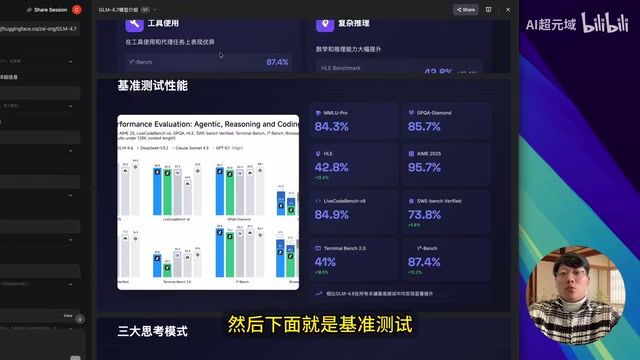
These benchmarks cover the major core dimensions of current AI model evaluation. Math competitions typically use standardized contest problems like AIME (American Invitational Mathematics Examination) to assess mathematical reasoning; code ability commonly uses benchmarks like HumanEval and LiveCodeBench, requiring models to generate executable code from natural language descriptions; software engineering capability is tested through benchmarks like SWE-bench, evaluating a model's ability to fix bugs in real GitHub repositories; browser capability tests (such as WebArena, WebVoyager) examine a model's ability to perform complex operations in real web environments. It's worth noting that benchmarks carry "overfitting" risks—models may have encountered similar problems during training—so real-world application performance remains the more reliable evaluation standard.
Looking at the overall data, GLM-4.7 has reached a level where it can compete head-to-head with top closed-source models, particularly excelling in mathematical reasoning and complex logic. However, benchmarks are ultimately just references—actual coding ability needs to be validated through real-world tasks.
Frontend Coding Tests: From SVG to 3D Games
SVG Animation Generation: A Solar System from a Single Prompt
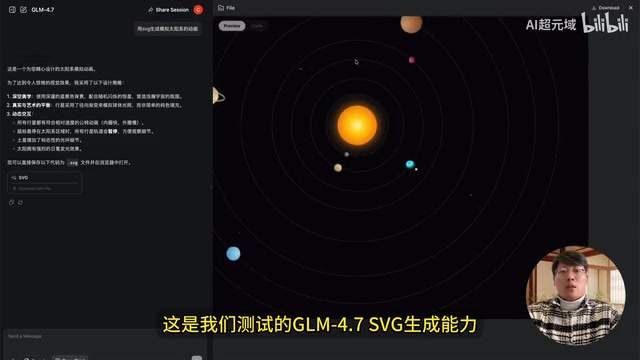
The first test starts with a simple task. Using just one prompt—"Generate an animated simulation of the solar system using SVG"—GLM-4.7 produced a remarkably polished solar system animation: eight planets orbiting the sun with clear, smooth trajectories, even including details like the moon orbiting Earth and Saturn's rings. The completeness far exceeded expectations.
Bubble Sort Visualization: Algorithm Meets Aesthetics
Next, raising the difficulty. The task asked GLM-4.7 to create a space-themed bubble sort visualization animation: 12 asteroids of varying sizes randomly arranged, with a command ship using the bubble algorithm to compare and sort them one by one, with the entire process shown visually.
The results were satisfying. The command ship sequentially compares adjacent asteroids, swapping them when the left one is larger. The movement animations are smooth and natural, and the interface displays real-time status information like "Comparing" and "Swapping"—zero errors throughout the entire run.
This problem seems simple but actually tests cross-domain integration capabilities spanning algorithm understanding, frontend technology selection, animation interaction design, and visual aesthetic expression. GLM-4.7 delivered a solid result.
3D Dinosaur Hunting Game: The Ultimate Frontend Stress Test
The final frontend challenge: create a 3D-style dinosaur hunting game using HTML5 Canvas and JavaScript. Specific requirements included a controllable pickup truck, machine gun shooting, mouse aiming, keyboard movement controls, and Jurassic environments like primeval forests and volcanoes.
HTML5 Canvas is a native 2D drawing API provided by browsers that allows real-time rendering of graphics, animations, and game visuals on web pages via JavaScript. While Canvas itself is 2D, developers can simulate 3D effects on the 2D canvas through mathematical projection transformations (like perspective projection)—exactly the technical approach GLM-4.7 employed in this game. Compared to WebGL (a browser 3D graphics API based on OpenGL ES) or professional 3D engines like Three.js, achieving 3D effects with pure Canvas is more challenging because it requires manually handling depth sorting, perspective transformation, lighting calculations, and other low-level logic.
GLM-4.7 successfully implemented this complex project. The pickup truck is equipped with a machine gun; players can aim with the mouse to shoot distant dinosaurs; small dinosaurs go down in two or three shots while large dinosaurs require more ammunition; dinosaurs actively flee when attacked; misty mountain ranges appear in the distance—the overall atmosphere is immersive.

This test comprehensively examines 3D graphics rendering, physics collision detection, AI behavior systems, multi-modal interaction, and the ability to organize large-scale complex code. GLM-4.7 generated and ran the entire project successfully on the first attempt—quite impressive performance.
Math Derivation Animation and PPT Auto-Generation
GLM-4.7 also smoothly completed two additional tasks. One was a visualization animation of the circle area formula derivation—cutting a circle into 64 pieces and rearranging them into an approximate rectangle, with text explanations of the cutting principle, rearrangement principle, and limit concept. Even someone with zero math background could intuitively understand the derivation process.
The other task involved providing a link about the GLM-4.7 model introduction, from which it automatically extracted webpage content and generated a well-structured PPT covering key information like model parameters, core features, and benchmark data—saving considerable manual organization time.
Tool Calling and Browser Automation Tests
By integrating GLM-4.7's API through Claude Code, paired with Google's official Chrome DevTools MCP, browser automation capabilities were further tested.
MCP (Model Context Protocol) is an open standard protocol launched by Anthropic in late 2024, designed to provide AI models with a unified interface for calling external tools. Through MCP, large language models can manipulate browsers, databases, file systems, and other external resources like calling APIs, without writing custom adapter code for each tool. The Chrome DevTools MCP used in this test is a browser control tool developed by Google based on this protocol, allowing AI models to navigate web pages, click elements, and extract content through the Chrome Developer Tools protocol. This "model + tools" combination is the core paradigm of Agentic AI—models no longer just generate text but can autonomously plan task steps, call tools to execute operations, and adjust strategies based on feedback, thereby completing complex multi-step tasks.
The test task was: visit a blog website, click the first three articles, extract article content, and rewrite them as posts suitable for publishing on X (Twitter).
GLM-4.7 accurately completed the entire workflow—automatically opening the browser, clicking three blog articles in sequence, returning to the homepage, extracting core content, and finally outputting three high-quality tweets with emoji and hashtags. The entire process ran quickly with clear logic and no stuttering or errors.
This demonstrates that GLM-4.7 not only writes code well but is equally reliable in agentic scenarios involving tool calling and multi-step task execution.
Ultimate Challenge: End-to-End iOS Native App Development
The most challenging test—having GLM-4.7 independently develop a complete iOS native vocabulary learning app within Claude Code. The required tech stack included iOS 17, Swift 5.9, SwiftUI, SwiftData, and SwiftCharts—all using Apple's latest technology frameworks.
This tech stack represents the most cutting-edge development framework combination in the Apple ecosystem. SwiftUI is Apple's declarative UI framework launched in 2019, where developers only need to describe what the interface "should look like" and the framework automatically handles rendering and state updates, greatly simplifying the imperative programming patterns of traditional UIKit. SwiftData is a data persistence framework released at WWDC 2023, designed to replace the decade-old Core Data with a more concise Swift-native API for managing local databases. SwiftCharts is Apple's native charting framework supporting bar charts, line charts, pie charts, and other visualization types. Requiring an AI model to master all these frameworks and coordinate their use is equivalent to testing the full-stack capabilities of a senior iOS development engineer, as even human developers need considerable study and practice to proficiently use this latest tech stack.
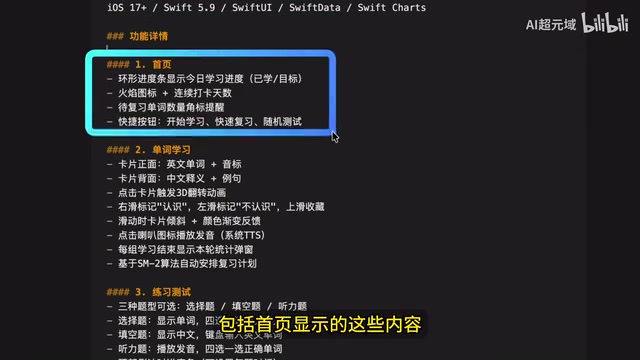
Functional requirements covered the following modules:
- Home page displaying daily learning goals and progress
- Vocabulary cards with front/back 3D flip animations
- Left/right swipe to switch words
- Practice test module (multiple-choice format)
- Learning progress statistics charts (based on SwiftCharts)
- Settings page (daily goals, reminders, etc.)
The core learning logic of a vocabulary app involves Spaced Repetition algorithms—a memory optimization method validated through extensive experiments in cognitive science. Its core principle is based on the Ebbinghaus forgetting curve: humans forget new knowledge quickly at first then more slowly, so reviewing at the point of near-forgetting achieves optimal memory retention with minimum review sessions. The most classic implementation is the SM-2 algorithm (SuperMemo 2), widely adopted by mainstream memory software like Anki. The algorithm dynamically adjusts the next review interval based on the user's mastery of each knowledge point: correct answers extend the interval, while incorrect answers shorten it.
After roughly ten-plus minutes of automated development, GLM-4.7 successfully completed the vast majority of features. After compiling successfully in Xcode, the app ran well: card swiping was smooth, 3D flip animations were natural, the "mastered" marking feature worked correctly, and both the practice module and progress statistics charts functioned properly. The only unimplemented feature was the settings page, which could easily be completed through follow-up instructions.
This test comprehensively examined full-stack iOS native development capability, complex gesture interaction and animation system design, engineering implementation of spaced repetition learning algorithms, multi-module application architecture organization, and end-to-end product development from scratch. The fact that GLM-4.7 could complete such a complex engineering project in a single conversation is truly impressive.
How to Use GLM-4.7 and API Access Guide
GLM-4.7 currently offers multiple access methods:
- International users: Access chat.z.ai directly for web-based conversations, or obtain an API Key through the z.ai platform for development
- China-based users: Use GLM-4.7's online chat through the BigModel platform, or create an API Key to integrate into your projects
- Claude Code integration: Set up the Base URL, API Key, and model ID to call GLM-4.7 as the backend model within Claude Code
Thanks to the MIT open-source license, developers can also deploy private versions independently, offering very high flexibility.
Conclusion: Where Does GLM-4.7's Coding Ability Actually Stand?
Through multi-dimensional real-world tests spanning frontend development, browser automation, and iOS native app development, GLM-4.7 demonstrated remarkably comprehensive coding capabilities:
- Outstanding frontend development: From simple SVG animations to complex 3D games, one-shot generated code is high quality and highly runnable
- Stable and reliable tool calling: Browser automation workflows are smooth and accurate, with seamless MCP integration
- Solid complex engineering capability: Can independently complete end-to-end iOS native app development with clean architecture and complete functionality
- Balances technology and aesthetics: Generated interfaces and animations have good visual presentation while meeting functional requirements
As an MIT-licensed open-source model, GLM-4.7 has genuinely approached the level of Gemini and Claude Sonnet 4.5 in coding and agentic capabilities, particularly excelling in code generation completeness and runnability. For developers, this means another powerful and free AI coding assistant to choose from—one that's fully open-source and freely available for commercial use.
If you're looking for a reliable AI coding tool, GLM-4.7 is worth trying.
Related articles
 Product Reviews
The Programmer's Desk Setup Guide: Building a Workspace That Feels Like Home
Discover how programmers build productive, comfortable workspaces. From multi-monitor setups to ergonomic design, explore the desk philosophy that drives focus and flow.
 Product Reviews
Qoder vs Cursor Real-World Comparison: Which $20/Month AI IDE Is Better?
Hands-on comparison of Qoder vs Cursor AI IDEs: Agent autonomy, human interaction count, and architecture decisions. Qoder needed only 2 interactions vs Cursor's 8.
 Product Reviews
Cursor Cloud Agent Demo: Eliminating Bottlenecks Across the Entire Software Development Lifecycle
Deep analysis of Cursor's Cloud Agent demo showing how cloud VMs, automated test artifacts, and a full-chain control plane systematically eliminate human bottlenecks across the software development lifecycle.