Harness Engineering: The Key Technique for Unlocking Hidden AI Agent Capabilities

Harness engineering—not just the model—is what truly determines AI Agent performance and product differentiation.
This article examines how harness engineering—the scaffolding built around LLMs including tool orchestration, context management, execution environments, and feedback loops—serves as a critical yet underestimated capability amplifier for AI Agents. Using OpenAI's Codex as a case study, it demonstrates how seamless integration of browsing and CUA capabilities through superior harness design creates the closed-loop workflow that separates top-tier AI products from mediocre ones, especially as base model capabilities converge.
The Overlooked Capability Amplifier: Harness Engineering
In discussions about AI Agents, attention tends to focus on the underlying model's capabilities—parameter scale, reasoning ability, context length, and so on. However, an increasingly apparent yet often overlooked fact is: what determines an Agent's actual performance is often not the model itself, but the "harness" (framework/scaffolding) built around it.
Recently, a developer shared this perspective on social media: surprisingly few people realize that harness engineering can deliver massive capability improvements for Agents. Using OpenAI's Codex as an example, they pointed out that Codex has become one of the best "daily workhorse tools" precisely because its harness makes the integration of browsing and CUA (Computer-Using Agent) capabilities seamless and fluid.
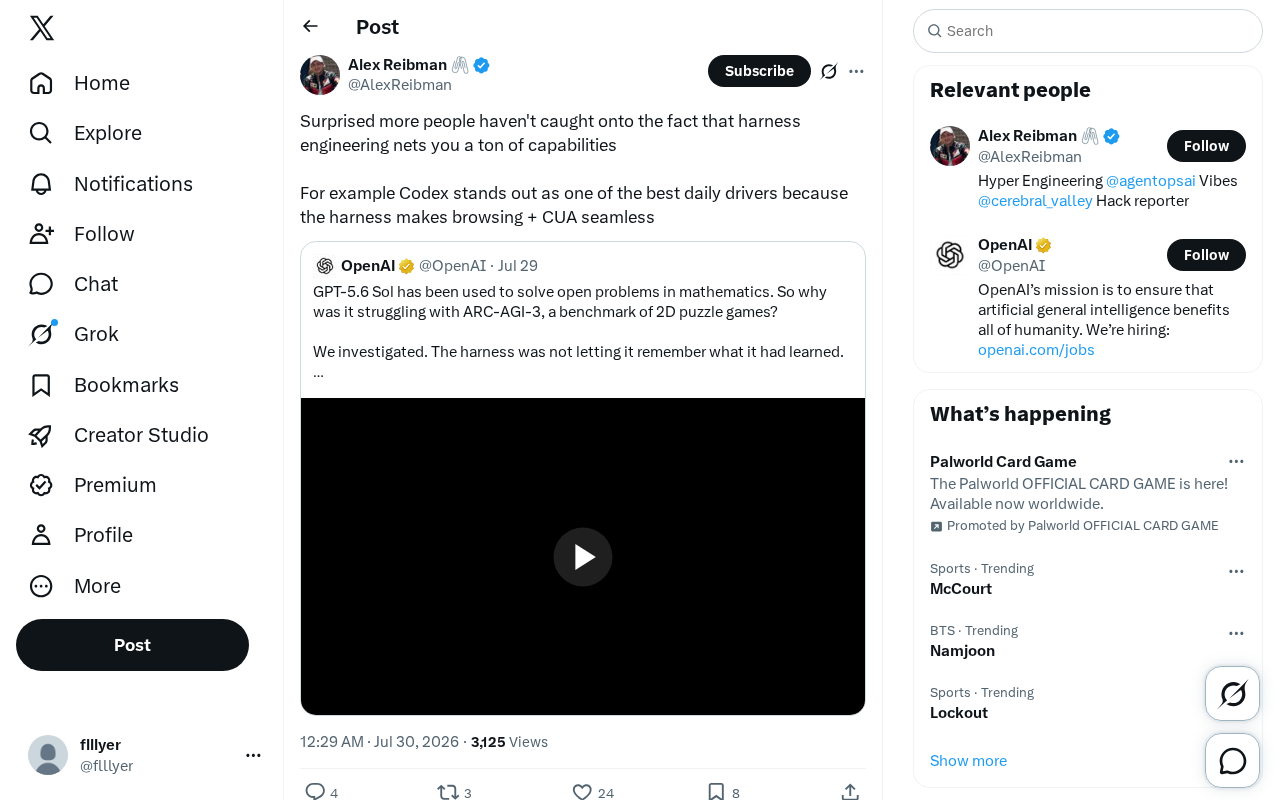
This observation may seem simple, but it touches on a core yet underestimated engineering dimension in current AI Agent development.
What Is Harness Engineering: The Mindset Shift from Model to System
Definition and Core Components of a Harness
Harness (originally meaning "horse tack" or "rigging") in the AI context refers to the entire engineering system wrapped around a large language model. It includes but is not limited to:
- Tool invocation and orchestration logic: How the model calls external tools and parses returned results
- Context management: How to organize, compress, retrieve historical information and external knowledge
- Execution environment: How browsers, code sandboxes, file systems, etc. are integrated
- Feedback and error-correction loops: How the model is guided back on track when it makes mistakes
In other words, the harness is the critical bridge that transforms a "thinking model" into a "working Agent." The same base model, equipped with harnesses of different quality, can exhibit vastly different capability levels in practice.
Tool Invocation: From Simple APIs to Complex Orchestration
Tool invocation is one of the foundational capabilities in modern LLM Agent architectures. The core mechanism works as follows: when the model identifies during reasoning that it needs external information or capabilities, it generates a structured function call request (containing the function name and parameters), the system executes that function and injects the result into the conversation context, and the model continues reasoning based on the result. From OpenAI's initial introduction of Function Calling in 2023, to today's support for parallel tool calls, chained tool orchestration, and standardized protocols like MCP (Model Context Protocol), tool invocation has evolved from simple one-shot queries into complex multi-step orchestration systems. High-quality tool orchestration requires solving a series of engineering challenges including tool selection strategies, call sequence optimization, failure retry logic, and result format standardization—and these are precisely the core battlegrounds of harness engineering.
Context Management: The Underestimated Engineering Bottleneck
Although modern LLM context windows have expanded to 128K or even millions of tokens, context management remains a core engineering challenge in actual Agent operation. The reason is: during multi-step task execution, Agents rapidly accumulate large amounts of intermediate information (tool return values, execution logs, error messages, etc.), and simply stacking this information will quickly exhaust the context window and cause model attention to scatter. An excellent harness needs to implement intelligent context compression (summarization), key information priority ranking, sliding window strategies, and coordination between RAG (Retrieval-Augmented Generation) and long-term memory. This is essentially about finding a dynamic balance between "letting the model see enough information" and "avoiding information overload"—and the art of achieving this balance is precisely the dividing line between top-tier harnesses and ordinary frameworks.
Why Codex Stands Out
The original post specifically mentioned that Codex achieves seamless integration of browsing capabilities and CUA (Computer-Using Agent). This point is highly representative.
CUA (Computer-Using Agent) refers to AI agents that can directly operate computer graphical interfaces just like humans. Unlike traditional API-based approaches, CUA visually recognizes screen content (such as buttons, text fields, menus, and other UI elements), then simulates mouse clicks, keyboard inputs, and other operations to complete tasks. OpenAI's Operator product, released in early 2025, is a typical implementation of CUA. The core challenge of this technology lies in: AI needs to understand screen semantics at the pixel level, map visual information to executable action sequences, and handle uncertainties in real environments such as page loading delays and popup interruptions. The emergence of CUA marks a paradigm shift for AI Agents from "can only call preset APIs" to "can operate any software."
For a programming assistant, being able to autonomously browse web pages to consult documentation and search for error messages, while also directly operating the computer environment (running commands, modifying files, executing code), means it can form a complete "perceive—decide—execute—verify" closed loop.
This closed-loop structure derives from the classic OODA loop (Observe-Orient-Decide-Act) in control theory and robotics. In the AI Agent context, "perceive" corresponds to browsing web pages and reading files for information acquisition; "decide" is the model choosing the next action based on current state; "execute" is completing specific operations through tool calls or CUA; "verify" is checking whether execution results meet expectations, such as running test cases or checking output formats. The key value of this closed loop is fault tolerance: the Agent is no longer engaged in "one-shot reasoning" but can continuously adjust its strategy based on environmental feedback. The core competitive advantage of products like Devin and Codex lies precisely in the stability and recovery speed of this loop—how quickly the Agent can get back on track when it encounters errors.
Achieving this smooth closed-loop experience relies not on how clever the model is in any single inference step, but on how the harness organically stitches these heterogeneous capabilities together.
Why Harness Engineering Has Been Chronically Underestimated
The Obscuring Effect of Model Halo
The current industry narrative is highly focused on base model iterations. Whenever a new model is released, benchmark rankings, parameter comparisons, and scores flood the feeds. This atmosphere leads people to subconsciously believe that "capability = model."
However, developers who have actually deployed Agents discover: the same model, under a well-designed harness versus a crude framework, delivers completely different levels of usability. An excellent harness can:
- Compensate for the model's capability gaps (e.g., using tools to supplement computation or retrieval abilities)
- Significantly improve task success rates (through retries, verification, and step-by-step execution)
- Reduce hallucination risks (by introducing real-world environment feedback)
Engineering Barriers and Experience Moats
Another reason harness engineering is "rarely captured" by most people is that it's inherently a systems engineering discipline requiring extensive practical experience. Unlike calling an API for immediate results, it requires repeatedly refining tool interfaces, context strategies, error handling, and other details through real-world tasks. This kind of "dirty, tedious work" rarely gets the spotlight, but it's precisely what creates the moat that separates products.
Practical Implications for AI Developers and the Industry
Repositioning the Source of Capability
For teams currently building AI applications, this perspective provides important directional guidance: when your Agent performs poorly, your first reaction should not just be "switch to a stronger model," but rather examine whether your harness is refined enough. In many cases, the capability ceiling lies not in the model, but in how you organize and orchestrate it.
A New Battleground for Differentiated Competition
As base models increasingly converge—and as open-source models continuously approach the top closed-source levels—harness engineering is becoming the key battleground for AI product differentiation.
Between 2024 and 2025, the capability gap between base models has been shrinking rapidly. Open-source models (such as the Llama series, Qwen series, DeepSeek, etc.) have approached or even surpassed some closed-source models on multiple benchmarks. Meanwhile, the differences in core reasoning capabilities among closed-source models (GPT-4o, Claude, Gemini, etc.) are also becoming increasingly marginal. This convergence means: building product moats by simply relying on "stronger models" is becoming increasingly difficult. The industry is undergoing an evolution similar to the chip industry—when underlying hardware differences narrow, system architecture, software optimization, and ecosystem integration become the real differentiating factors. In the AI Agent space, the counterpart to this "system architecture" is precisely harness engineering.
The Codex example demonstrates that even when underlying capabilities are similar, whoever can "stitch" browsing, code execution, and environment operation capabilities more smoothly will deliver a better daily user experience.
This also explains why some products with seemingly similar model capabilities can feel worlds apart in actual use—the gap hides in those invisible engineering details.
Conclusion
This observation from the developer community, though brief, highlights a profound trend in AI Agent development: capability gains are increasingly coming from systems engineering outside the model. Harness engineering is not an appendage to model capability—it's a capability amplifier, and in some scenarios, the true source of capability itself.
For teams hoping to build advantages in the AI application space, prioritizing and investing in harness engineering may be a seriously underestimated yet highly rewarding strategic choice. While everyone is chasing bigger models, the true masters have already started perfecting their "harness."
Note: The views in this article come from a single social media source and represent individual developer experience sharing. Actual product performance should still be verified in context of specific use cases.
Related articles

How to Interview Engineers in the AI Era: Practical Insights on Restructuring the Interview Process
When AI coding tools render traditional algorithm interviews ineffective, how should teams restructure? Insights from a year of practice on evaluating systems thinking, problem decomposition, and human-AI collaboration.

AI Agent Observability: A New Paradigm for Production Debugging and Hallucination Governance
Deep dive into AI Agent observability tools for production debugging and hallucination governance, covering full-chain tracing, semantic evaluation, and continuous improvement strategies.

How Theoretical Physicists Can Efficiently Get Started with Machine Learning: Optimal Paths and Resource Guide
A systematic guide for theoretical physicists transitioning to ML, covering math advantages, a three-stage learning path, classic textbooks, and physics-ML cross-disciplinary research directions.