Has Google AI Really Fallen Behind? A Real Competitiveness Analysis from Transformer to Gemini

Analyzing whether Google AI truly fell behind in the generative AI race, from Transformer origins to Gemini.
Despite a viral tweet claiming Google AI "burned bright for 3 seconds then fell off," the reality is far more nuanced. As the inventor of the Transformer architecture and home to DeepMind, Google's technical foundations are unmatched. While ChatGPT captured public mindshare first, Google's Gemini models now compete at the frontier, backed by full-stack advantages from TPU chips to billions-scale distribution channels. The perceived lag reflects narrative dynamics and the innovator's dilemma rather than actual technical inferiority.
A Tweet That Sparked a Discussion
Recently, a short comment circulating on Twitter sparked considerable discussion about Google's AI strategy. The original post was quite dramatic: "Google burned bright for like 3 seconds then fell off and was never seen again, it's honestly sad."
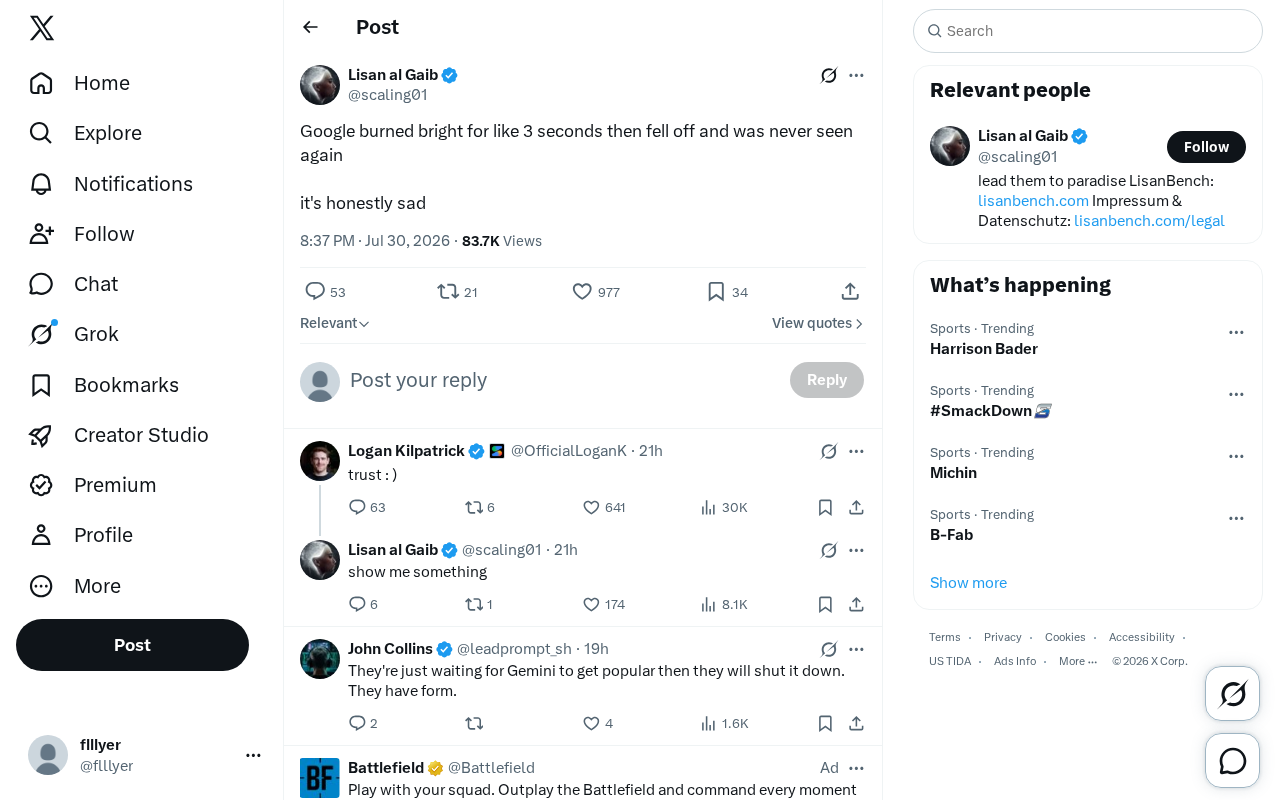
This somewhat teasing and wistful comment, while a subjective observation, reflects a common perception of Google's position in the generative AI race. As one of the most important technical pioneers of the deep learning era, why has Google left some observers with the impression of being a flash in the pan? This is actually an industry topic worth deep analysis.
Where Did Google AI's "Spotlight Moment" Come From
To be clear, the "three seconds of glory" in the tweet is more of an emotional exaggeration than a factual statement. Quite the contrary—Google's technical accumulation in AI is extremely deep.
Transformer Architecture: The Foundational Role
In 2017, Google Brain published the industry-changing paper Attention Is All You Need, introducing the Transformer architecture. This architecture became the technical foundation for the GPT series and virtually all mainstream large language models that followed. Without Google's research, today's generative AI boom simply wouldn't exist.
Additionally, Google's DeepMind has long been regarded as one of the world's top AI research institutions, thanks to breakthroughs like AlphaGo and AlphaFold. From a technical depth perspective, Google is far from a "three-second" flash-in-the-pan player.
The ChatGPT Shock: Why It Created the Illusion of Falling Behind
What truly put Google on the defensive in public discourse was the market reaction after ChatGPT burst onto the scene in late 2022. OpenAI rapidly captured the public imagination through a consumer-facing conversational product, while Google was perceived as responding sluggishly. The hasty launch of Bard in early 2023, which produced factual errors during its first demonstration, further fueled doubts about Google's execution capability.
This contrast between "strong technology, weak products" is precisely the source of the tweet's sentiment—a giant that should have been leading appeared hesitant during the most critical window for productization.
Google AI's Real Competitiveness: Do the Facts Match the Tweet
Looking at the current situation, the claim that Google was "never seen again" simply doesn't hold up.
Gemini's Catch-Up and Breakthroughs
Google launched the Gemini model series in late 2023 and has continued iterating since. Gemini 1.5 Pro, with its ultra-long context window (supporting up to a million tokens at one point), demonstrated unique advantages in specific scenarios. Gemini now competes head-to-head with GPT-4 and Claude series models on multiple authoritative benchmark leaderboards, with some versions even reaching the top.
Full-Stack Advantages from Chips to Distribution
Unlike many competitors, Google possesses a complete chain spanning custom TPU chips, massive data resources, search entry points, and distribution channels like Android and Chrome. This vertical integration capability is a formidable moat in long-term competition. Seamlessly embedding AI capabilities into Search, Workspace, Android, and other products reaching billions of users is a distribution advantage that no pure model company can replicate.
What Industry Psychology Does This Tweet Reflect
Setting aside factual disputes, the reason this tweet resonated points to several noteworthy industry psychological phenomena.
The Power of Narrative Exceeds Technology Itself
In the AI race, public and capital market attention is often dominated by "narratives." Whoever captures the public imagination first gains the upper hand in the battle for mindshare. OpenAI accomplished this narrative with ChatGPT, and even though Google's technology is no less impressive, it was at one point on the losing side of the narrative war. This reminds all tech companies: leading research results don't automatically translate into market perception.
The "Innovator's Dilemma" for Tech Giants
Google's hesitation is, to some extent, a textbook case of the "Innovator's Dilemma." Search advertising is its core cash cow, and conversational AI naturally diverts search traffic, potentially disrupting its business model. This inherent contradiction forces Google to be more cautious when embracing change, which makes it appear "a step behind" to outside observers.
Conclusion: An AI Marathon Far From Over
Summarizing Google's AI journey as "three seconds of glory" clearly underestimates the company's technical depth and long-term resilience. The generative AI competition is a marathon, not a sprint. Today's leaders may not have the last laugh, and those temporarily behind may surge ahead later.
For observers, rather than being swayed by emotional hot takes, it's better to focus on actual technological progress, product execution, and commercialization capabilities. Whether Google has truly "fallen behind"—the answer isn't in a tweet, but in the continuous product iteration and market performance over the coming years. This contest over the future of AI has only just reached halftime.
Related articles

GLEE Competition: A Detailed Guide to the NeurIPS 2026 Official Negotiation AI Challenge
NeurIPS 2026 GLEE Competition challenges AI agents to negotiate in real-time via natural language, covering bargaining, persuasion, and game strategies. Full guide on rules, approaches, and prizes.

Revolut Drops Perplexity for ChatGPT Go — Is This an Upgrade or a Downgrade?
Revolut replaced Perplexity Pro with ChatGPT Go for premium members. We compare both AI products' positioning and value to help you decide if it's an upgrade or downgrade.

Glasp MCP Connector: Let AI Directly Access Your Knowledge Base
Glasp MCP Connector links your personal highlights to Claude and ChatGPT via MCP protocol for natural language knowledge retrieval. Learn about its features, privacy design, and the MCP ecosystem trend.