Revolut Drops Perplexity for ChatGPT Go — Is This an Upgrade or a Downgrade?

Revolut swaps Perplexity Pro for ChatGPT Go — a top-tier to entry-level shift that sparks user debate.
Revolut replaced its Premium members' Perplexity Pro perk with ChatGPT Go, sparking community debate. While Perplexity Pro excels at AI-powered search with citations, ChatGPT Go is an entry-level conversational AI tier. The swap reflects broader trends in fintech companies using AI subscriptions as marketing tools, with users advised to choose AI tools based on actual needs rather than bundled freebies.
Background: Revolut's Major AI Perk Shakeup
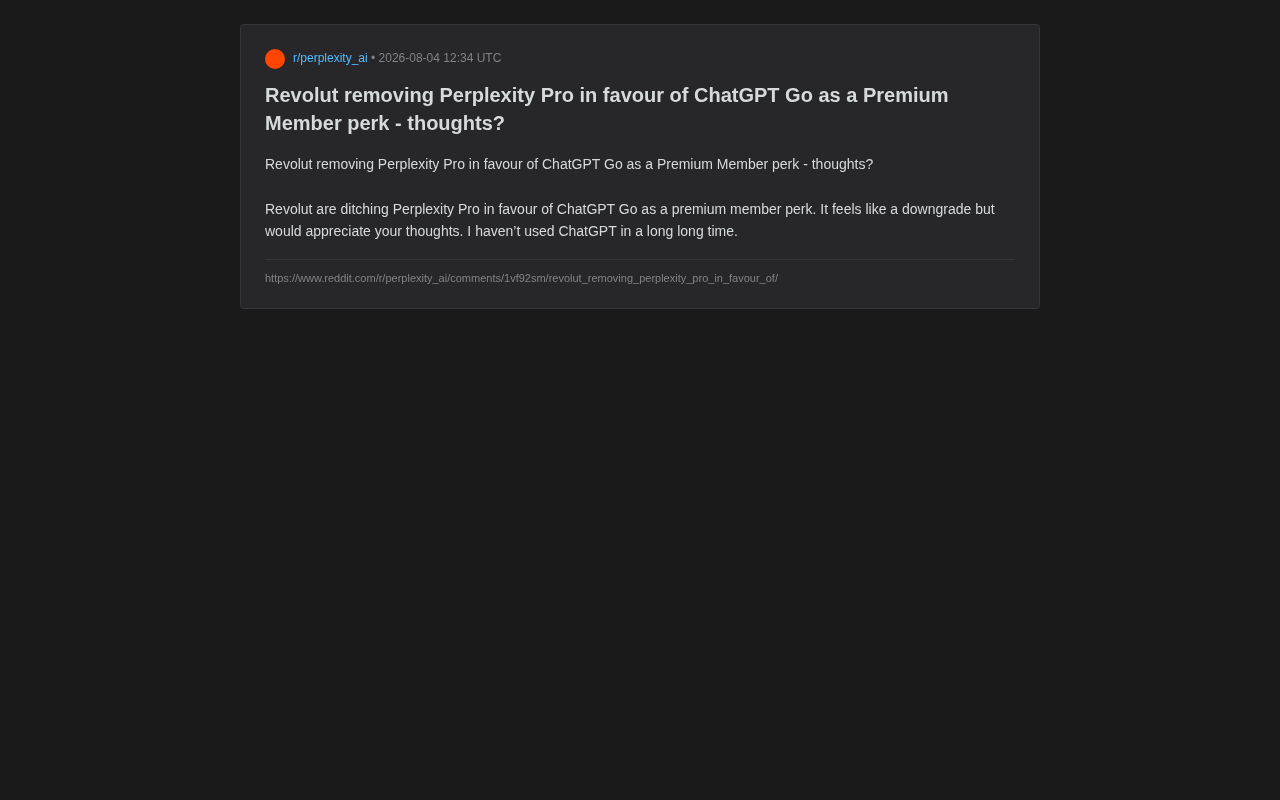
Digital bank Revolut recently adjusted its Premium Member benefits, replacing the previously included Perplexity Pro subscription with OpenAI's newly launched ChatGPT Go. The change has sparked considerable discussion on Reddit and other communities, with many users' first reaction being — doesn't this count as a "downgrade"?
Revolut is a London-headquartered global digital bank founded in 2015, currently valued at over $45 billion with more than 45 million users worldwide. Its business model centers on a tiered membership system, ranging from the free Standard tier to Premium (approximately £9.99/month) and up to Metal and Ultra tiers, attracting users at different spending levels through differentiated benefits. In recent years, Revolut has continuously incorporated non-financial perks — such as airport lounge access, insurance, and digital subscriptions — into its membership packages to boost user retention and competitive moats.
For users who rely heavily on AI tools, which AI service is bundled into their membership directly impacts their daily experience. And behind this swap lies a revealing look at the current competitive landscape and product positioning differences in the AI subscription market.
Perplexity Pro vs. ChatGPT Go: Core Positioning Differences
What exactly sets these two products apart?
To judge whether this change is an upgrade or downgrade, you first need to understand that these two products aren't positioned in quite the same space.
Perplexity Pro's core strength lies in "AI search." It excels at real-time web retrieval, providing answers with cited sources — making it ideal for research, fact-checking, and quickly obtaining conclusions with references. The Pro version also unlocks the ability to switch between multiple underlying models (such as GPT-4, Claude, etc.), essentially functioning as an "aggregated" AI search and Q&A tool.
Perplexity AI was founded in 2022 by former OpenAI researcher Aravind Srinivas. Its core technical approach combines large language models with real-time web retrieval to build what it calls an "Answer Engine." Unlike traditional search engines that return lists of links, Perplexity uses a RAG (Retrieval-Augmented Generation) architecture to first fetch relevant information from the internet in real time, then have an LLM synthesize structured answers with clear source citations. The Pro version allows users to freely switch between models like GPT-4o, Claude 3.5 Sonnet, and Sonar Large, while supporting more complex multi-step reasoning and file upload analysis — making it the tool of choice for information-intensive workers.
ChatGPT Go is a relatively lightweight paid tier that OpenAI launched between its free version and Plus. It focuses on conversational generation, writing assistance, code help, and other general-purpose capabilities, backed by OpenAI's own model ecosystem. Compared to the free version, Go offers higher usage limits and faster responses, but still falls short of ChatGPT Plus in feature depth.
To understand ChatGPT Go's positioning, you need to view it within OpenAI's complete subscription hierarchy. The free version provides limited GPT-4o access; ChatGPT Plus ($20/month) offers higher message caps and priority access to new features; ChatGPT Pro ($200/month) targets heavy professional users with unlimited access and the strongest reasoning model, o1 pro. ChatGPT Go, sitting between the free tier and Plus, is essentially a bundled distribution product designed by OpenAI for B2B partners (such as banks and telecom carriers), trading lower unit costs for scaled user growth as part of OpenAI's strategy to expand its paying user base.
Which one better fits your use case?
In simple terms:
- If your primary need is searching, looking up information, and getting answers with sources, Perplexity Pro is genuinely more suited to the task;
- If you mostly write copy, create summaries, have chat-based Q&A sessions, or get coding assistance, ChatGPT Go is a better fit.
Judging from the original Reddit poster's statement that they "haven't used ChatGPT in a long time," this subjective sense of "downgrade" largely stems from personal usage habits — people accustomed to Perplexity's search-style experience will naturally feel uncomfortable switching back to a conversational product.
Why Do Users Generally Feel This Is a "Downgrade"?
The obvious gap in subscription value
One practical reason users instinctively feel this is a "downgrade" is the perceived value difference between subscription tiers. Perplexity Pro is Perplexity's top-tier paid plan, typically priced around $200/year; ChatGPT Go is OpenAI's relatively entry-level paid tier, not the flagship Plus or Pro version.
From the perspective of "swapping a top-tier product for an entry-level one," it's understandable that users feel their benefits have been diluted. After all, when both are framed as "a free AI subscription," one represents the ceiling of its product line while the other barely clears the free threshold.
The psychological gap from brand perception
Another psychological factor is brand familiarity. ChatGPT, being the most widely recognized AI product among the general public, may actually make users feel like "there's nothing exciting about it" — since many people already have free accounts, the marginal value of receiving an entry-level paid version is lower than getting a Perplexity Pro subscription that they wouldn't normally pay for separately. The latter feels more like a "pleasant surprise."
This relates to the "endowment effect" and "loss aversion" in behavioral economics: once users become accustomed to a certain benefit, the negative feelings from losing it far outweigh the positive feelings from receiving a substitute of equivalent value. Even if ChatGPT Go is equally useful in certain scenarios, the mere act of "losing Perplexity Pro" is enough to trigger dissatisfaction.
Why Do Banks Frequently Adjust AI Subscription Benefits?
This incident also reflects a broader trend: fintech companies are treating AI subscriptions as marketing tools for user retention and acquisition.
From Revolut's perspective, which AI company they partner with and which product they offer often depends on partnership terms, cost-sharing arrangements, and market buzz. OpenAI, as the AI brand with the most traffic-driving power today, offers direct benefits for boosting membership attractiveness through brand association. These partnerships are mutually beneficial: banks gain a marketing selling point, while AI companies gain scaled paid user referrals.
Bundling AI subscriptions as membership benefits isn't unique to Revolut. T-Mobile in the US market provides Apple TV+ and Netflix Basic for free to certain plan subscribers; Samsung Galaxy phones come preloaded with Gemini Advanced trial periods; Microsoft 365 has deeply integrated Copilot AI into its office suite. The business logic behind this model: AI companies supply distribution partners at heavily discounted wholesale prices in exchange for user scale and usage data; distributors leverage "exclusive AI benefits" to create differentiation. It's estimated that such B2B bundles typically cost only 30%-50% of retail price, making "gifting AI subscriptions" a high-ROI marketing investment for banks.
Therefore, these benefit adjustments will most likely continue to change in the future. Users shouldn't view any particular AI subscription as a long-term stable membership perk, but rather as a periodic "bonus."
How Should Users Rationally Approach This Change?
Evaluate based on your actual needs
For users who are torn, the recommendation is to return to actual use cases for assessment:
- If you barely use AI search features, losing Perplexity Pro has limited impact;
- If you already have a paid ChatGPT account, this "gift" indeed offers little additional value;
- If you regularly use both, consider subscribing to Perplexity separately and treating ChatGPT Go as a supplementary bonus.
Don't let "free giveaways" dictate your choices
More importantly: bundled AI subscriptions are fundamentally part of the bank's marketing strategy and shouldn't be the sole basis for choosing your tools. What should truly determine which AI you use is whether it solves your actual problems — not whether it's "given away for free."
The AI tools market is currently in a period of rapid iteration, with each product's capability boundaries shifting every few months. Perplexity is continuously strengthening its Deep Research functionality, while ChatGPT is advancing memory, custom GPTs, and multimodal capabilities. Users should develop a "tool portfolio" mindset, flexibly deploying different tools based on task type, rather than betting all their needs on a single product.
Conclusion
Revolut's replacement of Perplexity Pro with ChatGPT Go does represent a "top-tier to entry-level" gap in product tier positioning, and users feeling like it's a downgrade is not unreasonable. However, since the two products serve different purposes, whether it's truly a "downgrade" ultimately depends on individual usage habits.
This change also reminds us that AI subscriptions are increasingly becoming marketing chips for various platforms. As users, rather than agonizing over changes in bundled benefits, we'd be better off developing independent judgment about the real value of AI tools — after all, a tool's significance lies in whether you can actually use it, not whether you received it for free.
Related articles

Amphibious Transforming Drone: Beyond 100x Power Savings, What Are the Real Needs?
Is the amphibious transforming drone just a gimmick? Starting from the 100x power difference of the M4 Morphobot, explore real application scenarios and thesis topic ideas, analyzing boundary conditions where pure drones and pure ground robots both fail.

Warhound Raises $200 Million: Genetically Engineered "War Dogs" Paired with Anduril Gear
Warhound raises $200M, backed by Ben Lamm and Palmer Luckey, to genetically engineer dogs for military and law enforcement use and equip them with Anduril gear. This article analyzes its technology direction, funding logic, and ethical controversy.

Claude API Comes to Google Cloud: IAM Integration and SDK Access Guide
Anthropic hosts the full Claude API on Google Cloud with IAM-controlled permissions and unified billing. This guide covers the Vertex AI and Anthropic-hosted entry points, IAM role configuration, and SDK access.