Local Merge Queues: Solving Code Conflicts for Parallel AI Programming Agents

Local merge queues provide orderly code integration for parallel AI programming agents to prevent conflicts.
As developers run multiple AI programming agents like Claude Code in parallel, code merge conflicts become inevitable. Local merge queues solve this by serializing the final merge step on the developer's machine using optimistic concurrency control, enabling parallel AI work while maintaining code consistency. This reflects the broader industry shift toward multi-agent collaboration and AI-native development infrastructure.
What Happens When Multiple AI Programming Assistants Work Simultaneously
With the rise of AI programming agent tools like Claude Code and GitHub Copilot Workspace, the way developers work is undergoing a fundamental transformation. Claude Code is a command-line AI programming agent developed by Anthropic that can directly read, understand, and modify entire codebases within the terminal, execute shell commands, and perform end-to-end code changes. Unlike traditional code completion tools, these AI programming agents possess autonomous planning and execution capabilities—they can understand high-level task descriptions, independently determine which files need modification, how to organize code structure, and verify the correctness of changes. GitHub Copilot Workspace represents another approach, providing AI assistance for the entire workflow from Issue to Pull Request within a browser environment. The common trait of these tools is elevating AI from a "suggester" to an "executor," enabling it to independently complete full units of development work.
In the past, we were accustomed to single-threaded interactions with AI—generating code, reviewing and merging changes one by one. Now, an increasing number of developers are experimenting with running multiple AI agents in parallel, having them simultaneously handle different task branches to boost overall development throughput.
However, this parallel approach introduces a classic yet thorny engineering problem: code merge conflicts. Code merge conflicts are a classic problem in version control systems, fundamentally rooted in race conditions from concurrency control theory. In the context of Git, conflicts exist at three levels: textual conflicts (two branches modify the same line of the same file), structural conflicts (e.g., one party renames a file while the other modifies it), and semantic conflicts (text merges successfully but program logic is broken). Git's three-way merge algorithm can automatically resolve most textual conflicts, but semantic conflicts are nearly impossible to detect automatically and must be discovered through testing or manual review.
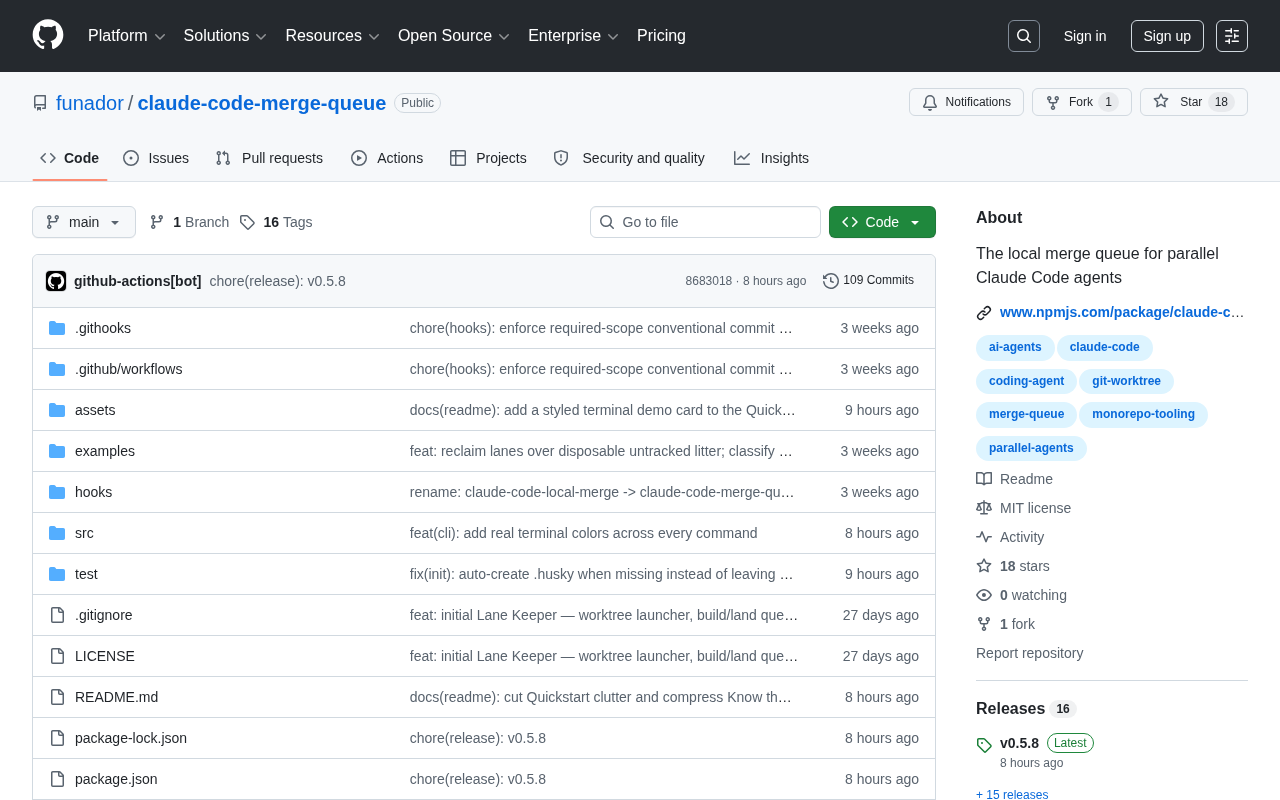
When multiple Claude Code agents modify the same codebase simultaneously, each generates changes based on the code state at a particular point in time. Once these changes need to be merged back into the main branch, conflicts are almost inevitable. In scenarios where AI agents work in parallel, the probability and complexity of conflicts increase significantly because agents lack the implicit coordination that human teams have (such as verbal communication and shared coding conventions). This is precisely the core pain point that local merge queue projects aim to solve—providing an orderly code integration mechanism for Claude Code agents running in parallel.
Core Concepts and Working Principles of Merge Queues
Merge Queue is not an entirely new concept. In large-scale software engineering practice, platforms like GitHub and GitLab have long provided merge queue functionality. The core idea is: queue pending changes for sequential testing and integration, ensuring each merge is based on the latest verified code state.
How Traditional Merge Queues Work
Traditional merge queues typically run on CI/CD servers and follow this process:
CI/CD (Continuous Integration/Continuous Deployment) is a foundational practice in modern software engineering. Continuous integration requires developers to frequently merge code changes into a shared mainline and verify the correctness of each merge through automated testing. Within this framework, the specific merge queue process is as follows:
- A developer submits a Pull Request and requests a merge
- The system adds the PR to a queue rather than merging immediately
- The queue processes items one by one: virtually merging the PR changes with the latest main branch
- Running the complete test suite for verification
- Only actually merging into the main branch after verification passes
GitHub's Merge Queue feature became GA in 2023. It creates temporary merge branches on the server side, stacks PRs from the queue in order, and runs CI checks. If a PR causes test failures, it's automatically removed from the queue without affecting other PRs. GitLab's Merge Train feature is similar, creating a series of pipeline-style merge verifications. The typical latency for these remote solutions ranges from minutes to tens of minutes, which is reasonable for formal merge processes in large projects but far too cumbersome for the pace of local development where AI agents might produce changes every few seconds.
This mechanism effectively prevents "semantic conflicts"—situations where two changes don't conflict syntactically but logically break each other when merged.
Why AI Agent Scenarios Need Localized Merge Queues
The unique aspect of this project is localizing the merge queue. For parallel Claude Code agents, they typically run on the developer's local machine, iterating quickly and committing frequently. If every merge had to go through the full pipeline of a remote CI server, the latency and cost would be prohibitive. A local merge queue can directly coordinate the output of multiple agents on the developer's machine, completing the ordering, integration, and verification of changes with much lower overhead.
From a concurrency control perspective, the local merge queue employs a variant of Optimistic Concurrency Control (OCC): allowing multiple agents to execute their tasks in parallel (the optimistic phase), but performing conflict detection and ordering when finally committing merges (the validation phase). If validation fails—meaning an agent's changes conflict with already-merged content—the changes need to be rolled back or regenerated based on the new state. This strategy is highly efficient when conflict rates are low, as most work can be done in parallel with serialization only at the final integration point. In contrast, pessimistic concurrency control (such as file locking), while completely preventing conflicts, would severely limit parallelism and is unsuitable for the rapid iteration patterns of AI agents.
Engineering Challenges of Parallel AI Programming
Having multiple AI agents work in parallel sounds appealing, but practical implementation faces multiple challenges. The local merge queue is just one piece of the solution puzzle.
Code State Consistency Issues
Each agent "snapshots" the current code state when starting a task. When Agent A completes its task, Agent B might still be working based on an outdated state. Without coordination, B's output might conflict with A's already-merged changes. The merge queue addresses this by enforcing serialization of final merge operations, allowing each agent's output to be validated against the latest state.
Resource Consumption and Task Scheduling
Running multiple AI agents in parallel means simultaneously consuming large amounts of API call quotas and computational resources. Taking Claude as an example, each agent instance may require multiple rounds of conversational reasoning when executing complex programming tasks, with each round involving thousands to tens of thousands of tokens in input and output. When multiple agents run in parallel, token consumption grows linearly or even super-linearly. Additionally, API services typically have rate limits, such as requests per minute and daily token caps, and multiple agents calling simultaneously may trigger throttling. From a cost perspective, the API pricing of high-performance models makes the economic cost of large-scale parallel usage considerable.
Therefore, how to schedule tasks, prevent agents from doing duplicate work, and decide whose changes take priority when conflicts occur are all engineering problems that require careful design. Intelligent task scheduling needs to consider not only minimizing code conflicts but also finding a balance between resource consumption and development efficiency.
Where Are the Boundaries of Human-Machine Collaboration?
You might not have noticed, but even with automated merge queues, human review remains indispensable. Merge queues can automate ordering and testing, but final code quality and architectural soundness judgments still require developer intervention. The value of merge queues lies in reducing the burden of handling mechanical conflicts for humans, not in completely replacing review.
Industry Trend: From Single-Agent to Multi-Agent Collaboration
This project reflects an industry trend worth paying attention to: AI programming is evolving from "single-agent assistance" to "multi-agent collaboration."
Once a single AI agent can handle relatively complex programming tasks, developers naturally pursue higher parallelism to amplify productivity. This gives rise to a series of new infrastructure needs—agent orchestration, task distribution, conflict resolution, result integration, and more. The local merge queue is an early exploration of this kind of "AI-native development infrastructure."
AI-native Development Infrastructure refers to tools and platforms specifically designed for AI agents participating in software development, distinct from traditional DevOps toolchains designed for human developers. This concept is analogous to "cloud-native"—it's not about simply migrating existing tools to AI scenarios, but about redesigning infrastructure based on the behavioral characteristics of AI agents. AI agents have several key characteristics that distinguish them from humans: they can be massively parallelized, have no context-switching costs, but each instance has limited context windows and lacks cross-session memory. Around these characteristics, new infrastructure needs to address agent identity management (which agent modified which code), context synchronization (how to make agents aware of other agents' progress), and quality assurance (how to use automated means to replace some manual review).
From Individual Tools to Complete Workflows
We can foresee that a complete set of supporting toolchains will form around AI programming agents in the future, just as ecosystems formed around continuous integration during the DevOps era. Merge queues, agent monitoring, cost management, quality gates, and other tools will gradually mature, helping developers more reliably harness multiple AI agents.
Summary: The Bottleneck in AI Programming Is Shifting
This project reminds us that the real bottleneck in AI programming is shifting from "whether AI can write correct code" to "how to efficiently coordinate the output of multiple AIs." The local merge queue is a pragmatic and focused attempt that doesn't pursue flashy capabilities but rather solves the most fundamental, highest-frequency engineering friction in parallel AI programming.
For developers currently experimenting with running multiple Claude Code agents in parallel, tools like this are worth following and trying out. For the industry as a whole, it signals that AI-assisted development is entering a new phase that requires dedicated infrastructure support.
Related articles

How to Interview Engineers in the AI Era: Practical Insights on Restructuring the Interview Process
When AI coding tools render traditional algorithm interviews ineffective, how should teams restructure? Insights from a year of practice on evaluating systems thinking, problem decomposition, and human-AI collaboration.

AI Agent Observability: A New Paradigm for Production Debugging and Hallucination Governance
Deep dive into AI Agent observability tools for production debugging and hallucination governance, covering full-chain tracing, semantic evaluation, and continuous improvement strategies.

How Theoretical Physicists Can Efficiently Get Started with Machine Learning: Optimal Paths and Resource Guide
A systematic guide for theoretical physicists transitioning to ML, covering math advantages, a three-stage learning path, classic textbooks, and physics-ML cross-disciplinary research directions.