Meta Smart Glasses Update: Tampering with the Privacy LED Will Automatically Disable the Camera

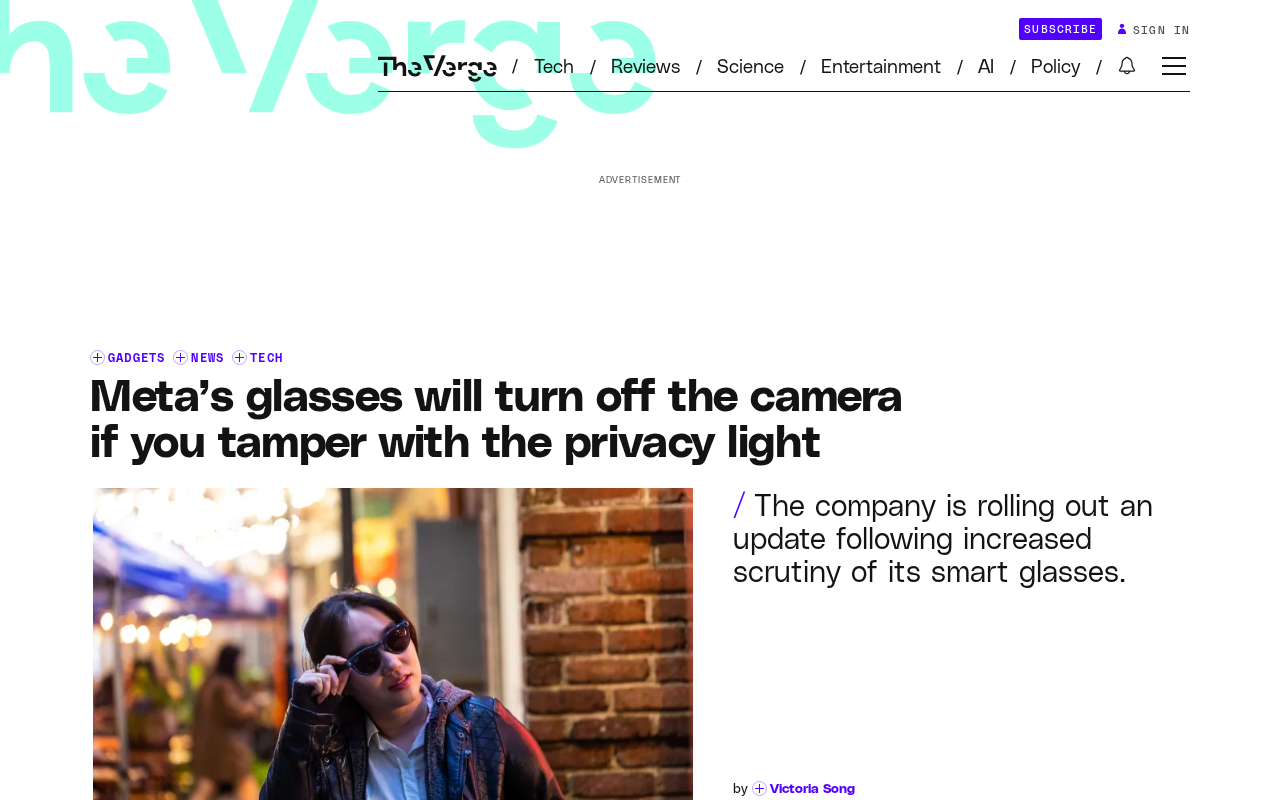
Meta will disable smart glasses cameras if the Privacy LED is physically tampered with or damaged.
Meta has announced a software update for its smart glasses that automatically disables the camera if the Privacy LED is tampered with or destroyed. The update escalates privacy protection from passive notification to active hardware enforcement, directly countering modders who physically remove the indicator light. However, experts note that detection mechanisms can potentially be bypassed, and the LED itself has inherent visibility limitations in real-world settings.
A Technical Response to Privacy Controversy
As smart glasses gradually enter mainstream use, Meta's wearable device has remained at the center of public scrutiny. In response to growing backlash over privacy concerns, Meta has announced a new software update: if the device detects that someone has tampered with or damaged the Privacy LED on the glasses, the camera will be automatically disabled.
This move directly targets "modders" who attempt to bypass the privacy indicator through physical means — such as drilling over or removing the LED. Meta is sending a clear message: recording activity must always be visible to those nearby and cannot be covertly disabled.
The Privacy LED: The Core Defense of Smart Glasses
The biggest difference between smart glasses and traditional cameras is their inconspicuousness. Glasses sit naturally on the face, making it difficult for bystanders to tell whether the wearer is recording video or taking photos. This is the core of the smart glasses privacy debate.
To address these concerns, Meta built a white LED indicator into the glasses that lights up when the camera is active, serving as a notification to those nearby. This small light is actually a critical line of defense in Meta's privacy design — a "trust contract" between the wearer and the people around them.
Technical Background: The Origins of Privacy LED Design
The Privacy LED concept draws from the "status indicator" tradition of early camera devices, such as the green light next to a laptop's webcam. However, the complexity of the smart glasses scenario far exceeds that of traditional devices — it requires a sufficiently visible visual cue within an extremely small form factor, without compromising wearability. The Meta Ray-Ban smart glasses use a white LED positioned on the right front of the frame, with brightness calibrated to meet visibility thresholds in indoor environments. Notably, the original product was criticized by users and privacy researchers for having an LED that was too dim and too discreetly placed to be noticed by ordinary people during everyday interactions — a critique that provided social justification for subsequent modding behavior.
The problem, however, is clear. Once a technically capable user physically disables this light, the glasses become a fully covert surveillance device. This not only violates the product's privacy design intent but could also lead to serious societal consequences.
From "Passive Notification" to "Active Enforcement"
Previously, the Privacy LED was merely a passive indicator — it could alert others, but couldn't prevent physical tampering. This software update upgrades the logic from "notification" to "enforcement": once the system detects that the privacy light has been damaged, the camera function is immediately disabled.
This effectively elevates privacy protection from the level of "social constraint" to "hardware functional constraint." In other words, Meta is trying to make tampering with the Privacy LED pointless — because once the light is destroyed, the camera becomes unusable as well.
Technical Background: Hardware Integrity Detection via Software-Hardware Integration
The core technical concept behind this update is "Hardware Integrity Verification," which has well-established precedents in security chips and Trusted Execution Environments (TEE). In practice, the system likely monitors the current/voltage feedback of the LED driver circuit to determine whether the light is intact — if an open or short circuit is detected (indicating physical damage or obstruction), it triggers a camera lockout. Similar mechanisms are used in industrial tamper-proofing and smartphone water damage detection (humidity sensors linked to software). This "software sensing hardware anomalies" design extends the security boundary beyond purely physical protection into the firmware layer, ensuring that a single physical act of destruction cannot bypass the overall protection system.
The Ongoing Battle Between Modders and Manufacturers
Reports indicate that some modders have already resorted to physical drilling to block the Privacy LED. The motivations behind such behavior vary: some are driven by technical curiosity, while others may have more concerning intentions.
Industry Background: The Historic Tug-of-War Between Hardware Modding Communities and Manufacturers
The battle between hardware modding communities and manufacturers has a long history — from early game console modchips, to smartphone bootloader unlocks, to bypassing drone no-fly zone restrictions. Modders have always sought ways to push past manufacturer-defined boundaries. This ecosystem has positive dimensions: the open-source hardware movement and the Right to Repair movement both grew from it. However, when modding targets privacy protection mechanisms, the nature of the act changes fundamentally: it is no longer users asserting control over their own devices, but rather expanding functionality at the cost of others' privacy. Meta's challenge is that its user agreements and hardware design must simultaneously address "well-intentioned technical explorers" and "malicious covert recorders" — two groups whose technical methods are often indistinguishable.
This battle is essentially the long-standing "cat and mouse game" between hardware manufacturers and the modding community — manufacturers design safeguards, modders find loopholes, and manufacturers push out patches. Meta's latest software update is simply the newest move in this ongoing arms race.
Notably, Meta's choice to counter physical tampering with a software detection mechanism reflects a more forward-thinking design philosophy: rather than relying solely on hardware defenses, the software system can sense abnormalities in hardware state, building a multi-layered privacy protection architecture.
Can Technical Measures Truly Solve Smart Glasses Privacy Issues?
While Meta's update is a step in the right direction, whether it can fundamentally eliminate smart glasses' privacy risks remains questionable.
The detection mechanism risks being circumvented. More technically capable modders may find ways to fool the detection system into believing the Privacy LED is still functioning normally, meaning the cat-and-mouse game is likely to keep evolving.
The inherent limitations of the Privacy LED itself. Even when the indicator is working properly, people nearby may not notice this tiny light in noisy public spaces, bright outdoor environments, or when the wearer deliberately obscures it. The privacy light is therefore more of a "symbolic" notification than an absolutely reliable form of protection.
Privacy Protection Requires Both Technical and Regulatory Approaches
The privacy challenges posed by smart glasses ultimately cannot be solved through technology alone. They involve legislation, social ethics, and the self-discipline of users.
Industry Background: The Legal and Regulatory Landscape for Wearable Camera Devices
Globally, targeted legal regulations for wearable camera devices like smart glasses remain significantly underdeveloped. The EU's General Data Protection Regulation (GDPR) addresses recording from a data processing perspective, but enforcement is extremely difficult. The applicability of U.S. "one-party consent" vs. "two-party consent" laws to video recording varies by state. China's Personal Information Protection Law explicitly prohibits unconsented facial data collection, but the boundaries in wearable scenarios remain vague. This legal vacuum means Meta's technical efforts are effectively filling a regulatory gap — the company is self-regulating through product design, partially substituting for external institutional constraints that have yet to materialize. While this "technology-as-law" model has practical necessity, it also raises deeper questions about whether tech companies should bear quasi-public regulatory responsibilities.
Meta's update demonstrates the manufacturer's technical commitment, but building genuine public trust in wearable camera devices will require more robust industry standards and institutional frameworks working in concert.
Conclusion
Meta's addition of a "tamper with the Privacy LED and the camera shuts off" feature is a constructive response to growing public anxiety over privacy. It upgrades privacy protection from a passive notification to an active constraint, signaling that the company takes societal concerns seriously.
However, this is more like one move in a long game than a decisive endgame. As smart glasses and other wearables become increasingly widespread, striking the right balance between technological innovation and privacy protection will be a challenge the entire industry — and society at large — must grapple with for the long term. Meta's approach may offer a valuable reference for the industry: good technical design should consider privacy from the ground up, making "doing harm" costly enough to be not worth the effort — whether through hardware integrity verification, legal deterrence, or the collective shaping of social norms. All three are indispensable.
Key Takeaways
Related articles

White House Invites OpenAI and Other Giants to Preview Voluntary AI Framework: Open-Source Language Becomes Key Battleground
Trump administration invites OpenAI, Anthropic, and Google to preview a voluntary AI framework, with open-source language emerging as the core lobbying battleground that could reshape industry competition.

AI Art Prompt Structure Breakdown: Creating a Desert Crystal Pyramid Scene
Breaking down a popular Reddit AI artwork to reveal the five core elements of structured prompts: subject, material, lighting, environment, and atmosphere for AI art scene creation.

$100 Million Deal: AI Gives 50,000 Ukrainian Kamikaze Drones Autonomous Target Lock
A U.S. company struck a $100M deal with Ukraine to deploy AI visual lock-on capabilities on 50,000 cheap kamikaze drones, enabling terminal autonomous guidance to defeat electronic warfare jamming.