Monolite Review: Is This Scan-to-Join Audience Interaction Tool Worth Trying?

Monolite is a lightweight audience interaction tool featuring scan-to-join QR codes, custom branding, and data reports.
Monolite is a new audience interaction tool by indie developer Anıl, enabling real-time participation via QR code scanning without app downloads. Key features include instant QR join, custom branding, and detailed data reports. Compared to established competitors like Kahoot!, Mentimeter, and Slido, Monolite differentiates through its lightweight, zero-barrier experience. Still in early stages on Product Hunt, it targets meetings, education, and community events.
From One-Way Presentations to Two-Way Interaction: What Problem Does Monolite Solve?
In meetings, classrooms, and live events, there's a long-standing pain point: speakers deliver their content on stage while the audience remains in a passive receiving state. Scattered attention, low engagement, and lack of feedback — these issues significantly diminish the impact of even the most carefully prepared presentations.
This problem has deep roots in academic research. Educational psychology studies show that adult attention during passive listening typically begins to decline significantly after 10-18 minutes. Harvard Graduate School of Education's Professor Eric Mazur demonstrated back in the 1990s through "Peer Instruction" that incorporating interactive elements into classroom sessions can improve conceptual understanding by 40-70%. This finding spawned the entire Audience Response System (ARS) industry — from early hardware clickers to today's mobile web apps. While the technological medium has continuously evolved, the core challenge remains the same: how to transform one-way information delivery into two-way cognitive engagement.
A new tool that recently debuted on Product Hunt, Monolite, targets precisely this scenario. Its tagline is clear and simple — "Turn any audience into active participants."
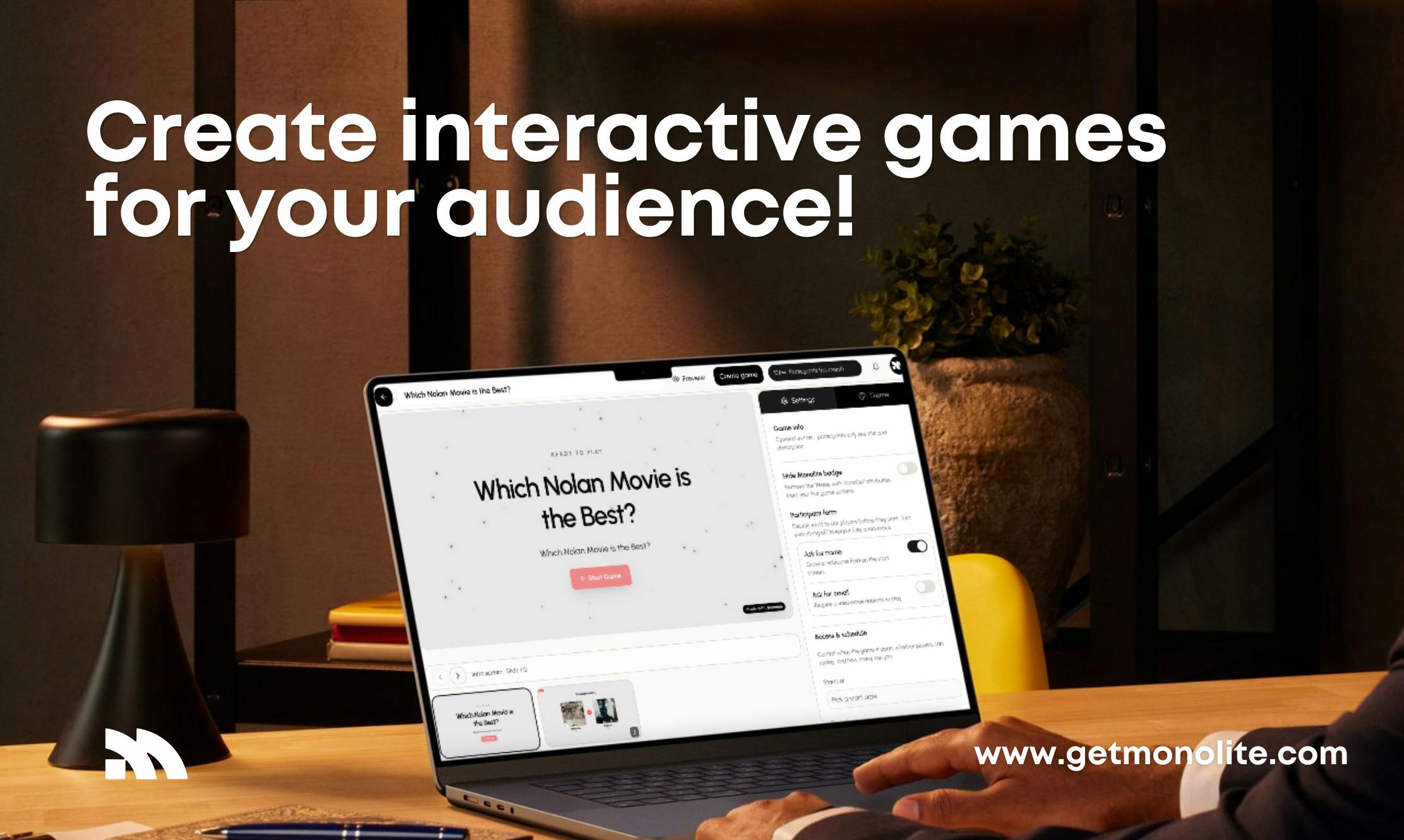
Monolite was built by independent developer Anıl and is positioned across three categories: Meetings, Maker Tools, and Community. Its core logic is to create interactive games that transform one-way presentations into real-time participatory experiences for the audience.
Monolite Core Features Explained
Instant QR Join: Zero-Barrier Participation
Monolite's most prominent feature is lowering the barrier for audience participation. The tool provides an Instant QR Join function — audience members simply scan a QR code displayed on screen with their phones. No app download required, no account registration needed — they're instantly in the interactive session. It also supports Public Participation, further expanding its applicability to scenarios ranging from meeting rooms with dozens of people to conferences with hundreds.
From a technical implementation perspective, this feature combines WebSocket real-time communication technology with Progressive Web App (PWA) principles. When audience members scan the QR code, their mobile browser opens a lightweight web page that establishes a persistent connection with the server via WebSocket, enabling millisecond-level bidirectional data transmission. This approach has significant advantages over native apps: no app store downloads, no device storage consumption, and excellent cross-platform compatibility. Industry data shows that each additional participation step (such as downloading an app or registering an account) can result in 50-70% user drop-off, making "frictionless participation" the lifeline of such tools.
This "scan and use" design is extremely friendly for event organizers. In real-world scenarios, the simpler the participation flow, the higher the actual participation rate — any unnecessary steps can cause massive potential participant attrition.
Custom Branding: Maintaining Visual Consistency
For enterprises and professional events, brand consistency is an important consideration. Monolite offers Custom Branding capabilities, allowing users to unify the interactive pages with their own brand identity. This feature is particularly useful for marketing events, corporate training, and business presentations, making the interactive component feel like an organic part of the event itself rather than a disconnected third-party tool.
Custom branding capability is commonly known as "white-label" functionality in the SaaS industry. Its commercial value is substantial: according to SaaS pricing research, products with white-label capabilities can typically charge 2-5x the base price, because they satisfy enterprises' rigid requirements for brand unity and professional image. For event scenarios, when interactive pages present unified brand colors, logos, and visual styles, audience trust and immersion both increase significantly, and interaction completion rates rise accordingly. This means white-label functionality isn't just a premium pricing mechanism — it's also a key design element for improving actual product effectiveness.
Detailed Data Reports: From Interaction to Insights
Interaction isn't just about creating excitement — more importantly, it's about collecting feedback and insights. Monolite provides Detailed Reports that help organizers review participation data after events. This data can be used to evaluate content effectiveness, understand audience preferences, and provide a basis for optimizing future events. A data-driven feedback loop is what distinguishes these interaction tools from "entertainment novelties" to "professional tools."
The value of detailed data reports goes far beyond simple "event reviews." In modern event marketing and corporate training systems, data reports are the core tool for proving ROI (Return on Investment). Training departments need to demonstrate training effectiveness to management, event organizers need to show participation depth to sponsors, and educators need to identify students' knowledge gaps. In these scenarios, metrics like "number of participants," "quiz accuracy rates," "interaction duration," and "trending topics" form a comprehensive effectiveness evaluation framework. From a product development perspective, data capabilities are also a key lever for transitioning from a free tool to a paid SaaS — basic interactions free, in-depth data analysis paid — this is the industry's standard business model.
Monolite Use Cases and Target Users
Monolite's three category tags — Meetings, Maker Tools, Community — clearly outline its target user groups:
- Enterprises and Teams: Useful for team building, training, and interactive icebreakers and knowledge quizzes in internal meetings.
- Educators: Enhance student engagement and knowledge retention through interactive games in the classroom.
- Event Organizers and Community Managers: Energize the atmosphere at offline events and community gatherings while collecting participant feedback.
- Independent Creators: Make content sharing more engaging with interactive tools.
Monolite vs. Kahoot, Mentimeter, and Other Competitors
This market segment already has several established players, such as Kahoot!, Mentimeter, and Slido. For Monolite to stand out, it needs to find its footing in ease of use, pricing, and differentiated features.
A deeper look at the competitive landscape helps contextualize Monolite's positioning. The audience interaction tool market has formed a clear hierarchy: Kahoot! (founded 2012, went public 2021, valuation once exceeding $7 billion) focuses on gamified quizzes and dominates the K-12 education space with over 9 billion cumulative participants globally; Mentimeter (Swedish company, founded 2014) emphasizes real-time polls and word clouds with extremely high penetration in corporate meeting scenarios; Slido (founded 2012, acquired by Cisco for approximately $250 million in 2021) specializes in Q&A and polling for large conferences with deep Webex integration. These three occupy the education, internal corporate, and large event sub-segments respectively. Opportunities for newcomers typically lie in: lighter user experiences, lower price thresholds, or customized features for specific vertical scenarios (such as community operations or maker meetups).
Based on its current feature set, Monolite's advantage lies in its lightweight and zero-barrier participation experience, while mature competitors are more comprehensive in template variety, integration capabilities, and enterprise-grade features. Monolite's current "free trial" strategy is a reasonable approach for acquiring early users.
Early Market Performance and Growth Potential
Looking at Product Hunt data, Monolite has currently received 8 upvotes and 5 comments, ranking 15th. This is a relatively early-stage result, indicating the product is still in its infancy and hasn't yet generated significant market buzz.
It's worth noting that Product Hunt, as a product discovery platform, is an important channel for independent developers to acquire early users and validate their market. The platform averages 30-50 new product launches daily, and achieving a top-5 ranking typically requires 150-300 upvotes. Monolite's 8 upvotes and 15th-place ranking represent a typical cold-start phase. For independent developers, what matters at this stage isn't the absolute numbers but the quality of feedback from early users. Successful indie developer products (like early-stage Notion, Loom, etc.) often followed a "niche reputation → community spread → scale growth" path, where word-of-mouth from product experience matters more than paid acquisition.
As an independent developer's creation, Monolite demonstrates clear product thinking and a well-defined value proposition. Rather than attempting to pile on features, it focuses on the core goal of "getting the audience to participate" and forms a complete usage loop through QR code joining, custom branding, and data reporting.
However, in the highly competitive interactive presentation space, Monolite faces real challenges: how to establish differentiation in a market with homogenized features, and how to convince users already accustomed to Slido or Mentimeter to switch over. For tools like these, the smoothness of the actual interactive experience and the fun factor of the games often determine user retention more than feature lists.
Conclusion: Is Monolite Worth Trying?
Monolite represents a product direction with persistent demand — how to reactivate real-time human interaction in the digital age. For users who frequently present to audiences or organize events, it offers a lightweight option worth trying. The product currently offers a free trial, so interested users can directly experience its interactive capabilities and judge whether it fits their use case.
Related articles

How to Interview Engineers in the AI Era: Practical Insights on Restructuring the Interview Process
When AI coding tools render traditional algorithm interviews ineffective, how should teams restructure? Insights from a year of practice on evaluating systems thinking, problem decomposition, and human-AI collaboration.

AI Agent Observability: A New Paradigm for Production Debugging and Hallucination Governance
Deep dive into AI Agent observability tools for production debugging and hallucination governance, covering full-chain tracing, semantic evaluation, and continuous improvement strategies.

How Theoretical Physicists Can Efficiently Get Started with Machine Learning: Optimal Paths and Resource Guide
A systematic guide for theoretical physicists transitioning to ML, covering math advantages, a three-stage learning path, classic textbooks, and physics-ML cross-disciplinary research directions.