Pinery Prose: Redefining the AI Book-Writing Experience with Diff Review

Pinery Prose applies code diff review to AI book writing, giving authors line-by-line control over every edit.
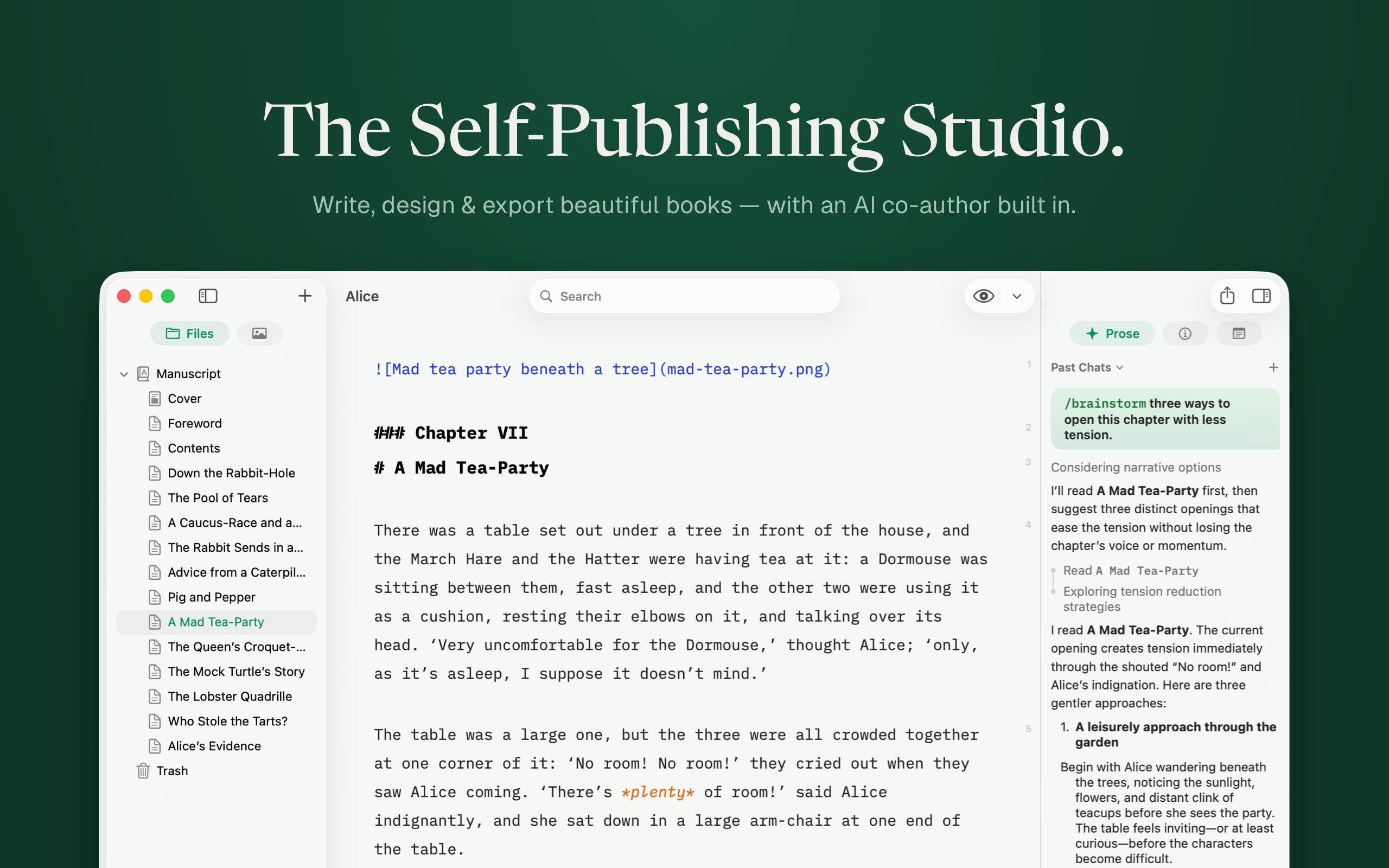
Pinery Prose is a Mac-based AI co-authoring tool that borrows the diff review mechanism from software engineering, letting authors accept or reject each AI suggestion individually. It covers the full self-publishing workflow—writing, design, and export to ePub 3/PDF—while keeping all files in plain Markdown to ensure data sovereignty and zero vendor lock-in.
When AI Writing Meets "Diff Review"
In an era overflowing with AI writing tools, a core tension continues to plague creators: AI-generated content often replaces the original text wholesale, stripping authors of any sense of control over their words. Current AI writing tools exist on a full spectrum when it comes to "control": at one end sit general-purpose LLMs like ChatGPT and Claude, where users provide prompts and AI autonomously generates content with almost all control on the AI side; at the other end are traditional proofreading tools like Grammarly that only make spelling and grammar-level tweaks, leaving control entirely with the user. Products in between, like Notion AI and Jasper, offer paragraph-level rewriting and expansion, but typically employ a "direct replacement" interaction model—users either accept an entire rewritten paragraph or manually compare before-and-after text to spot differences.
Recently, Pinery Prose landed at #18 on Product Hunt's daily chart with 110 votes, offering a distinctly engineering-minded solution—turning every AI edit into a diff (difference comparison) that you can "accept or reject."
Pinery itself is a self-publishing studio for Mac, and the new Prose feature in version 2.0 upgrades it into an "AI co-author for books." This "co-author" doesn't write from scratch on your behalf—instead, it collaborates deeply based on pages you've already written.
How the Diff Review Mechanism Returns Control to Authors
The most noteworthy design in this AI book-writing tool borrows from version control in software development. Diff (difference comparison) is one of the most fundamental version control concepts in software engineering, traceable back to the diff tool in Unix systems in 1974. In modern software development, distributed version control systems like Git have made diffs the core collaborative workflow: when each developer submits code changes, the system automatically generates a line-by-line comparison, marking additions (green) and deletions (red). Team members conduct Code Review through Pull Requests, deciding line by line whether to merge. This mechanism ensures code quality while giving every change clear accountability and a traceable record.
Pinery Prose brings this mechanism into the writing domain: when AI offers edit suggestions, it doesn't overwrite your text directly. Instead, it presents "original vs. suggestion" in diff format, letting the author accept or reject each change individually. In essence, this brings the rigor of code review to creative writing—every AI-suggested modification requires the author's "approval" before taking effect.
This design addresses two major pain points in AI writing:
- Controllability: The author remains the ultimate decision-maker; AI only provides suggestions rather than making unauthorized rewrites. In book writing—a context requiring high consistency and personal style—this line-by-line confirmation mechanism ensures AI won't inadvertently alter the author's tone, word choices, or narrative rhythm.
- Traceability: Every change is clearly visible, completely eliminating the black-box problem of "I don't even know what the AI changed." Authors can learn from AI's editing logic during the review process while preserving expressions they don't want altered.
For books—long-form content that demands consistent style and the author's personal voice—this "confirm each change" model is especially important. It lets AI truly play the role of an "editing assistant" rather than a "ghostwriter."
From Writing to Finished Book: A Complete Self-Publishing Workflow
Unlike many AI writing tools that focus solely on "generating text," Pinery emphasizes a complete self-publishing workflow. This positioning has deep industry context: Self-Publishing has experienced explosive growth over the past decade. According to Wordsrated data, in 2022 alone, over 3 million self-published books were listed on Amazon Kindle Direct Publishing (KDP). Traditional publishing typically takes 6-18 months and involves literary agents, editors, designers, printers, and other intermediaries, while the maturation of self-publishing toolchains enables individual authors to go from writing to listing in just weeks. However, self-published authors often must simultaneously serve as writer, editor, typesetter, cover designer, and marketer—tool integration directly impacts efficiency. Pinery targets precisely this "one person, many roles" pain point.
Its core capabilities cover three key stages:
Write
Prose intervenes in the writing process as an AI co-author, offering expansion, polishing, and revision suggestions based on existing content to help authors efficiently refine their manuscripts. Unlike AI generation starting from a blank page, it emphasizes collaborative optimization built on the author's existing foundation, meaning the manuscript's core ideas and structure always remain author-driven.
Design
As a "publishing studio," Pinery handles not just text but also book layout and design, giving content the visual presentation of a finished book. For self-published authors, professional typesetting is often the most overlooked element yet has the greatest impact on reader experience.
Export
Final output can be exported as ePub 3 or PDF format. ePub 3 is an open e-book standard developed by the International Digital Publishing Forum (IDPF, now merged into W3C), built on HTML5, CSS3, and JavaScript, supporting multimedia embedding, interactive content, and rich typographic control. Currently, all major global e-book platforms (such as Apple Books, Google Play Books, Kobo, etc.) support ePub 3 format. Although Amazon Kindle uses its proprietary KF8/AZW3 format, its underlying architecture heavily borrows from ePub 3's technical framework. PDF is suited for print and fixed-layout distribution. For self-published authors, ePub 3 means one production covers most distribution channels—authors can go directly from Pinery to publishing without juggling between multiple tools.
Data Sovereignty: Files Always Stay in Plain Markdown
Another design philosophy that shouldn't be overlooked is data openness. Pinery explicitly promises: Your files stay plain Markdown.
Markdown was created by John Gruber in 2004, with a design philosophy of making plain text readable while being convertible to structured HTML. As a lightweight markup language, Markdown files are essentially .txt files with minimal formatting markers (like # for headings, ** for bold), openable and editable by any text editor on any operating system.
This is particularly rare today. Many writing and publishing tools use proprietary formats that "lock" user content within their ecosystem—once users stop using the tool or the product shuts down, authors face difficult content migration. In the context of Data Sovereignty, using open formats means user content doesn't depend on any specific software's continued existence. Markdown, as an open, plain-text, cross-platform markup language, delivers tangible benefits:
- Authors have complete ownership and portability of their raw files
- Content can be opened, edited, and backed up with any text editor—even if Pinery stops operating tomorrow, all manuscripts remain intact and can seamlessly migrate to Obsidian, Typora, VS Code, or any other Markdown-supporting tool
- Zero risk of vendor lock-in, forming a stark contrast with tools like Notion and Google Docs that use proprietary data structures
This "data sovereignty belongs to the user" stance is philosophically aligned with the diff review mechanism—both maximize the return of control to creators.
Pinery Prose's Strengths and Challenges
Pinery Prose is built by independent developer Heberti Almeida and currently targets Mac only. From a product positioning perspective, it targets a vertical but genuinely needed scenario: individual authors in self-publishing.
In this space, its competitive differentiation is crystal clear:
- Interaction paradigm innovation—Reconstructing AI writing interaction with the engineer-familiar diff mindset, leveraging AI efficiency while preserving author control. On the control spectrum of AI writing tools, Pinery Prose carves out a unique position: it allows AI to make deep editing suggestions while ensuring the author's final say over every word through the line-by-line approval mechanism.
- Full workflow coverage—From writing and design to book export, completing the entire publishing process in one place, solving the efficiency loss self-published authors face when switching between multiple tools.
- Open data format—Markdown format safeguards users' long-term interests and data freedom, reflecting a commitment to long-term trust relationships with users.
Of course, as a newly launched product, it faces practical challenges: Mac-only support limits its audience; the quality of AI suggestions and the operational efficiency of diff review in very long texts (a book might contain tens or even hundreds of thousands of words) still await validation from more real users. Additionally, in the self-publishing tools space, it must compete against established tools like Scrivener and Vellum that already have mature user bases.
Nevertheless, the concept Pinery Prose proposes—"every edit is a reviewable diff"—points AI-assisted creative tools toward a direction worth emulating: AI should augment authors, not replace them. In an era of increasingly powerful generative AI, finding the right balance between efficiency and control is precisely the most valuable exploration products like this can undertake.
Key Takeaways
Related articles

White House Invites OpenAI and Other Giants to Preview Voluntary AI Framework: Open-Source Language Becomes Key Battleground
Trump administration invites OpenAI, Anthropic, and Google to preview a voluntary AI framework, with open-source language emerging as the core lobbying battleground that could reshape industry competition.

AI Art Prompt Structure Breakdown: Creating a Desert Crystal Pyramid Scene
Breaking down a popular Reddit AI artwork to reveal the five core elements of structured prompts: subject, material, lighting, environment, and atmosphere for AI art scene creation.

$100 Million Deal: AI Gives 50,000 Ukrainian Kamikaze Drones Autonomous Target Lock
A U.S. company struck a $100M deal with Ukraine to deploy AI visual lock-on capabilities on 50,000 cheap kamikaze drones, enabling terminal autonomous guidance to defeat electronic warfare jamming.