Starling Project Analysis: Can AI Independently Write a Complete Desktop System?

Analyzing whether AI can truly build a complete desktop system independently, using the Starling project as a lens.
The Starling project claims to be the first desktop system written by AI, sparking debate about AI's engineering capabilities. This analysis examines what "AI-written" actually means, the immense technical complexity of desktop systems, why such projects keep emerging alongside AI tool evolution, and the gap between generating code and building maintainable systems. The conclusion: while AI programming progress is real, the distance from writing code to building systems remains significant.
A Bold Declaration
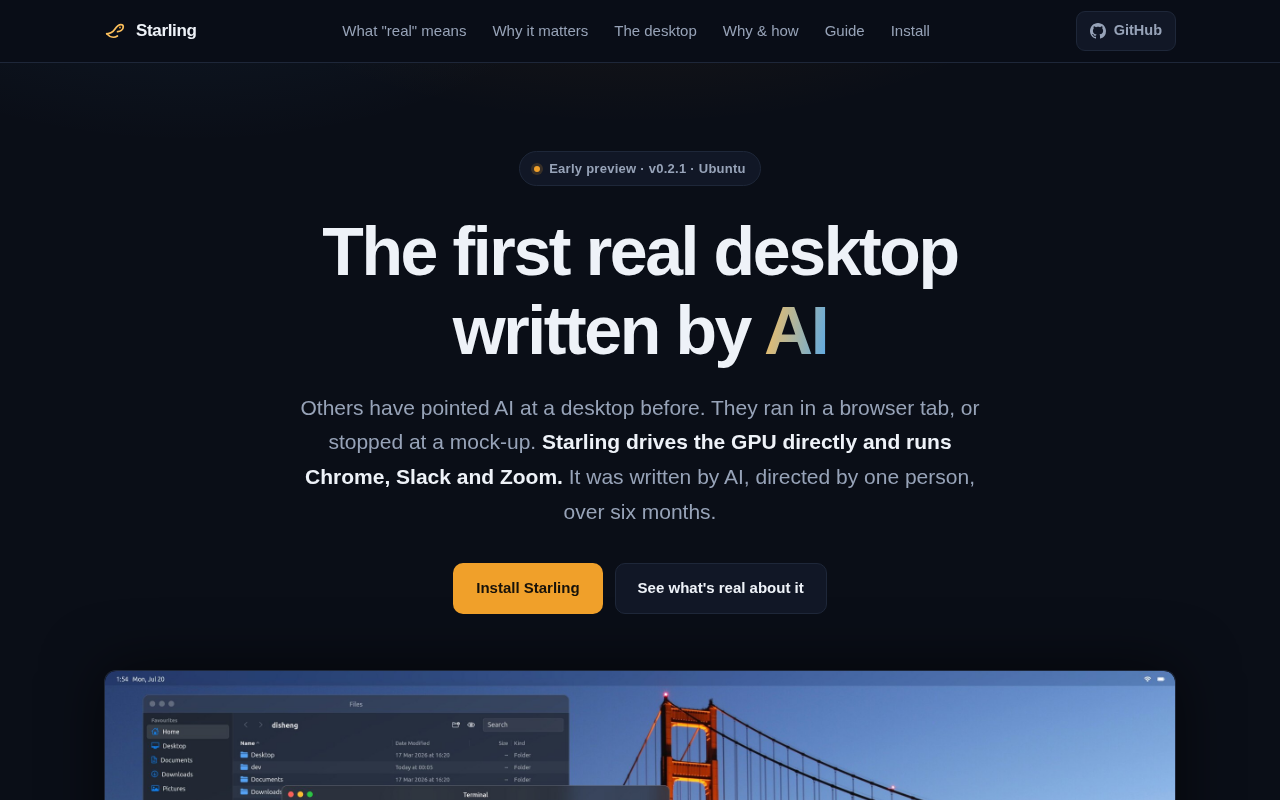
Recently, a project called Starling caught attention on Hacker News with an ambitious tagline — "The first real desktop written by AI." Although the post is still in its early stages of discussion (8 upvotes, 2 comments), the project touches on a topic being debated repeatedly: Can AI truly handle the complete construction of large, complex software engineering projects?
From simple code completion to function-level generation, and now claims of building a complete "desktop system," the boundaries of AI programming capabilities are being continuously tested. Regardless of its maturity level, Starling's emergence deserves a sober examination from both technical and industry perspectives.
What Does "Written by AI" Actually Mean?
The Ambiguity of Definition
"Written by AI" is an expression full of tension yet easily misunderstood. In practice, it could correspond to several fundamentally different scenarios:
- Fully autonomous generation: AI independently completes architecture design, code implementation, and debugging starting from requirements, with virtually no human intervention. This is the most radical and hardest to achieve form.
- Human-AI collaboration led: Developers provide high-level requirements and constraints, AI generates the vast majority of code, and humans review, correct, and integrate.
- Assisted acceleration: AI participates as a powerful tool, but core architecture and key decisions remain under human control.
For projects like Starling, what the outside world cares most about is: "What percentage of actual engineering work did AI handle?" and "Does this code meet usable, maintainable engineering standards?" Without transparent development logs and code audits, any claim of being "the first" requires caution.
Notably, the measurement standard for "AI-written code" itself is a question without consensus. The industry currently lacks a unified metrics framework to define the proportion of AI contribution — is it calculated by lines of code, by functional modules, or by decision points? If humans provide detailed architectural blueprints and interface definitions, and AI only fills in implementation details, does that count as "AI-written"? This definitional ambiguity means any claim about "AI independently writing" something needs to be accompanied by specific methodology explanations to have substantive meaning.
The Technical Complexity Threshold of Desktop Systems
A so-called "desktop system" typically involves window management, graphics rendering, event loops, process scheduling, input/output handling, and a series of modules interweaving low-level and high-level concerns. Such systems have considerably high requirements for state management, concurrency correctness, and performance — far more complex than generating a standalone algorithm function or a simple web application.
To understand this complexity, we can look at historical desktop system engineering. The X Window System, born in 1984, went through decades of iteration by hundreds of engineers before forming a stable architecture; its successor, the Wayland protocol, has been in development since 2008 and is still refining its ecosystem. Even relatively lightweight window managers (like i3 or Sway) involve complex geometric calculations, focus management, and multi-monitor coordination. The core challenges of a desktop system include: the window compositor needs to coordinate rendering buffers from multiple applications at 60 frames per second or higher; the event loop must dispatch keyboard, mouse, touch, and other inputs to the correct window within microsecond-level latency; inter-process communication (IPC) mechanisms need to balance security isolation with efficient data transfer. The interactions between these components form an enormous state space, where any concurrency error could cause the entire desktop to freeze or crash.
If Starling was indeed primarily written by AI and has reached a "truly usable" level, it would validate not just code generation capability, but AI's understanding and organizational ability for system-level architecture — which happens to be a weak spot for current large models.
The core difficulty that current large language models face in system-level architecture lies in their attention mechanism, which fundamentally processes weighted information within a limited context window. Even with context lengths extended to hundreds of thousands of tokens, models still struggle to maintain globally consistent design intent across tens of thousands of lines of code. System architecture decisions often involve anticipating future requirements, estimating performance bottlenecks, and weighing coupling between different subsystems — judgments requiring engineering intuition and accumulated experience that cannot yet be effectively learned through pattern matching. Research shows that large models' accuracy significantly decreases as the number of abstraction layers requiring cross-layer reasoning increases.
Why Projects Claiming AI-Written Complete Systems Keep Emerging
The Evolution Curve of AI Programming Tools
Over the past two years, AI programming tools have undergone significant leaps. From GitHub Copilot's inline completion, to AI-native editors like Cursor and Windsurf, to "programming Agents" capable of autonomously executing tasks across files and modules, AI's code-handling granularity has moved from "snippets" to "projects."
Several key technical breakthroughs support this evolution. First is the dramatic expansion of context windows: from 4K tokens in the GPT-3 era to 100K or even longer contexts supported by some models today. The amount of code a model can "see" has grown from a few hundred lines to entire codebases — this is the physical foundation for moving from snippet-level to project-level generation. Second is the maturation of Tool Use capabilities: modern programming Agents are no longer limited to pure text generation but can invoke terminals to execute commands, read and write file systems, run test suites, and consult documentation, forming a closed-loop "think-act-observe" workflow. Third is the enhancement of multi-step reasoning and planning capabilities: through techniques like Chain-of-Thought, Tree-of-Thought, and others, models can decompose complex tasks into manageable sub-steps and execute them one by one. Projects like Devin, OpenHands, and SWE-Agent are attempting, on these technical foundations, to have AI handle the complete development workflow from requirements analysis to code submission.
In this context, attempts at "AI writing complete desktop systems" represent a natural industry evolution. Developers are eager to know: as task scale keeps expanding, where exactly are AI's capability boundaries? Starling is essentially a public test of these boundaries.
The Double-Edged Sword of the "First" Narrative
In tech communities, "the first" is often an extremely viral label that quickly captures attention. But it's also a double-edged sword: once the gap between actual project maturity and marketing claims is too large, it can trigger backlash. The Hacker News community is known for being critical and technically rigorous, with comment sections often raising questions like "how much was actually written by AI," "what's the code quality like," and "is there cherry-picking."
For such projects, the most convincing evidence isn't the tagline, but rather a reproducible development process, an open codebase, and independent third-party evaluation.
A Rational Perspective: Opportunities and Pitfalls Coexist
The Exploration Value Worth Affirming
Regardless of Starling's ultimate level of completion, such projects have exploratory significance in themselves. They push AI toward high-end engineering complexity scenarios, exposing current tools' real shortcomings in long-range planning, context consistency, and system debugging, providing concrete problem samples for subsequent research.
Furthermore, if developers can openly share the complete workflow of "AI-led + human review," this has reference value for the entire industry in understanding how to collaborate with AI to build large systems. This transparency is especially important now: the software industry is at a critical juncture transitioning from "AI-assisted programming" to "AI-led programming," and the industry urgently needs real case studies to establish accurate awareness of AI capability boundaries. Every publicly shared failure case, every engineering challenge AI cannot independently solve, is valuable input for driving tool improvement.
The Over-Promising That Requires Vigilance
On the other hand, we should also be wary of the tendency to equate "AI-generated" with "AI independently completing high-quality engineering." The core difficulty of software engineering has never been just "writing code," but rather writing code that is correct, robust, maintainable, and capable of long-term evolution. Current large models excel at generating seemingly reasonable code, but still require substantial human intervention to ensure system correctness and handle edge cases.
This gap is particularly evident in industrial practice. There's a well-known rule of thumb in software engineering: writing code typically accounts for only 20%-30% of the entire software delivery cycle, with the remaining time consumed by requirements clarification, architecture design, test verification, security auditing, performance tuning, documentation, and long-term maintenance. Even if AI can efficiently generate initial code, subsequent regression testing (ensuring new code doesn't break existing functionality), security hardening (defending against injection attacks, buffer overflows, privilege escalation, and other vulnerabilities), and performance profiling (identifying hot paths and memory leaks) still heavily depend on human engineering judgment. More critically, software systems need to continuously evolve over months or even years — when requirements change, does AI-generated code have sufficient modularity and extensibility to support refactoring? When production incidents occur, can developers quickly understand the intent of AI-generated code and locate problems? These "post-code" engineering challenges are the core criteria for measuring whether a system is truly "usable."
Therefore, facing expressions like "the first desktop system written by AI," the reasonable attitude is: maintain open curiosity while insisting on the rigor of technical verification.
Conclusion
Starling is a microcosm of AI programming capabilities' continuous breakthrough trajectory. It poses a sharp and important question: Can AI independently handle the complete construction of system-level software? The answer remains unclear and requires more transparent evidence to support it.
For developers and observers, rather than rushing to draw conclusions about "the first," it's better to focus on the real capability boundaries these projects reveal — progress in AI programming is certain, but from "can write code" to "can build systems," there remains a distance that demands serious attention. This distance concerns not only the advancement of technical capabilities but also how we establish trust mechanisms for AI engineering outputs — including auditable development processes, quantifiable quality metrics, and clear delineation of human-machine responsibility boundaries.
Related articles

StoryVoice: Automatically Generate Customer Case Studies from 5-Minute Voice Interviews
StoryVoice is an AI case study generator that lets customers record 5-minute voice interviews via a link, automatically producing case studies with real quotes and metrics for B2B marketing teams.

Cloudflare Uses AI to Standardize Engineering Practices: From Standards Drift to Automated Enforcement
Deep dive into how Cloudflare uses LLMs to auto-enforce engineering standards, solving standards drift in large teams. Explores AI code review in CI/CD pipelines, challenges, and implications.

50 Decision Engines: Reshaping Creator Economy Operations with Quantitative Tools
Deep dive into the Sovereign Creator Calculator Suite: 50 Notion-based interactive decision engines covering pricing, churn, ad ROI, and MRR modeling for data-driven creator growth.