Supervision: A Model-Agnostic Engineering Toolkit for Computer Vision

Roboflow's model-agnostic open-source toolkit bridging CV model outputs to production applications.
Supervision is an open-source computer vision toolkit by Roboflow that serves as the engineering glue layer between model inference and application deployment. With 48K+ GitHub stars, it provides model-agnostic detection handling, rich visualization annotators, built-in ByteTrack object tracking, zone counting, and dataset format conversion between COCO, YOLO, and Pascal VOC—all with minimal dependencies.
A CV Toolbox Focused on "Reusability"
In computer vision engineering practice, developers often face a common pain point: while mature frameworks already support model training and inference, there's still a significant amount of repetitive and tedious engineering work between "getting model output" and "building a complete application." Drawing bounding boxes, object tracking, zone counting, result filtering, format conversion—these seemingly simple yet repeatedly implemented features are exactly what Roboflow's open-source library Supervision aims to solve.
As its project tagline states: "We write your reusable computer vision tools." Supervision's positioning is crystal clear—it's not a training framework, nor a model library, but rather the engineering glue layer connecting models to applications.
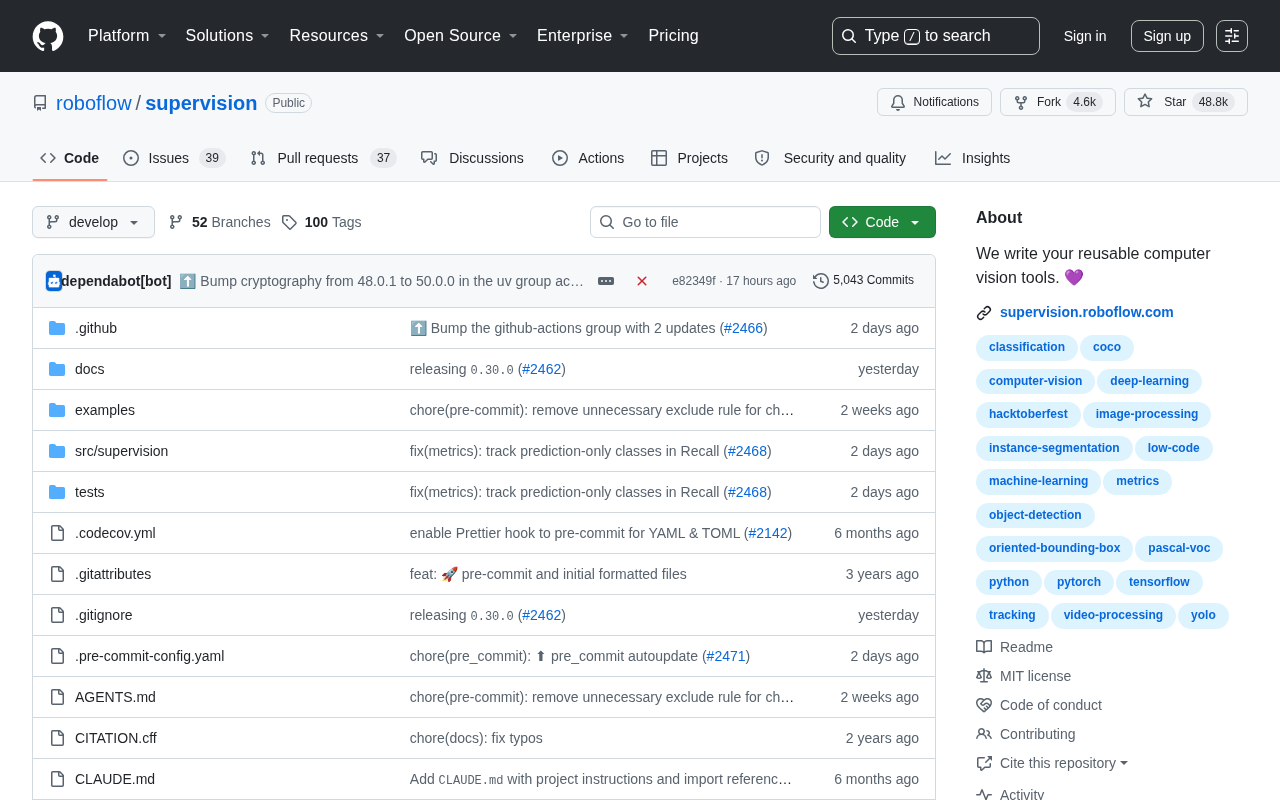
The project has accumulated 48,751 stars and 4,610 forks on GitHub, with 132 new stars added in a single day, showing sustained and growing popularity. As an open-source project written in Python, it has become a staple in many vision engineers' toolchains.
What Problems Does Supervision Solve
Model-Agnostic Universal Design
One of Supervision's core design principles is being model-agnostic. Whether you're using the YOLO series, Detectron2, detection models from the Transformers ecosystem, or Roboflow's own inference service, Supervision provides a unified interface to receive and process these models' outputs.
To understand the value of this design, you need to first appreciate the fragmented state of model outputs in the current CV ecosystem. YOLO-series models typically output tensors in [x_center, y_center, width, height, confidence, class] format; Detectron2 uses custom Instances objects with bounding boxes stored in (x1, y1, x2, y2) format; detection models in HuggingFace Transformers return normalized coordinates plus post-processing dictionaries. Every time you switch models, downstream visualization and business code needs to change accordingly—a massive engineering burden in fast-iterating projects.
This means developers can freely switch between different models without rewriting large amounts of post-processing and visualization code. It abstracts out a standard data structure called Detections, unifying the diverse output formats from various models into a single specification, dramatically reducing engineering migration costs. The Detections object internally uses NumPy arrays to store bounding box coordinates (xyxy format), confidence scores, class IDs, tracking IDs, and optional segmentation masks, while providing factory methods like from_ultralytics(), from_detectron2(), and from_transformers() for zero-cost adaptation to different model outputs. This design pattern resembles the "Adapter Pattern" in software engineering, using a thin conversion layer to unify heterogeneous interfaces into a standard protocol.
Out-of-the-Box Visualization and Annotation
In real projects, "drawing" detection results is one of the most frequent requirements. Supervision provides a rich set of Annotator components, including bounding box annotation, mask annotation, label annotation, tracking trajectory drawing, heatmaps, and more. With just a few lines of code, developers can transform raw model inference results into clear, intuitive visualized images or videos.
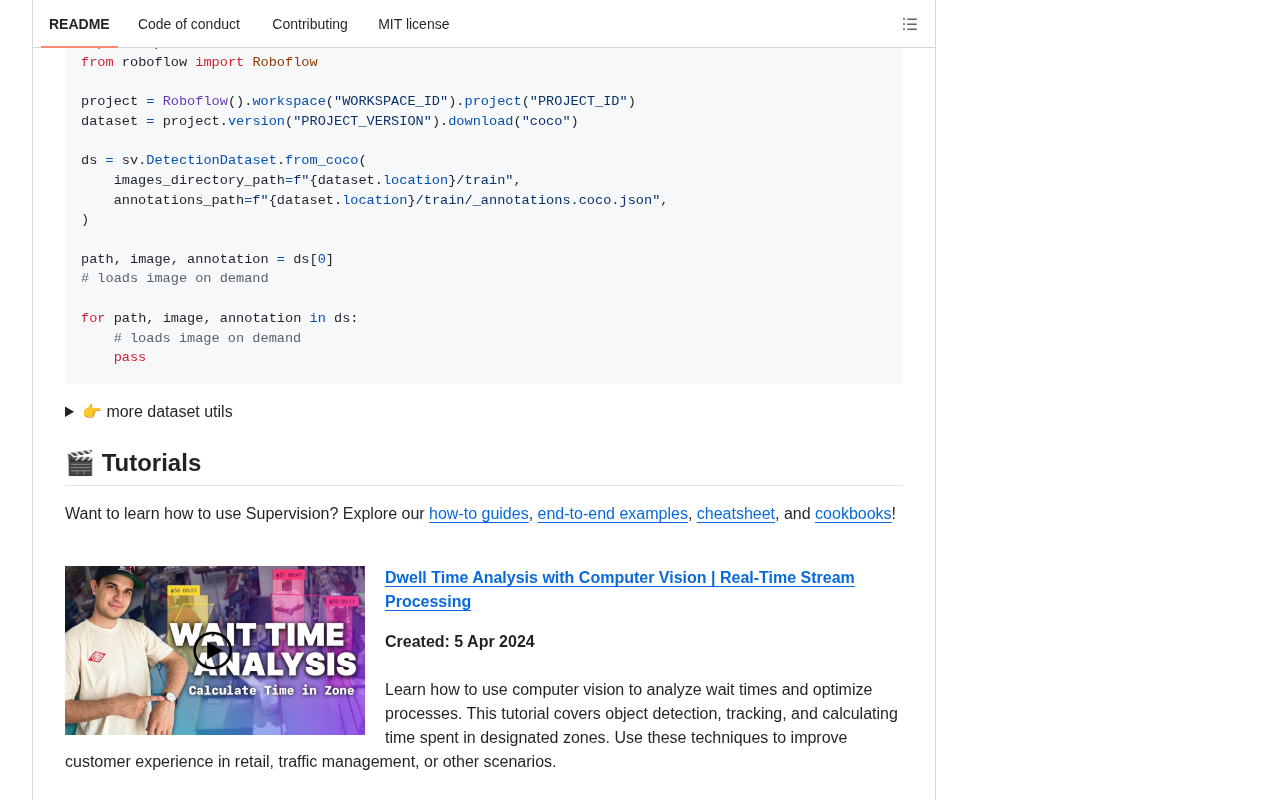
This "what you see is what you get" capability is extremely friendly for rapid prototyping, demo presentations, and debugging.
Core Feature Modules in Detail
Object Detection and Segmentation Post-Processing
Supervision provides a complete processing pipeline for object detection, instance segmentation, keypoint detection, and other tasks. It supports filtering detection results (by confidence, class, area size, and other criteria), converting between different coordinate formats, and aggregating operations, making complex post-processing logic concise and readable.
Notably, Supervision also includes a built-in implementation of Non-Maximum Suppression (NMS). NMS is an indispensable post-processing step in object detection—since detection models typically produce multiple overlapping candidate boxes for the same target, NMS removes redundant detections by calculating IoU (Intersection over Union) between boxes, keeping only the optimal results. Supervision encapsulates these algorithms into simple function calls, saving developers from having to write their own implementations or piece together code from various sources each time.
Object Tracking and Zone Counting
In video analysis scenarios, single-frame detection is far from sufficient—cross-frame object tracking is the key. Supervision integrates mainstream tracking algorithm interfaces, assigning stable IDs to each target, thereby supporting business logic such as "zone entry/exit counting," "dwell time statistics," and "line-crossing detection."
From a technical perspective, Multi-Object Tracking (MOT) is one of the most challenging sub-problems in computer vision. Its core difficulty lies in data association—how to correctly match detection results of the same target across consecutive frames, especially in complex scenarios where targets are occluded, disappear and reappear, or multiple targets cross paths. Current mainstream tracking paradigms fall roughly into two categories: one based on motion prediction (e.g., ByteTrack uses Kalman filtering to predict a target's next-frame position, then applies the Hungarian algorithm for matching); the other incorporates appearance features (e.g., DeepSORT introduces Re-ID features to enhance association robustness). Supervision has a built-in ByteTrack tracker and provides a unified tracking interface, allowing developers to obtain usable tracking results without needing to deeply understand the underlying state estimation and matching algorithms.
Typical applications include foot traffic counting in retail, vehicle counting in traffic scenarios, and behavior analysis in security surveillance. These features, which would otherwise require substantial custom code, can be quickly implemented through Supervision's LineZone, PolygonZone, and other utility classes. LineZone triggers counting by detecting whether a target's center point crosses a preset virtual line segment; PolygonZone defines arbitrary polygon regions to determine whether targets are inside the area, supporting more flexible spatial analysis needs.
Dataset Format Conversion and Processing
Beyond the inference side, Supervision also excels in data processing. It supports loading and converting between multiple mainstream dataset formats including COCO, YOLO, and Pascal VOC, making it easy for developers to move data between different toolchains and reducing format adaptation friction.
The differences between these three formats are rooted in their respective historical backgrounds and design philosophies. COCO format (originating from Microsoft's Common Objects in Context dataset) uses a centralized JSON file to store all annotation information, with bounding boxes in [x, y, width, height] (top-left coordinates plus width and height), supporting segmentation polygons and keypoints—complete in structure but large in file size. YOLO format is a lightweight annotation method defined by the Darknet framework, where each image corresponds to a .txt file with each line recording class x_center y_center width height (all coordinates normalized to 0-1)—concise and efficient but limited in information. Pascal VOC format (originating from the Visual Object Classes challenge launched in 2005) uses XML files to store annotations per image, with bounding boxes as (xmin, ymin, xmax, ymax) absolute coordinates. When developers need to train a YOLO model with COCO-format data, or import YOLO training data into an annotation tool that uses VOC format, format conversion becomes essential. Supervision encapsulates these conversion logics into clean APIs, eliminating the burden of writing custom parsing scripts.
Why It Deserves a Place in Your Toolbox
Lowering the Computer Vision Engineering Barrier
Supervision's greatest value lies in standardizing and componentizing repetitive engineering work. For small-to-medium teams or individual developers, this means focusing limited energy on business logic and model performance rather than burning it on the tedium of reinventing the wheel.
Active Open-Source Community and Ecosystem Integration
Backed by Roboflow, a highly influential company in the computer vision space, Supervision enjoys continuous maintenance updates and active community support. Founded in 2019, Roboflow positions itself as "developer infrastructure for computer vision," with products covering the complete workflow from data annotation (Roboflow Annotate), dataset management, and model training to cloud/edge deployment. The company has secured multiple funding rounds from investors including a16z, serving over 250,000 developers and tens of thousands of enterprises. As a core component of its open-source strategy, Supervision serves both as a gateway to capture developer mindshare and as a bridge connecting Roboflow's various paid services—developers using Supervision to process inference results can seamlessly integrate with Roboflow's dataset hosting and model deployment capabilities.
The accumulation of nearly 50,000 stars demonstrates the broad recognition it has earned among developers. Deep integration with the Roboflow platform further extends its applicability across data annotation, model deployment, and other stages.
Lightweight, Flexible, and Modular
Compared to some monolithic frameworks, Supervision maintains a lightweight positioning. It doesn't force binding to a specific tech stack, and developers can import only the feature modules they need. This "just enough" philosophy allows it to flexibly embed into various project architectures. From a dependency management perspective, Supervision's core dependencies include only foundational libraries like NumPy, OpenCV, and Pillow—it doesn't introduce heavy dependencies at the deep learning framework level. This means it can be quickly installed in local development environments and easily integrated into Docker containers and edge device deployment environments.
Summary
Supervision precisely addresses the "last mile" pain point in computer vision engineering. It doesn't aspire to become an all-encompassing framework; instead, it diligently turns high-frequency, repetitive tasks like detection, tracking, visualization, and data processing into reusable tools.
For any developer building vision applications, Supervision deserves a place in the toolbox—it significantly reduces boilerplate code and accelerates the journey from model to product. Nearly 50,000 stars and continuously rising popularity represent the community's best vote for this pragmatic tool.
Related articles

NVFP4 Dynamic Quantization in Practice: W4A4 Accelerated Deployment for the Full Gemma-4 Model Family
NVFP4 dynamic quantization covers all five Gemma-4 model sizes using W4A4 mixed-precision with calibrated FP8 KV Cache, dramatically reducing VRAM usage and deployment costs for efficient inference from edge to cloud.

Why CodeAct Code-First Agents Haven't Won Yet: A Deep Dive into the Paradigm's Dilemma
Deep analysis of why CodeAct code-first agents haven't replaced ReAct chat-first frameworks. Examining model training bias, protocol limitations, MCP design flaws, and sandbox challenges.

Qwen3-Max Deep Dive: How Coding and Collaboration Capabilities Are Redefining AI Development Assistants
Deep analysis of Alibaba's flagship model Qwen3-Max, covering its coding, Cowork collaboration capabilities, and potential for redefining AI-assisted software development.