NVFP4 Dynamic Quantization in Practice: W4A4 Accelerated Deployment for the Full Gemma-4 Model Family

NVFP4 W4A4 quantization enables efficient deployment of the full Gemma-4 model family with mixed-precision strategies.
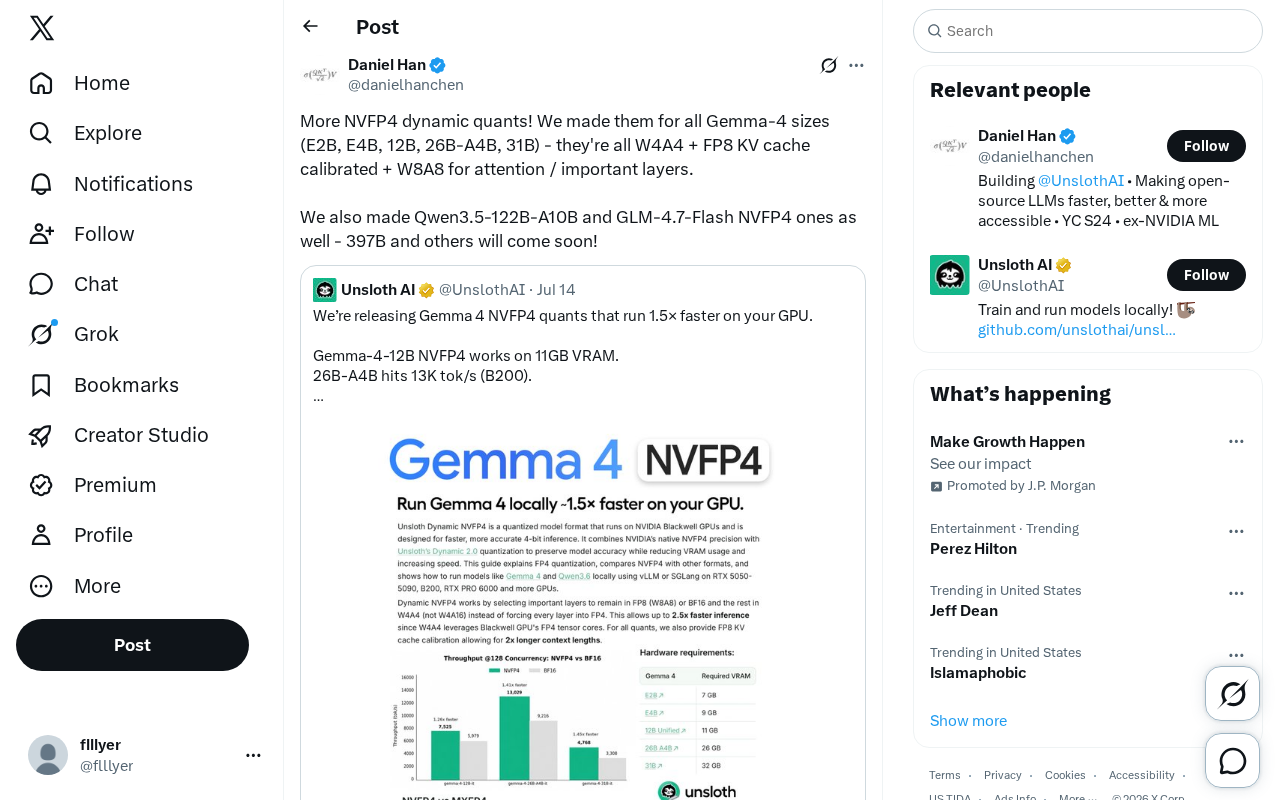
A new batch of NVFP4 dynamic quantization models covers all five Gemma-4 sizes plus Qwen3.5 and GLM-4.7, using a W4A4 mixed-precision strategy with calibrated FP8 KV Cache and W8A8 attention layers. This approach dramatically reduces VRAM requirements while maintaining quality, enabling deployment from edge devices to cloud servers on next-gen Blackwell GPUs with native FP4 tensor core support.
NVFP4 Quantization: A New Breakthrough in LLM Inference Efficiency
As large language models continue to grow in scale, efficiently deploying these models on limited hardware resources has become one of the most pressing challenges in the industry. Recently, a batch of model weights based on NVFP4 dynamic quantization was released, covering the entire Gemma-4 series as well as popular models like Qwen3.5 and GLM-4.7, offering the community new high-performance deployment options.
According to the publisher, this quantization effort not only covers all five sizes of the Gemma-4 series (E2B, E4B, 12B, 26B-A4B, 31B) but also extends to Qwen3.5-122B-A10B and GLM-4.7-Flash, with the larger 397B model on the roadmap. This means that from edge-device small models to ultra-large-scale MoE models, NVFP4 quantization is rapidly moving toward full-spectrum coverage.
What Are NVFP4 and the W4A4 Quantization Scheme
NVFP4 is a 4-bit floating-point data format introduced by NVIDIA, designed specifically for the tensor cores of next-generation GPUs (such as the Blackwell architecture). Unlike traditional INT4 integer quantization, FP4 uses a floating-point representation (1 sign bit, 2 exponent bits, 1 mantissa bit), dramatically compressing storage and bandwidth requirements while preserving dynamic range.
The reason floating-point representation is more suitable for neural network quantization than integer representation comes down to how neural network weights and activations are distributed—they typically follow a bell-shaped distribution resembling a Gaussian or Laplacian curve, with most values concentrated near zero and a small number of outliers spread across distant regions. INT4 can only uniformly represent 16 discrete values; when facing outliers, it must either clip them or sacrifice precision in the central region. FP4's floating-point encoding naturally provides denser representation granularity near zero and greater dynamic range in regions far from zero, aligning closely with actual data distributions. NVIDIA introduced native hardware tensor core support for FP4 operations for the first time in the Blackwell architecture (e.g., B100/B200 GPUs), meaning FP4 is not just a storage compression format but can directly participate in matrix multiplication computations, achieving throughput close to theoretical peak performance.
The Meaning and Advantages of W4A4
The quantized models in this release use a W4A4 scheme, meaning both weights and activations are at 4-bit precision. Compared to W4A16 schemes that only quantize weights, W4A4 further compresses the storage and computational overhead of activations, theoretically delivering higher inference throughput—but also placing greater demands on quantization algorithm precision control.
To understand the fundamental difference between these two approaches, you need to distinguish between two types of inference bottlenecks. W4A16 means weights are stored at 4 bits but must be dequantized to 16-bit floating point for multiplication with activations during computation—essentially a storage-only compression scheme where computation still occurs at high precision, primarily optimizing for memory-bound bottlenecks. W4A4, on the other hand, compresses both weights and activations to 4 bits and performs matrix multiplication directly at low precision, saving not only bandwidth but also reducing actual computation. When batch size is large, the inference bottleneck shifts from memory bandwidth to compute throughput (compute-bound), and this is where W4A4's advantages truly shine. However, quantizing activations is more challenging than quantizing weights because activations are dynamic and input-dependent—their distributions can vary dramatically across tokens. This is why "dynamic quantization" techniques are needed to determine quantization parameters in real-time rather than using static preset values.
Mixed-Precision Strategy Explained
One important detail: these models are not simply compressed entirely to 4-bit. The publisher employed a carefully designed mixed-precision strategy:
- W4A4 as the primary quantization scheme, used for the vast majority of layers
- FP8 KV Cache that is calibrated, maintaining higher precision for the attention cache
- W8A8 for attention mechanisms and other critical layers
This layered approach embodies the core philosophy of current quantization practice—aggressively compress less sensitive layers while preserving higher bit-widths for critical layers that significantly impact precision, thereby balancing efficiency and quality. The theoretical basis for this approach comes from extensive experimental observations: different layers in a model have vastly different sensitivities to quantization noise. Feed-forward network (FFN) layers are typically robust to low-bit quantization, while Query/Key projections in attention layers are more precision-sensitive—small numerical deviations get amplified through the softmax operation, causing significant shifts in attention weight distributions.
The Practical Significance of Full Gemma-4 Quantization Coverage
The Gemma-4 series ranges from the ultra-lightweight E2B to the large 31B model, and having all of them quantized is of considerable value.
For edge deployment scenarios, small models like E2B and E4B can have their memory footprint further compressed after 4-bit quantization, making it possible to run them on consumer-grade GPUs or even some mobile devices. For medium-to-large models like 12B, 26B-A4B, and 31B, the VRAM savings from quantization mean a single GPU can host models that previously required multiple cards, significantly lowering the deployment barrier and cost.
The 26B-A4B model with its MoE (Mixture of Experts) architecture is particularly noteworthy—its active parameter count is far smaller than the total, and combined with NVFP4 quantization, its cost-performance advantage is further amplified. MoE is a sparsely-activated model architecture where the model contains multiple parallel "expert" sub-networks. During inference, input tokens are routed through a gating network (Router) to only a few experts for processing, so while total parameters are large, actual computation is comparable to a much smaller dense model. However, MoE's key pain point is: despite low computation requirements, all expert parameters must remain resident in VRAM since it's impossible to predict which token will be routed to which expert. This is precisely why quantization is tremendously valuable for MoE models—4-bit quantization can compress total parameter VRAM requirements to one-quarter of FP16, making it possible to deploy ultra-large-scale MoE models on limited GPUs.
Qwen3.5-122B-A10B is similarly an MoE structure with 122B total parameters but only about 10B activated, potentially delivering near-large-model capabilities on limited hardware after quantization. In FP16, 122B parameters require approximately 244GB of VRAM just for weight storage; after NVFP4 quantization, this can be compressed to approximately 61GB, making deployment on 2× 80GB GPUs a reality.
The Critical Role of FP8 KV Cache Calibration
In long-context inference scenarios, KV Cache is often one of the primary sources of VRAM consumption. As context length increases, KV Cache usage grows linearly and can quickly exceed the model weights themselves.
KV Cache is the core optimization mechanism for autoregressive generation in Transformer models. When generating each new token, the model needs to compute attention over all previous tokens. KV Cache stores previously computed Key and Value vectors to avoid redundant computation. For a model with L layers, H attention heads per layer, and head dimension D, processing a sequence of length N requires approximately 2×L×H×D×N×bytes_per_element of KV Cache storage. Taking a 32-layer model with GQA (Grouped Query Attention) processing 128K context as an example, KV Cache in FP16 can easily reach tens of gigabytes—in some scenarios even exceeding the VRAM footprint of the model weights themselves.
This quantization scheme uses calibrated FP8 precision for KV Cache—a pragmatic choice. Compared to aggressively compressing KV Cache to 4-bit, FP8 maintains relatively high numerical precision while still saving half the VRAM, avoiding quality collapse during long-text generation due to excessively low cache precision.
The "calibration" here refers to using representative datasets to determine the optimal quantization parameters (scale factors) for each layer's KV Cache, rather than using simple min-max statistical methods. Calibrated FP8 can significantly reduce precision loss compared to naive quantization, especially in long-context scenarios where KV values from early tokens accumulate small quantization errors that amplify over multiple attention computations as sequence length grows. The calibration process is specifically designed to minimize this accumulated error. This "preserve precision on critical paths" philosophy is an essential safeguard for quantization to truly work in production.
Impact on the Open-Source Community and LLM Deployment Industry
The release of these quantized models reflects the open-source community's continued investment in model deployment optimization. Quantization is no longer simple "one-click compression" but rather a systems engineering effort requiring fine-grained calibration across different layers and data types.
Looking at trends, as hardware with native FP4 support like Blackwell becomes widespread, NVFP4 is poised to become one of the mainstream formats for next-generation inference deployment. Blackwell's fifth-generation tensor cores introduce native hardware support for the FP4 data type for the first time—in the Hopper architecture (H100/H200), the lowest precision supported by tensor cores was FP8 and INT8; Blackwell's tensor cores can directly execute FP4×FP4 matrix multiplication, with theoretical peak compute doubling compared to FP8. Additionally, Blackwell introduces its second-generation Transformer Engine, which can dynamically select the optimal precision (FP4/FP8/FP16) for different layers at runtime, enabling hardware-software co-designed mixed-precision inference. This hardware-level support is the critical prerequisite for NVFP4 to truly land in production environments—low-bit quantization without hardware acceleration can often only save bandwidth without improving compute throughput.
With NVFP4 receiving tensor core acceleration at the hardware level, combined with software-level mixed-precision strategies, LLM inference costs can be compressed to new lows.
The publisher has indicated that quantized versions of larger models like the 397B will be released subsequently, meaning even ultra-large-scale models may be deployable on relatively accessible hardware through quantization in the future. For developers and enterprises hoping to run frontier models at lower cost, this is undoubtedly a direction worth watching.
Conclusion
From W4A4 as the primary quantization scheme, to calibrated FP8 KV Cache, to the mixed-precision design that preserves W8A8 for attention layers—these NVFP4 dynamic quantization models demonstrate the maturity of current model compression technology. They not only cover the entire Gemma-4 series but extend to popular models like Qwen3.5 and GLM-4.7, providing the community with complete deployment options from edge to cloud. As hardware and software ecosystems continue to co-evolve, efficient, low-cost LLM inference is becoming increasingly within reach.
Related articles

The Em Dash Stigma: When AI Tarnishes Human Writing Habits
The em dash is being labeled as an "AI marker," turning human professional writing skills into evidence of inauthenticity. This article explores how AI stigmatizes writing habits and how creators should respond.

Dopamine Jailbreak Tool: Complete Guide to iOS 15-26 Semi-Untethered Jailbreak
Complete guide to Dopamine open-source jailbreak tool supporting iOS 15-26 semi-untethered jailbreak. Learn its mechanics, compatible versions, technical details, and risks. Led by developer opa334 with 5,800+ GitHub stars.

Which Programming Language Is Best for AI Coding Assistants? The Battle Between Type Systems and Training Data
Exploring language choice in the AI coding assistant era: statically typed languages like TypeScript and Rust enable AI self-correction via compiler feedback, while Python leads with massive training data.