T3Code Open Source Project Analysis: Why Theo's TypeScript Code Tool Gained 1400+ Stars in One Week

Theo's T3Code project gained 1400+ Stars in one week, extending the T3 Stack's type-safe philosophy into developer tooling.
T3Code, led by well-known developer Theo (ping.gg founder), rapidly gained 1,431 Stars in one week, accumulating 16,425 Stars total. Built on TypeScript and continuing the T3 Stack's type-safety philosophy, the project benefits from Theo's strong community influence and demonstrates both high attention and practical usage through its Star/Fork ratio. The article evaluates its growth model, practical value, and implications for the modern open source ecosystem.
T3Code Emerges: 1,431 Stars in One Week
In the GitHub open source ecosystem, projects that can garner over 1,400 Stars in a single week are rare. T3Code, led by well-known developer community figure Theo (founder of ping.gg), is exactly such a rapidly rising star. The project has now accumulated 16,425 Stars and 3,669 Forks, using TypeScript as its primary development language, demonstrating strong community appeal.
For developers familiar with the modern web development ecosystem, the "T3" prefix is no stranger. It originates from Theo's advocated tech stack philosophy — centered on type safety, integrating modern toolchains like Next.js, TypeScript, tRPC, and Tailwind CSS. Each of these tools has its own positioning: Next.js is a React-based full-stack framework providing server-side rendering (SSR), static site generation (SSG), and other capabilities; tRPC is an end-to-end type-safe RPC framework that allows frontend and backend to share type definitions without writing API schemas; Tailwind CSS is a utility-first CSS framework that enables rapid styling through atomic class names. Their common characteristic is that they all deeply embrace TypeScript's type system, enabling compile-time type checking protection across the entire chain from database to frontend UI. T3Code's emergence continues this technical philosophy, offering developers a new productivity tool option.
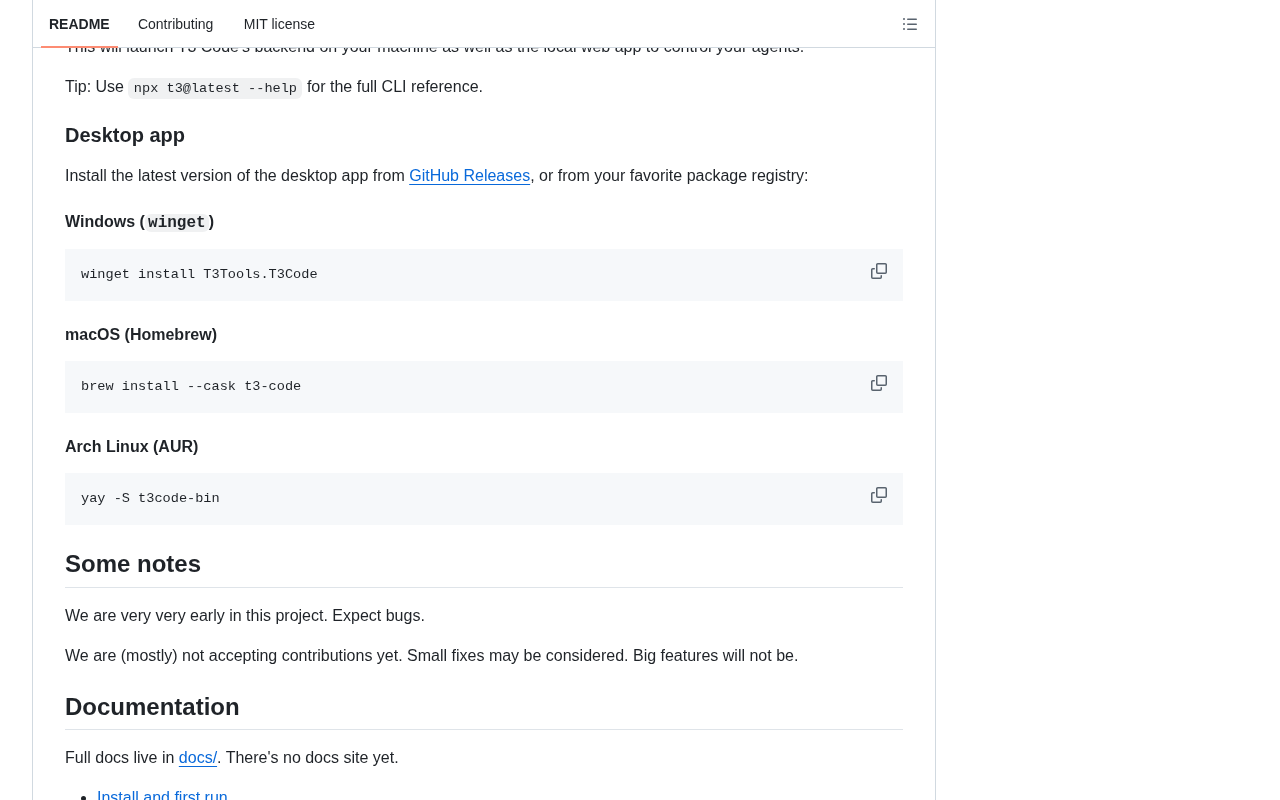
Continuation and Innovation of the T3 Ecosystem: From T3 Stack to T3Code
The Community Foundation Laid by create-t3-app
Theo and his team had already established an excellent reputation in the developer community through create-t3-app. This scaffolding tool enables developers to quickly set up type-safe full-stack applications, becoming the starting point for many TypeScript projects. The launch of T3Code can be seen as a further extension of this philosophy into the code tooling domain.
Choosing TypeScript as the core language is no coincidence. In today's era of increasingly prevalent AI-assisted programming and modern development tools, TypeScript's type system offers unique advantages — when large language models (the models behind tools like GitHub Copilot, Cursor, etc.) generate code, type annotations provide additional contextual constraints, making AI-generated code more accurate and less error-prone. Meanwhile, TypeScript's structural type information enables IDEs to provide more precise auto-completion and error detection, complementing AI assistance. According to the 2024 Stack Overflow Developer Survey, TypeScript has consistently ranked among the "most loved languages" for multiple years, with its adoption rate in enterprise applications continuing to climb. T3Code's choice of this technical direction aligns with Theo's longstanding engineering philosophy while also lowering the barrier to entry for community contributors — TypeScript has already become the mainstream choice for frontend and full-stack development.
Community-Driven Growth Logic
Here's a notable detail: T3Code's growth largely benefits from Theo's powerful influence in the developer community. As an active technical content creator, he has over 400,000 YouTube subscribers, known for his straightforward technical commentary and live coding style, and commands a large following on Twitter and other platforms. This "KOL-driven" open source project growth model is becoming a unique phenomenon in the modern open source ecosystem. Unlike traditional open source projects that rely on corporate backing or organic growth, these projects leverage creators' content distribution capabilities to achieve cold starts. Similar cases include open source projects launched by technical creators like Fireship (Jeff Delaney) and ThePrimeagen. The advantage of this model lies in quickly obtaining community feedback and contributors, but the risk is that long-term project maintenance may become overly dependent on individual energy and enthusiasm.
The 3,669 Forks figure is also noteworthy. In the GitHub ecosystem, the Star/Fork ratio serves as a reference indicator for measuring a project's nature. T3Code's 16,425 Stars corresponding to 3,669 Forks gives a ratio of approximately 4.5:1. For comparison, pure utility projects (like VS Code extensions) typically have higher ratios (10:1 or above), while frameworks and scaffolding projects tend to have relatively higher Fork counts since developers need to create their own projects based on templates. T3Code's ratio indicates it possesses the dual attributes of being both "watched" and "used." A high Fork count typically means developers aren't just following the project — they're willing to build upon it for secondary development or deep customization. This reflects T3Code's potential to become an infrastructure-level tool, rather than merely a "star project" for admiration.
Why Developers Need Open Source Tools Like T3Code
Core Value of Improving Development Efficiency
In software engineering practice, code-related tools can often significantly improve team efficiency. Whether it's code generation, code analysis, or development workflow automation, a well-designed tool can save developers substantial time on repetitive tasks. T3Code's rapid rise to prominence indirectly confirms the community's sustained demand for high-quality TypeScript development tools.
Adopting a fully open source strategy allows T3Code to benefit from the collective wisdom of the community. Developers can freely view source code, submit improvements, and report issues — this collaborative model often enables tool iteration speeds far exceeding those of closed products. For teams that depend on it, open source also means greater transparency and control — no need to worry about vendor lock-in. In the current environment where SaaS tool pricing strategies frequently change, the autonomy provided by open source tools is particularly valuable.
How to Rationally Evaluate T3Code's Practical Value
While GitHub Stars are an important indicator of project popularity, they cannot fully represent a project's maturity and actual value. Many projects gain significant attention early on through creator influence or topicality, but whether they can maintain active development and community support long-term is what ultimately determines their vitality. Research on open source project lifecycles shows that many projects that gain early attention enter a "maintenance fatigue period" after 6-12 months, during which declining community contribution rates and maintainer engagement can lead to project stagnation.
For developers considering adopting T3Code, evaluation from the following dimensions is recommended:
- Documentation completeness: Whether there are clear installation guides and usage instructions
- Issue and PR response speed: Whether maintainers are active (generally, projects with a median response time under 48 hours are in good maintenance condition)
- Version update stability: Whether there's a regular iteration cadence, whether Semantic Versioning conventions are followed
- Tech stack compatibility: Whether it matches your project's actual needs
- Dependency health: Whether project dependencies are actively maintained, whether known security vulnerabilities exist
Popularity can serve as a reference for initial screening, but final technical decisions should still come back to engineering practice itself.
Summary: What T3Code Tells Us About the Modern Open Source Ecosystem
T3Code's rapid rise is a vivid microcosm of today's open source ecosystem development — a technical leader's personal brand, an active developer community, and the pursuit of modern engineering principles like type safety collectively drive the creation and spread of quality open source tools.
This phenomenon also reflects an important evolutionary trend in the open source world: project success increasingly depends on the combination of technical strength and community operations capability. Pure technical superiority is no longer the sole success factor — founders who can clearly communicate project vision and build developer identification often bring momentum to projects far exceeding the technology itself.
As the project continues to develop, whether T3Code can transform from "topic buzz" to "practical value" deserves continued attention from the developer community. For TypeScript ecosystem practitioners and modern web developers, this is a project worth adding to your technology radar and keeping track of.
Related articles

Qwen3-Max Deep Dive: A Comprehensive Analysis of Its Coding and Collaboration Capabilities
Alibaba releases Qwen3-Max flagship model positioned as a new benchmark for coding and collaboration. Deep analysis of its capabilities, open-source strategy, and competitive landscape.

Midjourney Medieval Scene Prompt Techniques: Breakdown & Practical Guide
Deep analysis of a high-quality Midjourney medieval castle Prompt, breaking down keywords like medieval and empty, plus --raw, --stylize 750, and --ar 16:9 parameter techniques with practical tips.

TIME Feeds AI Crawlers Exclusive Web Pages with Embedded Ads: A New Monetization Strategy for Media
TIME magazine serves AI crawlers exclusive web pages with embedded ads, exploring new content monetization paths in the AI era. Analysis of differential serving technology, publisher dilemmas, and industry implications.