The Uncertain Future of Game Consoles: What Switch 2 Reveals About the Industry's Struggles

Nintendo's mixed fortunes reveal deep structural challenges facing the game console industry.
Nintendo's unveiling of a Star Fox 64 deluxe remaster adds shine to Switch 2 but highlights a thin game lineup. The article uses this as a lens to analyze the console industry's deeper struggles: weakening hardware upgrade motivation, intensifying multi-platform competition, vanishing exclusive content, the shift from selling hardware to selling services, and changing spending habits among younger players. Future consoles will evolve into comprehensive entertainment terminals, and only those offering truly unique experiences will survive.
Nintendo's Mixed Fortunes
This week has been a mixed bag for Nintendo. On Wednesday, the company surprised everyone by unveiling a deluxe remaster of Star Fox 64, breathing new life into a classic franchise that had been dormant for years and adding a welcome highlight to Switch 2's otherwise thin game lineup for this year.
It's worth noting that Star Fox 64 (known as Lylat Wars in Europe) was released in 1997 for the Nintendo 64 and was one of the most iconic 3D space shooters of its era — as well as one of the first games to support the Rumble Pak's vibration feedback. The title sold over 4 million copies worldwide and is still regarded as one of Nintendo's most influential IPs. However, after 2016's Star Fox Zero met with a lukewarm reception, the franchise fell into nearly a decade of silence. The release of this deluxe remaster is not just a tribute to a classic — it also reflects Nintendo's strategic reliance on nostalgic assets when new IP development proves challenging.
But behind the good news, bad news followed closely. This mix of highs and lows is a perfect reflection of the deeper predicament facing the entire game console industry.
The Console Market Faces Structural Challenges
Hardware Sales Cycles Have Hit a Bottleneck
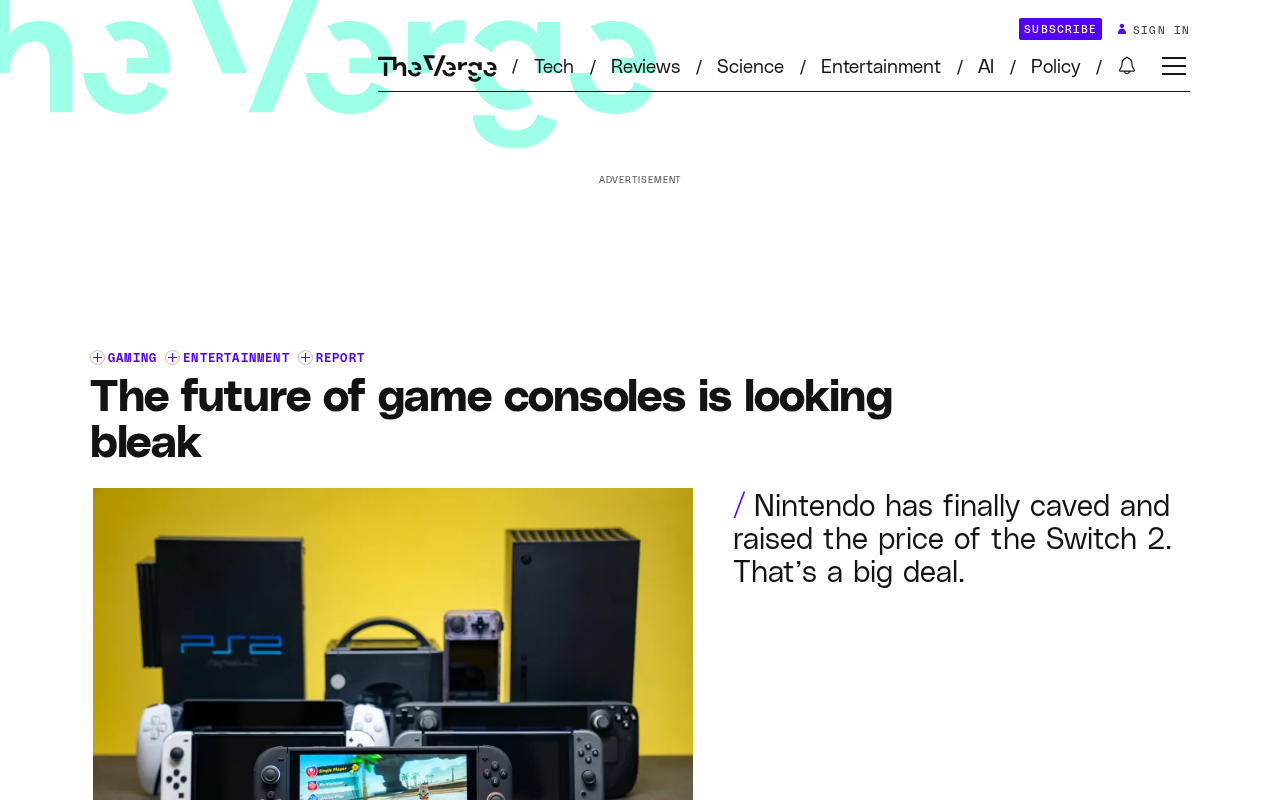
The game console industry is at a delicate turning point. The traditional 5-to-7-year hardware refresh cycle is breaking down, and players no longer crave new consoles the way they once did. Current-generation hardware is already powerful enough to run the vast majority of games, significantly weakening consumers' motivation to upgrade.
This phenomenon has deep historical roots. Console hardware refresh cycles have changed dramatically over the past three decades: the third generation (NES/SNES era) had cycles of about 5 years, the PS/N64 era extended to around 6 years, and the PS3/Xbox 360 era stretched to 7–8 years. Behind this lengthening trend lies the dual pressure of slowing chip process improvements (i.e., Moore's Law deceleration) and the exponential rise in game development costs. As the marginal benefits of hardware performance gains diminish, the "generational difference" perceived by consumers shrinks accordingly, naturally weakening the psychological drive to upgrade. Switch 2 faces precisely this structural dilemma — it needs to convince hundreds of millions of Switch owners to spend money again despite limited performance improvements.
For Nintendo, while the Switch 2 launch is highly anticipated, the thinness of its launch and subsequent game lineup is concerning. A remastered title can certainly evoke nostalgia, but whether it can truly drive hardware sales remains an open question.
Multi-Platform Competition Continues to Intensify
The competitive landscape of the gaming industry is undergoing fundamental change. The aggressive rise of PC gaming, mobile gaming, and cloud gaming services is steadily eroding the market share of traditional consoles. Players now have more choices and are no longer tied to any single console.
Among these, cloud gaming's core principle is to run all game computation on remote servers, with the player's device only responsible for receiving video streams and sending input commands — theoretically allowing any low-end device to run high-quality games. Major players currently include Microsoft Xbox Cloud Gaming, Sony PlayStation Now (now merged into PS Plus), and NVIDIA GeForce NOW. However, the core bottleneck for cloud gaming has always been network latency — even 20 to 30 milliseconds of input delay creates a noticeable disconnect in action or shooter games. The uneven distribution of global broadband infrastructure means cloud gaming will struggle to truly replace local console experiences for a considerable time, but its long-term erosion of the console market cannot be ignored.
Microsoft has already begun bringing Xbox exclusives to other platforms, and Sony is actively pursuing its PC porting strategy. Microsoft's shift began around 2022, when CEO Satya Nadella explicitly positioned Xbox as a "gaming services company" rather than a "hardware company." The business logic is clear: Xbox Series X/S hardware sales have consistently trailed the PS5, so rather than defending a relatively niche closed ecosystem, it's better to use premium content as a hook for subscription services that reach a broader player base. While these moves expand audience reach, they simultaneously erode the console's value as an independent ecosystem. When exclusives are no longer exclusive, why should players buy a console?
Three Industry Trends Are Reshaping the Console Landscape
The Shift from Selling Hardware to Selling Services
The gaming industry is undergoing a profound transformation from "selling hardware" to "selling services." The rise of subscription services like Xbox Game Pass and PlayStation Plus means console hardware is becoming a service gateway rather than a profit center. Under this business model, both the uniqueness and irreplaceability of consoles are declining.
Exclusive Content Is Becoming Increasingly Scarce
The core engine that once drove console sales — exclusive games — is becoming rarer. AAA game (Triple-A, referring to high-budget, high-production-value commercial games) development costs have exploded over the past decade: in the early 2010s, a mainstream AAA game budget was roughly $50 million to $100 million; by the 2020s, Cyberpunk 2077's development cost exceeded $300 million, and some blockbusters with marketing costs included have surpassed $500 million in total investment. This cost structure makes it nearly impossible for third-party developers to accept the audience limitations imposed by console exclusivity. Multi-platform releases have become the inevitable choice for risk mitigation, fundamentally undermining the commercial foundation of the console exclusivity ecosystem.
Nintendo releasing a Star Fox 64 remaster is certainly a positive signal, but relying long-term on remasters and nostalgia is ultimately not a sustainable strategy. What the industry truly needs is breakthrough innovation and entirely new experiences.
Shifting Player Spending Habits
The spending habits of the new generation of players are radically different from a decade ago. The popularity of free-to-play models, short-form video entertainment, and social games is fragmenting players' attention and budgets. Spending thousands on a dedicated gaming device is no longer a given for an increasing number of young players.
Where Are Game Consoles Headed?
Game consoles won't disappear in the short term, but their role and positioning are undergoing profound change. Future consoles may look more like comprehensive entertainment terminals rather than purely gaming devices. For Nintendo, Sony, and Microsoft, how they redefine their value during this transformation will determine their fate over the next decade.
The core question is: whoever can offer truly unique experiences that cannot be replicated on other platforms will be the one who holds their ground through the shake-up. Among the three major console makers, Nintendo's business model differs fundamentally from Sony's and Microsoft's. Sony and Microsoft compete on the logic of a "performance arms race," while Nintendo has pursued a "Blue Ocean Strategy" since the Wii era.
Related articles
 Industry Insights
The IRS Mobile App Debate: A Trust Crisis in Government Digital Transformation
The IRS's proposed mobile app has sparked heated debate. This article analyzes the core arguments, exploring data security, privacy, and the trust crisis in government digital transformation.
 Industry Insights
IRS Fully Embraces Claude AI, Accelerating Federal Government's AI Adoption
The IRS is recruiting staff with 24/7 Claude AI access, marking Anthropic's breakthrough into the federal government. Explore the strategic implications and tax use cases.
 Industry Insights
Nadella Introduces the Loopcraft Framework: Building AI Ecosystems Through Feedback Loops
Microsoft CEO Satya Nadella's Loopcraft framework explains how to build frontier AI ecosystems through nested feedback loops across technology, business, and ecosystem dimensions.